润发甄选

Search documents
2026,自有品牌的“大清洗”
3 6 Ke· 2026-01-16 12:47
Core Insights - The self-owned brand sector in retail is expected to face a bifurcation by 2025, with a few brands thriving while many others fail to gain traction [1][3] - Despite the rise of self-owned brands being seen as a lifeline for retailers, over 60% of small and medium-sized retailers have a self-owned SKU share of less than 5% [2][7] - The competition in the retail industry is intensifying, shifting from growth to survival, with profit margins shrinking and sales becoming harder to increase [4][5] Market Trends - Self-owned brands are becoming essential for differentiation, maintaining gross margins, and retaining customers, rather than just being an added advantage [7][8] - The satisfaction and recommendation rates for self-owned brands from leading retailers are approaching or surpassing those of national brands, indicating a shift in consumer preferences towards quality and value [8] - The number of new self-owned brand products being developed is increasing, with categories expanding beyond basic food items to personal care and household goods [10][12] Challenges in the Industry - Many retailers are blindly following trends without a clear strategy, leading to a proliferation of poorly defined private label products [9][14] - A significant number of retailers are treating self-owned brands as short-term profit tools rather than long-term brand assets, resulting in quality inconsistencies and frequent supplier changes [18][19] - The industry is facing operational challenges, including conflicts between departments, lack of specialized teams, and inefficient processes [20][21] Structural Issues - The self-owned brand market is experiencing a high closure rate among supermarkets, particularly in second and third-tier cities, with a 15% closure rate in the first half of 2025, up 5 percentage points from the previous year [6] - Retailers are struggling with supply chain issues, product development challenges, and operational inefficiencies, which hinder their ability to create successful self-owned brands [25][31] Strategic Recommendations - Retailers are advised to conduct thorough reviews of their self-owned brand strategies, focusing on profitability, product performance, and consumer perception [36][40] - Key performance indicators should include gross margin rates, new product success rates, and customer retention metrics to assess the effectiveness of self-owned brands [39][42] - A comprehensive approach involving strategic alignment, brand positioning, organizational structure, supply chain management, and continuous improvement is essential for success in the self-owned brand sector [41][44]

零售商发展自有品牌应立足长期深耕
Xin Lang Cai Jing· 2025-12-21 21:43
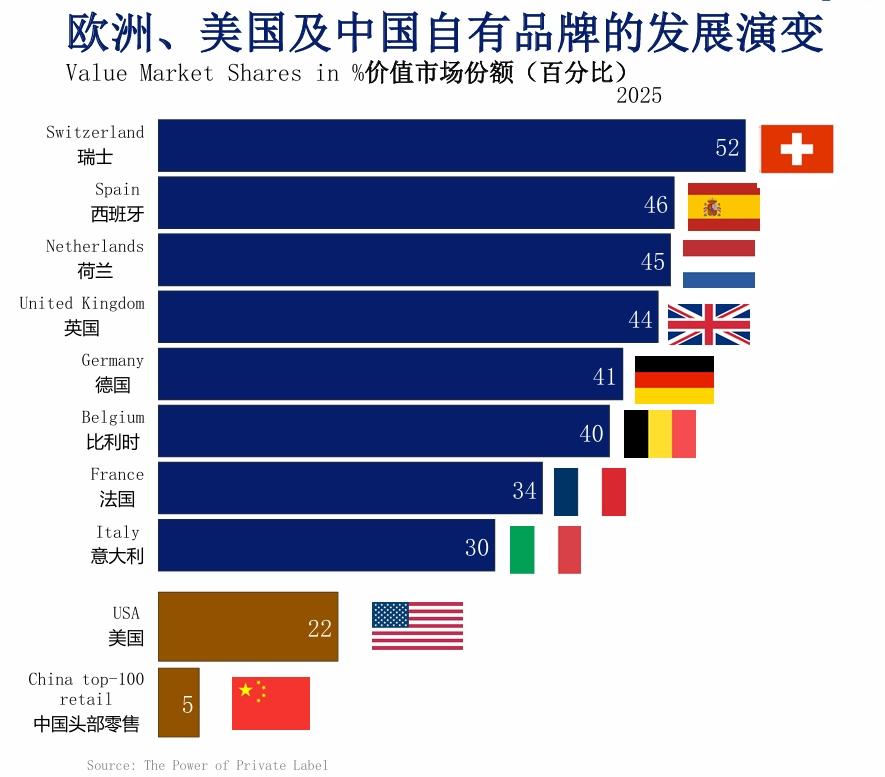
Core Insights - Retailer private labels have experienced an average annual growth of 44% over the past two years, indicating a significant shift in consumer purchasing behavior and increased competition for brand manufacturers [1] - The trend towards private labels is driven by a pragmatic consumer mindset seeking quality at a reasonable price, alongside the expansion of the consumer market into lower-tier cities [2] Group 1: Market Trends - Over 48% of urban households in China purchased private labels in the first three quarters of 2025, a 10 percentage point increase from the previous year [2] - The penetration rate of private labels in lower-tier cities has increased by over 12 percentage points, highlighting the strong market potential in these areas [2] Group 2: Retailer Strategies - Retailers are transitioning from merely selling products to creating their own brands, leveraging consumer insights and supply chain advantages to develop private labels [1] - Private labels allow retailers to reduce costs by eliminating intermediaries and brand premiums, thus improving profit margins and enabling better pricing control [2] - Retailers are focusing on enhancing the quality and value of private labels to meet the rising demand for high-quality, cost-effective products [2] Group 3: Long-term Strategy - Retailers must adopt a long-term perspective in developing private labels, emphasizing patience, steady growth, and careful expansion [3] - Establishing a robust user engagement system and maintaining high-quality standards in the supply chain are essential for building brand trust and loyalty [3] - Retailers should focus on creating iconic products and integrating private labels into consumers' lifestyles to enhance brand recognition and differentiation [3]
高鑫零售2025变革记 新帅是“金手指”?
Sou Hu Cai Jing· 2025-12-10 10:52
Core Viewpoint - The ongoing transformation of Gao Xin Retail, the parent company of RT-Mart, is marked by significant leadership changes and strategic shifts aimed at revitalizing the business and addressing declining performance metrics [3][4][9]. Leadership Changes - On November 30, Gao Xin Retail announced the resignation of CEO Shen Hui due to personal reasons, with Li Weiping appointed as the new CEO effective December 1, 2025. Li brings over 20 years of retail management experience, having previously held key positions at Hema and Lotte Supermarket [3][4]. - Li Weiping's appointment is seen as a strategic move, with a three-year service agreement and a fixed annual salary of 3.36 million yuan, reflecting the company's trust in her capabilities [3][4]. Organizational Restructuring - Since the acquisition by Dehong Capital in February 2025, Gao Xin Retail has undergone significant organizational changes, including a reduction in operational divisions from five to four and a focus on anti-corruption measures within the company [4][5]. - The company has initiated a product system overhaul, eliminating homogenized products and accelerating the development of private labels [4][5]. Strategic Initiatives - Gao Xin Retail has launched a "three-year strategy" aimed at enhancing product differentiation, improving supply chain efficiency, and transforming store formats to better serve community needs [5][6]. - The company has begun establishing front warehouses in several cities to improve logistics efficiency and reduce delivery times, while also closing underperforming stores and converting some into membership-based formats [5][6]. Financial Performance - Gao Xin Retail has faced declining revenues, with a reported 12.4% decrease in product sales revenue for the first half of the 2026 fiscal year compared to the previous year, attributed to increased market competition and consumer fatigue [14]. - The company has also seen a drop in same-store sales growth, with a reported decline of 11.7%, although online B2C sales have shown some growth [14][15]. Challenges Ahead - The company must navigate internal resistance to change and the competitive landscape, particularly in the areas of private label development and supply chain management, to achieve its strategic goals [7][16]. - Li Weiping's leadership will be critical in addressing these challenges and ensuring the successful execution of the company's transformation strategy [8][16].

零售商新老势力混战“自有品牌” 谁能更胜一筹?
Mei Ri Jing Ji Xin Wen· 2025-12-09 14:53
Core Viewpoint - Walmart is intensifying its focus on private label brands, particularly "Wojixian," as a strategic response to competition from e-commerce and emerging retailers, while also addressing the declining image of its Sam's Club brand [1][2][4]. Group 1: Walmart's Strategy - Walmart's private label "Wojixian" has been upgraded to cover essential categories like fresh produce, food, and beverages, emphasizing low prices and health attributes [2][4]. - The company is facing challenges as traditional retail formats struggle against e-commerce platforms, prompting a shift towards private labels to enhance competitiveness [1][4]. - The strategy of launching private labels is seen as a "last resort" to revitalize the hypermarket format amid increasing competition [1][4]. Group 2: Market Competition - Other traditional retailers, such as RT-Mart, are also focusing on private labels, with a similar emphasis on low prices and health trends [2][4]. - New players like Hema and Dingdong Maicai have established private labels as core competitive advantages, highlighting the shift in market dynamics [6][9]. - The competition for quality suppliers is intensifying as both established and emerging retailers seek to enhance their private label offerings [7][8]. Group 3: Financial Performance - RT-Mart's parent company, Gao Xin Retail, reported a revenue decline of 12.1% year-on-year, indicating the financial pressures faced by traditional retailers [5]. - Walmart's performance in China is primarily driven by Sam's Club, while its hypermarket segment has been experiencing store closures [5]. Group 4: Private Label Development - The private label penetration varies significantly among retailers, with Aldi achieving a 90% share in China, while Hema's community stores have nearly 60% [7]. - Successful private label strategies require strong brand value and supply chain management to maintain competitive pricing and quality [7][8]. - Walmart's approach involves stringent supplier selection, with only a small percentage of potential suppliers making it through the rigorous evaluation process [8].

零售商新老势力混战“自有品牌”,谁能更胜一筹?
Mei Ri Jing Ji Xin Wen· 2025-12-09 14:43
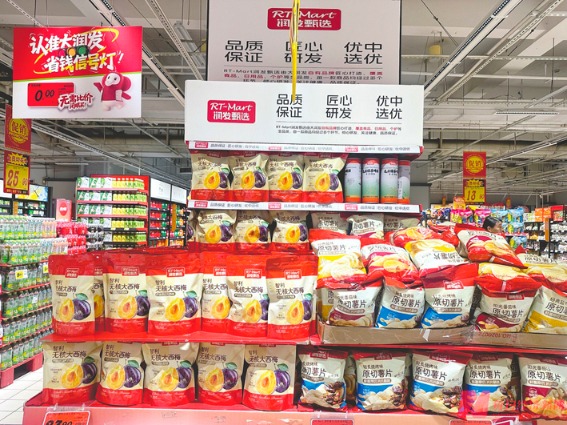
Core Insights - Walmart is developing its private label "Wojixian" as a response to the declining image of its high-end membership store Sam's Club, indicating a strategic shift in its retail approach [1][2] - The competition in the retail market is intensifying, with traditional retailers like Walmart and RT-Mart facing pressure from e-commerce and emerging players [1][4] Group 1: Walmart's Strategy - Walmart's "Wojixian" brand focuses on affordability and health, with products prominently displayed at low price points [2][3] - The company is adopting a strategy similar to RT-Mart, which is also enhancing its private label offerings, emphasizing low prices and health attributes [2][3] - The shift towards private labels is seen as a necessary response to market competition and performance pressures, as evidenced by declining revenues and profits reported by RT-Mart's parent company [3][4] Group 2: Market Competition - New retail players like Hema and Dingdong Maicai have established their private labels as core competitive advantages, launching various products since 2017 [4][5] - The self-owned brand strategy is crucial for retailers to attract customers and improve profit margins by defining product standards and reducing intermediary costs [4][5] - The competition for quality suppliers is intensifying as traditional retailers ramp up their private label initiatives, with companies like Dingdong Maicai investing in direct sourcing and partnerships [5][6] Group 3: Supply Chain and Brand Development - The success of private labels relies heavily on effective supply chain management and the ability to create strong brand value [5][6] - Walmart is currently focusing on supplier selection and has a rigorous evaluation process for potential suppliers, which limits the number of partnerships [6] - The retail landscape is evolving, with established players like Walmart actively learning from newer competitors to enhance their product offerings and market positioning [6]
山姆“人设”滑坡、沃尔玛“沃集鲜”成新宠 新老势力混战“自有品牌”谁能更胜一筹?
Mei Ri Jing Ji Xin Wen· 2025-12-05 13:37
Core Insights - Walmart is developing its private label "Wojixian" as a response to the competitive pressures from e-commerce and emerging retailers, positioning it as a "budget version" of Sam's Club [1][2] - The shift towards private labels by traditional retailers like Walmart and RT-Mart is driven by the need to compete with e-commerce platforms and new entrants in the retail market [1][3] Group 1: Private Label Strategy - Walmart's "Wojixian" focuses on affordability and health, with visible pricing strategies such as "everyday low prices" [2][3] - RT-Mart is also enhancing its private label offerings, emphasizing low prices and health trends, but adopts a dual-brand strategy for its private labels [2][3] - The competition in the retail sector is prompting established players to adopt private labels as a core strategy to attract customers and improve profit margins [4][6] Group 2: Market Performance and Challenges - RT-Mart's parent company, Gao Xin Retail, reported a revenue decline of 12.1% year-on-year, highlighting the financial pressures faced by traditional retailers [3] - Walmart's performance in China is primarily driven by the success of Sam's Club, while its traditional hypermarket format is facing challenges, including store closures [3][4] - The competition for quality suppliers and production sources is intensifying as retailers like Hema and Dingdong Maicai have already established strong private label brands [4][6] Group 3: Supply Chain and Brand Development - Successful private label development requires strong supply chain management and the ability to create distinct brand value [6][7] - Retailers are increasingly focusing on sourcing high-quality suppliers, with Walmart currently evaluating a limited number of potential suppliers for its private label products [6][7] - The competition for premium suppliers and production capabilities is expected to escalate as traditional retailers enhance their private label strategies [6][7]
高鑫零售(06808):新管理层开启三年调改及高派息策略
HTSC· 2025-11-13 08:17
Investment Rating - The report maintains an "Accumulate" rating for the company with a target price of HKD 2.18 [1][10]. Core Insights - The company reported a revenue of RMB 30.5 billion for the first half of FY26, a year-on-year decrease of 12.1%, and a net loss attributable to shareholders of RMB 1.2 billion, which aligns with the profit warning range [6][10]. - The new management has outlined a three-year transformation plan focusing on supply chain, store, and organizational structure reforms, with a commitment to high dividend payouts [6][9]. - The company declared an interim dividend of HKD 0.085 per share, with an expected annual dividend yield of approximately 9% [6]. Financial Performance - Revenue for FY26 is projected to be RMB 64.755 billion, reflecting a decline of 9.5% compared to the previous year [5][12]. - The net profit attributable to shareholders is expected to be RMB 38.85 million for FY26, a significant drop of 90.41% year-on-year [5][12]. - The company’s gross margin improved by 0.7 percentage points to 25.3% due to product mix optimization and increased private label penetration [8][9]. Strategic Initiatives - The company is implementing a nationwide procurement model to enhance pricing power, with a goal of achieving a 10% contribution from private label sales over the next three years [9]. - Store renovations are underway to transform locations into community lifestyle centers, with plans to complete over 200 store renovations within three years [9]. - The company aims to increase online sales contribution to 40-50% over the next three years, supported by the establishment of front warehouses [9]. Market Conditions - The competitive landscape has intensified, leading to a decrease in average transaction value, with same-store sales declining by 11.7% [7][9]. - Online sales showed resilience with a 7.4% increase in order volume, contributing to a 2.1% growth in online same-store sales [7][9]. - Rental income decreased by 7.0% year-on-year due to ongoing tenant restructuring and temporary impacts from store renovations [7].
高鑫零售2026财年上半年收入305.02亿元,预计下财年之前完成逾200家门店调改
Cai Jing Wang· 2025-11-11 14:10
Core Insights - Gao Xin Retail reported a revenue of 30.502 billion yuan for the six months ending September 30, 2025, with a gross margin of 25.3%, an increase of 0.7 percentage points year-on-year, and a net cash position of 11.958 billion yuan [1] - The company's online B2C business showed robust performance, with same-store order volume growing approximately 7.4%, leading to a same-store sales increase of about 2.1% [1] - The group initiated a front warehouse project to achieve efficient local delivery and acquire online incremental users, establishing front warehouses in five locations by September 2025 [1] Business Developments - The "Chao Sheng" private label series aims to connect directly with factories, eliminating intermediaries and brand premiums, while "Run Fa Zhen Xuan" promotes healthy eating from conceptualization to practical application [1] - The company plans to accelerate store renovations, with over 30 stores targeted for complete or regional renovations in the current fiscal year, and over 200 stores expected to be renovated before the next fiscal year [2] - New stores in Jiangsu and Anhui have adopted a comprehensive store renovation approach, with fresh and processed goods sales accounting for over 30% of total sales [2]
高鑫零售2026财年中期业绩公布:净现金近120亿元,加速门店调改与线上业务布局
Huan Qiu Wang· 2025-11-11 13:29
Core Insights - Gao Xin Retail Co., Ltd. reported a revenue of 30.502 billion RMB for the first half of the fiscal year 2026, with a gross margin of 25.3%, an increase of 0.7 percentage points year-on-year [1] - The company has a net cash position of 11.958 billion RMB, providing strong support for business operations and strategic initiatives [1] Business Performance - The online B2C business showed steady performance, with same-store order growth of approximately 7.4%, leading to a same-store sales increase of about 2.1% [3] - The company initiated a front warehouse project, establishing a low-cost model in cities such as Shanghai, Jiangyin, Luoyang, Jinan, and Qingyuan, leveraging resources from large supermarkets to enhance fulfillment efficiency and customer acquisition [3] - Gao Xin Retail is advancing a national joint procurement model, utilizing a four-in-one management system to reduce procurement costs and optimize product hierarchy and display standardization, thereby improving overall operational efficiency [3] - The company has developed a "1+1 dual brand matrix" for its private label products, with the "Chao Sheng" series directly connecting to factories to minimize intermediaries, while "Run Fa Zhen Xuan" focuses on health and local specialties, contributing over 2% to sales in September [3] Logistics and Store Development - Significant logistics optimization has been achieved through the integration of warehousing resources and the introduction of a market-based bidding mechanism, with expected cumulative savings exceeding 100 million RMB over the next few years, enhancing supply chain resilience [3] - Store renovations are a key focus for Gao Xin Retail, with new stores in Jiangsu Kunshan and Anhui Wuwei serving as models for the next generation of large supermarkets, where fresh and processed goods account for over 30% of sales [3] - The company plans to complete over 30 store renovations in the current fiscal year and aims to renovate more than 200 stores cumulatively before the next fiscal year [3] Future Strategy - Over the next three years, Gao Xin Retail will focus on "healthy products + enjoyable experiences + attentive service," targeting families and young customers within a three-kilometer radius, to enhance both experience and efficiency in its retail model, thereby unlocking operational resilience and long-term value [4]
3小时交流收费50万元,于东来“办学”怎么越来越贵了
3 6 Ke· 2025-10-24 11:47
Core Insights - The founder of Pang Donglai, Yu Donglai, emphasizes the importance of understanding his retail business model, suggesting that even a partial understanding can help others escape the "death zone" of retail [1] - Yu Donglai is increasingly positioning himself as a mentor, launching high-priced educational programs for entrepreneurs, reflecting his confidence in the value of his insights [2][3] Educational Initiatives - Yu Donglai announced plans to charge 1 million yuan for a two-day entrepreneur exchange program and 50,000 yuan for a three-hour personal sharing session [2][3] - The Pang Donglai Open Day will start on November 1, allowing limited groups to visit and learn about the business for a fee of 20,000 yuan per person [4] - The Pang Donglai Commercial Research Institute offers various paid courses, including a "Seed Class" with fees of 50,000 yuan for the first year, and 30,000 yuan for the subsequent years [5][6] Business Performance - As of October 21, 2023, Pang Donglai Group reported a total sales revenue of 18.95 billion yuan, with an expected annual revenue of 22 billion yuan, up from approximately 17 billion yuan the previous year [7] - The success of Pang Donglai is attributed to its strong brand loyalty and efficient supply chain, which are difficult for other retailers to replicate [13] Industry Context - The retail industry is facing significant challenges, with major players like Yonghui Supermarket and Bubu Gao experiencing substantial losses and store closures [9][12] - Despite the struggles of other retailers, Pang Donglai's growth has made it a beacon of hope in the industry, leading to a growing admiration for Yu Donglai among other entrepreneurs [10] Limitations of the Model - The unique success of Pang Donglai is closely tied to its regional identity and consumer loyalty, which may not be applicable to other retailers operating in different markets [13] - While many retailers are attempting to adopt Pang Donglai's model, they often lack the core competitive advantages that drive its profitability [13][14] - The sustainability of the profitability of these adapted models remains uncertain, especially given the high costs associated with store renovations and the need for genuine consumer trust in new private label products [16]