
可再生能源绿色电力证书(绿证)

Search documents
2026年1月绿证核发1.96亿个,2025年电量绿证均价5.51元远超2024年的1.25元
Sou Hu Cai Jing· 2026-02-14 06:02
Core Insights - The National Energy Administration reported that in January 2026, a total of 196 million green power certificates (referred to as "green certificates") were issued, covering 832,000 renewable energy generation projects, with 151 million certificates eligible for trading, accounting for 76.79% of the total issued [1][2] - The trading activity remained robust, with a total of 102 million green certificates traded in January, including 33.69 million through green power trading and 68.37 million in separate transactions [1] - The price differentiation in separate transactions was notable, with 6.5 million certificates corresponding to 2024 generation sold at an average price of 1.25 yuan per certificate, while 61.88 million certificates for 2025 generation sold at an average price of 5.51 yuan per certificate, indicating a significant increase in both transaction volume and price for the latter [1] Industry Developments - Green certificates serve as the sole proof of the environmental attributes of renewable energy generation in China, with each certificate corresponding to 1,000 kilowatt-hours of renewable energy [2] - A recent meeting by the National Energy Administration emphasized the implementation of energy law requirements and the introduction of policies to set minimum consumption targets for renewable energy, aiming to enhance responsibility among key energy-consuming industries and enterprises [2] - By 2025, the newly installed capacity of renewable energy is expected to reach 452 million kilowatts, representing a year-on-year growth of 20.7%, with total renewable energy capacity projected to be 2.337 billion kilowatts, accounting for approximately 60% of the national power generation capacity [2]
国家能源局:29.47亿个!
中国能源报· 2026-01-22 03:46
Summary of Key Points Core Viewpoint - The National Energy Administration released data on the issuance and trading of renewable energy green power certificates for December 2025, highlighting significant activity in both issuance and trading of these certificates. Group 1: Green Certificate Issuance - In December 2025, the National Energy Administration issued 211 million green certificates, covering 688,700 renewable energy generation projects, with 150 million being tradable, accounting for 71.32% of the total [1] - For the entire year of 2025, a total of 2.947 billion green certificates were issued, of which 1.893 billion were tradable [1] - The breakdown of green certificates issued in December 2025 by renewable energy type includes: - Wind Power: 9,278 - Solar Power: 4,748 - Conventional Hydropower: 5,779 - Biomass Power: 1,131 - Other Renewable Energy: 162 - Total: 21,099 [3] Group 2: Green Certificate Trading - In December 2025, a total of 202 million green certificates were traded, including 22.75 million for green electricity [4] - For the full year of 2025, 930 million green certificates were traded, with 250 million being for green electricity [4] - The trading breakdown for December 2025 by renewable energy type includes: - Wind Power: 9,415 - Solar Power: 8,931 - Biomass Power: 1,421 - Other Renewable Energy: 463 - Total: 20,230 [6] - The average trading price for green certificates for the production year 2024 was 1.12 yuan per certificate, while for 2025 it was 5.15 yuan per certificate, reflecting a month-on-month price change of -73.82% for 2024 and -0.22% for 2025 [7]


推动绿证市场高质量发展 提升社会用电“含绿量”
Huan Qiu Wang· 2026-01-14 08:13
Core Insights - The article emphasizes the growing importance of green electricity consumption in China, driven by events like the Hangzhou Asian Games and the Shanghai Import Expo, which achieved 100% green energy usage through green certificates [1] - China is positioned to become the largest market for green certificates globally, with a focus on developing a high-quality green certificate market to reflect the environmental value of green electricity [1][2] Group 1: Green Certificate Development - The National Energy Administration has established a comprehensive lifecycle management mechanism for green certificates, achieving full coverage in issuance and rapid growth in trading scale and user numbers [3] - In 2024, China issued 4.734 billion green certificates, a year-on-year increase of 28.36 times, with 3.158 billion being tradable [3] Group 2: Policy Measures and Market Goals - The recent policy document outlines 17 actionable measures to address insufficient demand and the undervaluation of green electricity's environmental benefits, focusing on a combined mandatory and voluntary consumption mechanism [6][7] - By 2027, the green certificate market aims to have a well-established trading system and improved mechanisms for green electricity consumption, with further enhancements expected by 2030 [7] Group 3: Integration with Other Mechanisms - The integration of green certificates with renewable energy consumption responsibilities, carbon emission controls, and carbon accounting is crucial for enhancing market vitality and fostering growth [8][9] - Local practices in provinces like Shanxi and Guangdong are promoting green electricity consumption through green certificate purchases, while cities like Shanghai and Beijing are developing carbon market accounting methods for green electricity [8] Group 4: Supporting Export Trade - The article highlights the increasing global trend towards green trade, with a focus on reducing carbon footprints in export products through green electricity consumption [10] - China, as the largest producer of green electricity, can meet the green power needs of export products, aligning with international standards and enhancing competitiveness [10][11]
我国绿证全生命周期管理机制进一步完善
Ke Ji Ri Bao· 2026-01-08 02:52
Core Viewpoint - The implementation of the "Renewable Energy Green Power Certificate Management Implementation Rules (Trial)" aims to standardize the lifecycle management of green certificates and promote the high-quality development of the green certificate market [1] Group 1: Implementation Details - The "Implementation Rules" consists of 10 chapters and 45 articles, detailing responsibilities, account management, certificate issuance, transfer, cancellation, dispute resolution, information management, and supervision [1] - The rules require power generation companies or project owners to complete information filing and submit for review within one month after the project is connected to the grid [1] Group 2: Certificate Issuance - The rules specify that the certificate issuance agency will issue green certificates monthly based on renewable energy generation, with one certificate issued for every 1,000 kilowatt-hours of renewable energy [2] - The National Energy Administration will continue to optimize and upgrade the national green certificate issuance trading system to enhance efficiency in processing large volumes of issuance, trading, and transfer data [2]
我国绿证全生命周期管理机制全面细化
Xin Lang Cai Jing· 2026-01-07 14:04
Core Viewpoint - The implementation of the "Renewable Energy Green Power Certificate Management Implementation Rules (Trial)" aims to standardize the lifecycle management of green power certificates, promoting high-quality development of the green certificate market [1][2] Group 1: Implementation Details - The "Implementation Rules" consist of 10 chapters and 45 articles, detailing responsibilities, account management, certificate issuance, transfer, cancellation, dispute handling, information management, and supervision [1] - The rules require power generation companies or project owners to complete information filing and submission for audit within one month after project completion and grid connection [1] Group 2: Certificate Issuance - Green certificates are issued monthly based on renewable energy generation, with one certificate issued for every 1,000 kilowatt-hours of renewable energy produced, and any shortfall carried over to the next month [2] - Different types of renewable energy projects, including wind, solar, biomass, geothermal, and marine energy, will receive tradable green certificates, while self-consumed energy and off-grid generation will receive non-tradable certificates [2] Group 3: System Support and Development - The National Energy Administration will continue to optimize the national green certificate issuance and trading system, enhancing system functionality and cross-platform interaction efficiency [2] - There will be a focus on ensuring efficient processing of large volumes of issuance, trading, and transfer data, along with strengthening tracking and statistical analysis capabilities [2]
量价齐升下,上亿张绿证谁是真买家?
2 1 Shi Ji Jing Ji Bao Dao· 2025-12-03 10:32
Core Insights - The renewable energy green certificate market in China has experienced significant growth in both volume and price, achieving international breakthroughs in 2023 [1][7] - As of September 2023, the cumulative issuance of green certificates reached 7 billion, with a trading scale of 529 million certificates, reflecting a year-on-year increase of 110% [1][3] - The average trading price of green certificates in Q3 2023 was 5.06 yuan per certificate, a 210% increase from Q1 [1][3] Market Dynamics - The growth of the green certificate market is driven by multiple factors, including policy optimization and increased demand due to international recognition [3][4] - The implementation of a comprehensive green certificate policy and the launch of a national trading system in 2024 have contributed to a stable supply of green certificates [3][4] - Price differentiation exists among green certificates from different production years, with the average trading price for 2024 production year certificates at 2.56 yuan and for 2025 at 5.22 yuan [3] Demand Drivers - The demand for green certificates is significantly influenced by corporate commitments to green electricity goals, regulatory requirements for high-energy-consuming industries, and pressure from downstream customers [5][6] - Five key categories of enterprises drive the consumption of green certificates: multinational companies with carbon reduction commitments, domestic companies with green electricity goals, high-energy-consuming industries, upstream suppliers responding to customer demands, and export-oriented manufacturers [5][6] Challenges and Opportunities - Despite the growth in demand, the consumption potential of green certificates remains underutilized, with structural challenges in attracting more buyers [1][5] - The mandatory green electricity consumption policy impacts high-energy industries by increasing operational costs, while also promoting market competition and efficiency [6][7] - The international recognition of Chinese green certificates by RE100 marks a significant step towards global integration, although further improvements in traceability and certification processes are needed [7][8] Future Considerations - Companies are encouraged to align their green certificate deployment with their overall low-carbon development strategies and carbon asset management systems [10] - The transition of green certificates from a cost item to a value item requires careful consideration of economic viability and necessity, emphasizing the importance of green electricity procurement and investment [10]
2025年9月国家能源局核发绿证2.29亿个
Zhong Guo Xin Wen Wang· 2025-10-30 06:13
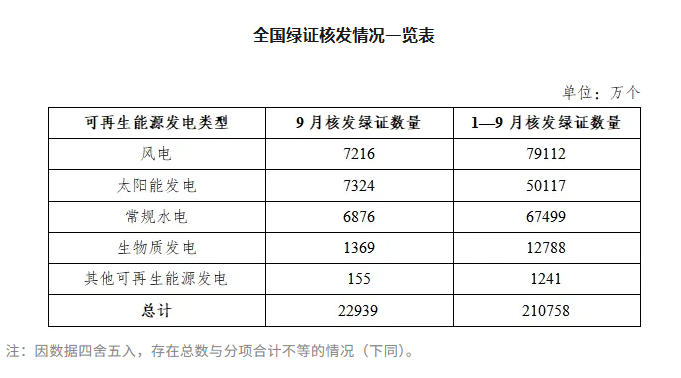
Core Insights - The National Energy Administration of China has released data on the issuance and trading of renewable energy green power certificates for September 2025, indicating a significant volume of certificates issued and traded [1]. Issuance of Green Certificates - In September 2025, a total of 229 million green certificates were issued, covering 306,500 renewable energy generation projects, with 158 million being tradable, accounting for 68.86% of the total [2]. - For the period from January to September 2025, the total number of green certificates issued reached 2.108 billion, with 1.435 billion being tradable [2]. Breakdown by Renewable Energy Type - Wind Power: 7.216 million (September), 79.112 million (January-September) - Solar Power: 7.324 million (September), 50.117 million (January-September) - Conventional Hydropower: 6.876 million (September), 67.499 million (January-September) - Biomass Power: 1.369 million (September), 12.788 million (January-September) - Other Renewable Energy: 0.124 million (September), 1.241 million (January-September) [4]. Trading of Green Certificates - In September 2025, a total of 65.12 million green certificates were traded, including 21.02 million for green electricity [2]. - From January to September 2025, the total number of traded green certificates was 529 million, with 179 million for green electricity [2]. Breakdown by Renewable Energy Type - Wind Power: 2.860 million (September), 26.204 million (January-September) - Solar Power: 3.288 million (September), 22.861 million (January-September) - Biomass Power: 0.162 million (September), 2.648 million (January-September) - Other Renewable Energy: 0.201 million (September), 1.225 million (January-September) [6]. Average Trading Price - In September 2025, the average trading price for the 44.10 million certificates traded was 4.99 yuan per certificate, reflecting a month-on-month decrease of 11.78% [7]. - The average prices for certificates from different production years were as follows: - 2023 and earlier: 0.23 yuan - 2024: 2.58 yuan - 2025: 6.46 yuan [9].
山东港口获超2.4万张“绿证”,预计可核减约12477吨碳排
Qi Lu Wan Bao Wang· 2025-10-13 07:33
Core Insights - Shandong Port has achieved a significant milestone in the green energy sector by obtaining 24,954 renewable energy green power certificates (green certificates) from the National Energy Administration, which is expected to reduce carbon emissions by approximately 12,477 tons [1][2] - Each green certificate corresponds to 1,000 kilowatt-hours of green electricity, enabling the consumption of 24.954 million kilowatt-hours of green electricity, equivalent to replacing the transport capacity of 5 million tons of trucks [1][2] Group 1 - The acquisition of green certificates marks the first such honor for Beijing Lugang Company, contributing to the construction of a green port and the implementation of the "carbon peak and carbon neutrality" strategy [1][3] - Green certificates serve as the official proof of renewable energy consumption, empowering enterprises to fulfill their environmental responsibilities and enhance their green brand image, thus creating a competitive advantage in the market [2] - The green certificates facilitate international trade by meeting the increasing green procurement demands of global supply chains, acting as a "hard pass" for enterprises to integrate into the global green industry chain [2] Group 2 - The successful certification reflects the internal collaboration and resource integration within Beijing Lugang Company and its partnership with Shandong Port Bohai Bay Port Group, demonstrating a unified effort towards green transformation [3] - Looking ahead, Beijing Lugang Company aims to further invest in renewable energy sectors such as wind and solar power, optimizing the energy consumption structure of the port and contributing to the national "dual carbon" goals [3] - The company intends to explore replicable and scalable green development pathways, striving to provide a "Shanport model" for the clean energy transition in the national port sector [3]

中国可再生能源绿色电力证书百间百答(2025年版)
Sou Hu Cai Jing· 2025-06-18 09:36
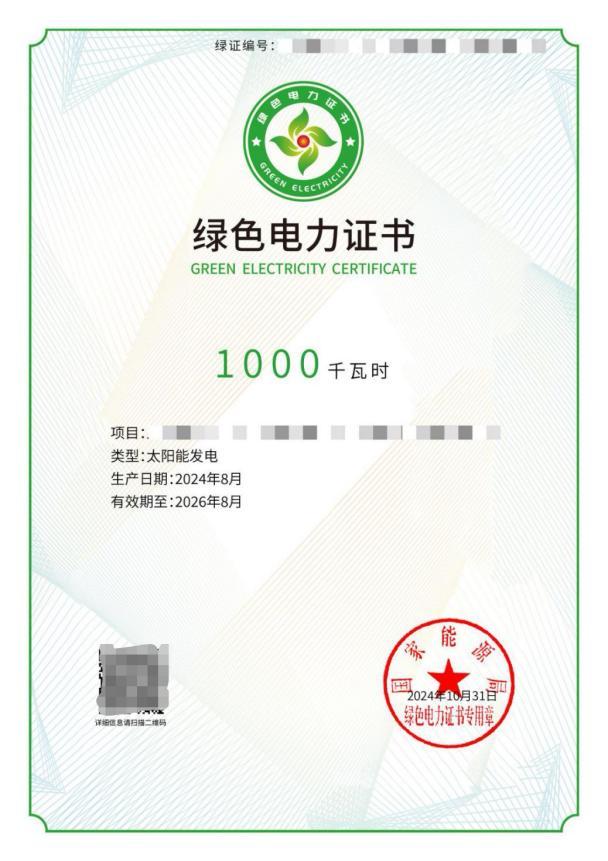
Group 1: Concept and Significance of Green Certificates - Green electricity refers to electricity generated from renewable energy sources such as wind and solar power, which is certified by a green certificate (green certificate) issued by the government or third-party organizations [2][17]. - The green certificate serves as the only proof of the environmental attributes of renewable energy electricity in China, facilitating the transition to green energy and supporting the achievement of carbon neutrality goals [2][21]. - Implementing the green certificate system helps guide green electricity consumption, promotes the development and utilization of renewable energy projects, and supports the connection between electricity and carbon markets [2][21]. Group 2: Issuance and Style of Green Certificates - The green certificates in China are issued by the National Energy Administration and are based on a national green certificate issuance and trading system [3][25]. - Each green certificate corresponds to 1,000 kilowatt-hours of electricity, and the certificates are issued monthly with a validity period of two years [3][18]. - The certificate includes essential information such as project name, electricity generation, and has both Chinese and English versions for verification [3][32]. Group 3: Trading Models of Green Certificates - Green certificate trading includes two models: separate trading and green electricity trading, with the former allowing nationwide trading without physical grid constraints [4][41]. - The trading price of green certificates is determined by the market without upper or lower limits, and transactions can be conducted through listing or bilateral negotiation [4][41]. - Foreign entities may purchase Chinese green certificates under certain conditions, and trading can be facilitated through authorized agencies [4][39]. Group 4: Application Scenarios of Green Certificates - Holders of green certificates can declare their consumption and apply for cancellation, with no difference in application between tradable and non-tradable certificates [5][54]. - Green certificates can be integrated into energy consumption control systems, and the traded electricity is counted towards energy-saving assessments [5][61]. - In the international context, Chinese green certificates are similar to the EU's Guarantees of Origin (GO) and are actively seeking international recognition [5][71]. Group 5: Cancellation and System of Green Certificates - The cancellation of green certificates is crucial for ensuring the uniqueness of their environmental attributes, with certificates being canceled after their validity period or upon consumption declaration [6][79]. - A green certificate account is used to manage green certificate assets, with each entity allowed only one account, while provincial accounts are managed by local authorities [6][84]. - The national green certificate issuance and trading system is linked to the registration system, allowing users to access and manage their certificates online [6][93].
绿证核销功能上线!
Zhong Guo Dian Li Bao· 2025-04-24 07:07
Core Points - The launch of the green power certificate (green certificate) cancellation function in the national green certificate issuance and trading system enhances the management of green certificates, ensuring a more standardized and transparent usage, which supports the construction of a green power consumption system and aids in achieving the "dual carbon" goals [1][2][3] Group 1: Green Certificate Lifecycle Management - The green certificate serves as an "electronic ID" for renewable energy, and the cancellation mechanism binds electricity to its environmental attributes, preventing misuse [2][3] - The cancellation function completes the lifecycle management of green certificates, ensuring that each certificate has a clear beginning and end [2] - The national green certificate issuance and trading system will monitor certificates monthly, sending reminders three months before expiration and automatically canceling expired certificates [3] Group 2: Enhanced Transparency and Data Management - The cancellation function provides a detailed record of green power consumption, allowing entities to generate a cancellation information sheet that includes various data points such as the number of certificates canceled and specific consumption scenarios [4][5] - The cancellation information sheet serves as a proof of green power consumption, enhancing the uniqueness of green certificates [5] Group 3: Policy Integration and Support - The cancellation mechanism supports the implementation of energy-saving and carbon reduction policies, reinforcing the foundational role of green certificates as a policy tool [7] - Users must select the environmental rights ownership location when purchasing green certificates, and cancellations must occur within the designated area, aiding local energy authorities in managing data effectively [7] - This regulation strengthens the function of green certificates in accounting for green power consumption, providing a reliable basis for local governments to assess energy consumption control and renewable energy responsibilities [7] Group 4: Future Developments - Additional trading platforms, including the China Green Power Certificate Trading Platform and various regional electricity trading centers, will also implement the green certificate cancellation function in the future [8]