
含光

Search documents
港股AI大涨,MINIMAX飙升26%,智谱涨逾7%,阿里涨近3%,千问推出最强模型
2 1 Shi Ji Jing Ji Bao Dao· 2026-01-27 09:24
Core Insights - The AI application concept has seen significant growth in the Hong Kong stock market, with MINIMAX-WP rising by 26.48%, Zhizhu by 7.56%, and Alibaba by nearly 3% [1][2] - Major tech companies are intensifying their competition in the AI sector, with each adopting different strategies [5][17] Group 1: Company Developments - Alibaba has released its strongest model, Qwen3-Max-Thinking, which is claimed to be the largest and most capable reasoning model, outperforming competitors like GPT-5.2 and Gemini 3 Pro in several benchmark tests [4][5] - Tencent's CEO, Ma Huateng, acknowledged the slow pace of AI development and emphasized the integration of large models and AI products [3] - Baidu has increased its AI-related revenue growth forecast for 2026 to 200%, aiming to lead the AI cloud market [3] Group 2: Model Innovations - Qwen3-Max-Thinking features over one trillion parameters and has set new records in 19 authoritative benchmark tests, focusing on reasoning technology innovations [5][8] - The model employs a new Test-time Scaling mechanism that enhances reasoning performance while being more economical, allowing for more efficient and intelligent reasoning results [7][8] - The model has significantly improved its autonomous tool-calling capabilities, enabling it to perform complex tasks like planning trips and analyzing data [8][9] Group 3: Strategic Moves - Alibaba is integrating Qwen into its ecosystem while also planning to spin off its chip company, Pingtouge, to transform it from a cost center to a revenue center [10][11] - The integration of Qwen into Alibaba's ecosystem aims to create a "super entrance" for AI applications, connecting various services like e-commerce, local life, and entertainment [13][15] - Other tech giants like Tencent and Baidu are also enhancing their AI strategies, with Tencent focusing on integrating AI into its social products and Baidu targeting B2B solutions [17][18]

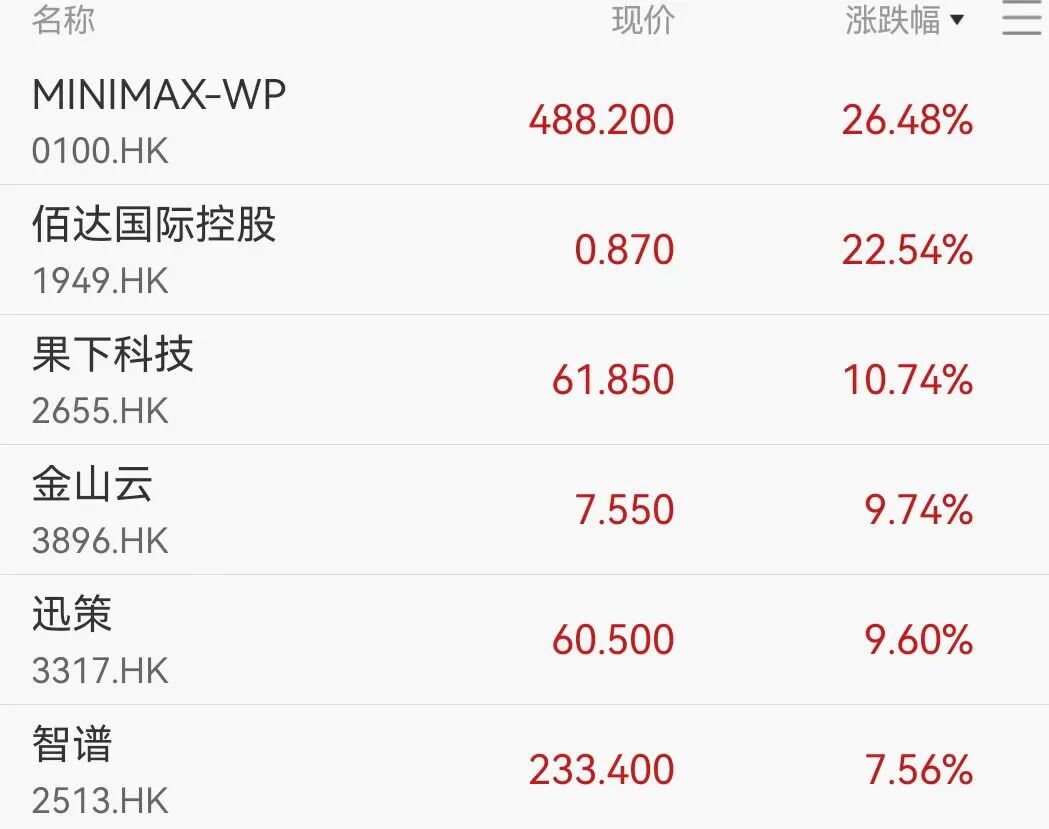
港股AI大涨,MINIMAX飙升26%,智谱涨逾7%,阿里涨近3%,千问推出最强模型
21世纪经济报道· 2026-01-27 09:19
Core Viewpoint - The article discusses the escalating competition among major tech companies in the AI sector, highlighting Alibaba's recent advancements and strategic moves in AI model development and ecosystem integration [2][4][12]. Group 1: AI Model Developments - Alibaba released its flagship reasoning model Qwen3-Max-Thinking, which is claimed to be the largest and most capable model in China, outperforming international models like GPT-5.2 and Gemini 3 Pro in several benchmark tests [4][6]. - The model features over one trillion parameters and has set new records in 19 authoritative benchmark tests, showcasing significant advancements in reasoning capabilities [6][8]. - A novel Test-time Scaling mechanism enhances the model's reasoning efficiency, allowing it to extract and refine previous reasoning results for smarter outcomes [8][9]. Group 2: Ecosystem Integration - Alibaba is integrating Qwen into its broader ecosystem, aiming to create a seamless AI experience for users, enabling functionalities like booking, shopping, and payment through natural dialogue [12][13]. - The establishment of the Qwen C-end business group signifies Alibaba's commitment to consumer-facing AI products, with plans to expand its capabilities across various services within the Alibaba ecosystem [12][13]. - The independent operation of Alibaba's chip company, Pingtouge, is aimed at transforming it into a revenue-generating entity, supporting the AI model and cloud services while reducing dependency on external suppliers [11][12]. Group 3: Competitive Landscape - Other tech giants are also intensifying their AI strategies, with Tencent focusing on integrating AI into its social applications, while Baidu emphasizes AI cloud solutions for enterprise clients [14]. - ByteDance is exploring hardware opportunities with its AI products, indicating a diverse approach to establishing AI as a core business component [14]. - The competition is shifting from merely developing AI models to creating comprehensive ecosystems that combine models, applications, and user experiences [13][14].

华为芯片,究竟有多牛(下)
2 1 Shi Ji Jing Ji Bao Dao· 2025-07-07 03:18
Core Viewpoint - Huawei's Ascend is positioning itself as a competitive alternative to NVIDIA by leveraging a system-level engineering breakthrough rather than focusing solely on individual chip performance [5][12]. Technical Breakdown - The "CloudMatrix 384 Super Node" consists of 384 Ascend 910 chips and 192 Kunpeng CPUs, interconnected to function as a single efficient unit [2][4]. - Unlike NVIDIA's reliance on copper cables for inter-chip communication, Huawei has developed a fully peer-to-peer interconnect bus using optical cables, significantly enhancing data transmission efficiency [8][10]. - Huawei's approach includes advanced mathematical algorithms for scheduling, deep hardware-software collaboration, and effective thermal management, contributing to the overall performance of the Ascend system [11]. Competitive Landscape - Huawei acknowledges a gap in chip technology, as NVIDIA has advanced to 3nm processes, while Huawei's chips are still a generation behind [14]. - The software ecosystem remains a challenge, with Huawei's CANN still needing to catch up to NVIDIA's established CUDA framework [15]. - Despite these challenges, Huawei is gaining traction in the Chinese market, especially as companies adapt to domestic chips due to restrictions on NVIDIA's products [16]. Industry Dynamics - The domestic AI chip market is diversifying into three main factions: tech giants like Huawei, pure chip manufacturers, and niche players focusing on specific applications [16]. - The pressure from U.S. sanctions has inadvertently spurred growth in China's semiconductor industry, allowing companies like Huawei to innovate and optimize system performance rather than solely competing on chip specifications [16][17].
