
四臂机器人

Search documents
AI浪潮下的“双向奔赴”
Ren Min Ri Bao· 2026-01-19 08:52
Group 1 - The core viewpoint of the articles highlights Shanghai's rapid development in AI, emphasizing the integration of technology, capital, and industry, with a focus on practical applications and value creation [1][2][3] - Shanghai's AI development is characterized by a differentiated approach that prioritizes "technology landing" and "value creation," aiming to solve specific problems in production processes [1] - The city has established a complete innovation ecosystem, with nearly 500 companies in the Zhangjiang AI Innovation Town, fostering collaboration across algorithms, computing power, and application scenarios [1] Group 2 - The recent surge of AI companies going public in Hong Kong reflects the recognition of Shanghai's tech innovation ecosystem by international capital and showcases the maturity of its capital market [2] - Shanghai is promoting deep integration between financial technology and industrial demand, ensuring that capital flows into hard technology and the real economy [2] - The regulatory framework in Shanghai balances innovation and risk management, facilitating a supportive environment for AI applications in finance while maintaining market risk controls [2][3] Group 3 - The synergy between finance and industry in Shanghai creates a fertile ground for AI companies, enabling smoother collaboration between financial institutions and tech firms [3] - The capital supply from the financial center and the industrial demand from the economic center form a virtuous cycle, where AI companies grow and attract capital, which in turn supports research and development [3] - Shanghai's status as the largest economic center in China, combined with its international financial hub capabilities, positions AI as a crucial link connecting technology, capital, and industry [3]


具身机器人进工厂:距离“稳定好用”还有多远?
Shang Hai Zheng Quan Bao· 2026-01-11 18:51
Core Insights - The article discusses the advancements and challenges of embodied robots in the manufacturing industry, highlighting their deployment in factories and the need for data integration to enhance their functionality [1][2]. Group 1: Embodied Robots in Manufacturing - Embodied robots have begun to be deployed in factories, with over a hundred sets implemented in a leading smartphone manufacturer's dark factories [1]. - The core demand from manufacturing enterprises for embodied robots can be summarized as "stable and easy to use," necessitating solutions for reducing reliance on human labor and accommodating flexible production needs [1]. - The complexity of manufacturing processes creates significant challenges in data collection and processing, leading to data silos that hinder the standardization of operations [1]. Group 2: Data as a Key Focus - The enhancement of embodied robots' capabilities in manufacturing requires long-term data collection, accumulation, and analysis, with a focus on the ability to transfer and reuse data across different scenarios [2]. - Embodied robots should function as a data hub, integrating with ERP, MES, and APS systems to establish connections with production processes and equipment [4]. - The transition of embodied robots into factories occurs in three stages: standard processing, handling undesirable tasks, and developing autonomous decision-making capabilities [4]. Group 3: Industry Perspectives - The current need in factories is not merely for robots but for intelligent systems that can adapt to complex physical environments [4]. - The relationship between suppliers and demanders has evolved from a one-sided adaptation to a collaborative approach, fostering the practical implementation of embodied robots in manufacturing [4].

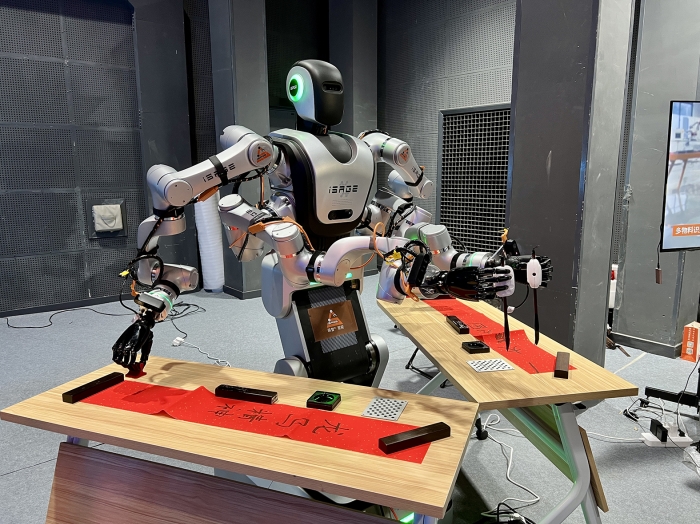
(经济观察)机器人突破“人形” “AI+制造”开辟产业空间
Zhong Guo Xin Wen Wang· 2026-01-10 12:41
Group 1 - The "AI + Manufacturing" topic is gaining significant attention, with practitioners exploring various angles to expand industrial space in high-precision fields [1] - Shanghai's "AI + Manufacturing" initiative aims to enhance the intelligence level of the manufacturing industry over three years, including the promotion of 100 demonstration application scenarios and the establishment of around 10 "AI + Manufacturing" demonstration factories [2] - The first batch of 10 model enterprises has been selected to cultivate "AI + Manufacturing" applications, identifying 50 scenarios that require AI technology [2] Group 2 - Companies in the industrial sector are not willing to pay for AI itself but for the improvements it brings, emphasizing the need for significant efficiency gains to justify investments [2] - The first product from a technology company focuses on 3D quality inspection in SMT production lines, showcasing substantial improvements in intelligence, recognition accuracy, and detection efficiency compared to traditional equipment [2] - The evolution of AI in manufacturing has shifted from incorporating expert experience to allowing AI to learn freely, which is believed to lead to transformative changes [3]
具身智能老炮再获数亿融资,移动多臂机器人已批量工业落地|早起看早期
36氪· 2025-12-24 00:25
Core Viewpoint - The article highlights the recent financing rounds of the robotics company Sazhi Intelligent, emphasizing its innovative technology and market potential in the industrial robotics sector, particularly in flexible manufacturing environments [5][6]. Financing Information - Sazhi Intelligent recently completed A++ and A+++ financing rounds, raising several hundred million yuan [7]. - The funding allocation includes 40% for technology research and development, 30% for overseas market expansion, 15-20% for smart manufacturing production line construction, and the remainder for working capital [7]. Company Overview - Founded in 2018 and headquartered in Shanghai, Sazhi Intelligent specializes in single-arm, dual-arm, and four-arm robots, as well as AMR mobile robots [9]. - The company has developed the SAGE-OS robot operating system and the SAGE-Brain integrated controller, addressing traditional automation challenges in flexibility and intelligence [9]. - Sazhi Intelligent's technology enables precise assembly and inspection tasks in dynamic industrial environments with a precision of ±0.05mm [9]. Market Size - The global industrial robotics market is currently valued in the hundreds of billions, with traditional robots serving only 30% of production processes, indicating significant potential for automation in the remaining 70% of discrete manufacturing scenarios [13]. - The demand for intelligent robots capable of autonomous movement and multi-space operations is increasing, particularly in sectors like new energy vehicles and high-end electronics [14]. Company Performance - Sazhi Intelligent has achieved profitability for several years, with revenue growth rates between 50% and 120%, and a projected growth of 300% for the next year [16]. - The company aims to increase its annual production capacity from approximately 1,000 units to 5,000 units [16]. Team Background - The founder and CEO, Zhang Jianzheng, holds a PhD in robotics from Shanghai Jiao Tong University and has 21 years of R&D experience, including a tenure at FANUC [18]. - The core team members have extensive backgrounds in automation and robotics, with an average industry experience of over 15 years [18]. Founder Insights - Zhang Jianzheng emphasizes the need for robots to operate in flexible manufacturing environments, contrasting traditional fixed robots with Sazhi's mobile and adaptable solutions [20]. - The company has maintained profitability and aims to recover the cost of robots through labor savings within 1.5 to 2 years [21]. Future Development Plans - Sazhi Intelligent plans to enhance its technology in "embodied intelligence, collective intelligence, and scalable intelligence" and to release a new generation of intelligent robots next year [22]. - The company aims to increase its overseas revenue share from over 20% to around 50%, focusing on building localized teams in regions like Southeast Asia, Mexico, Europe, and the Middle East [22]. Investor Perspectives - Haitong Kaiyuan expresses confidence in Sazhi Intelligent's technological capabilities and its successful integration into the supply chains of major global clients, viewing it as a key player in the shift towards flexible manufacturing [24]. - Guoyuan Equity highlights Sazhi's unique product design that aligns with human-like operational logic, enabling effective performance in dynamic environments, and sees significant growth potential in the industrial robotics market [24].
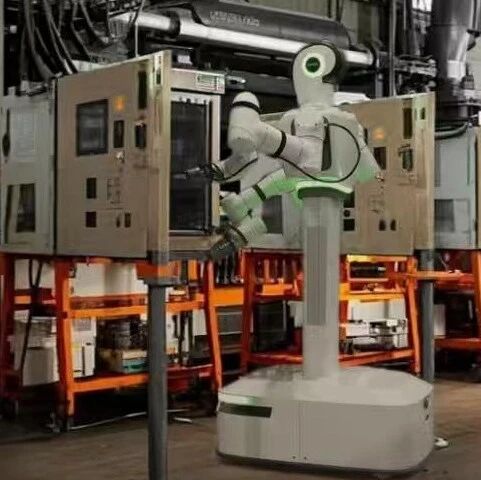
具身智能老炮再获数亿融资,移动多臂机器人已批量工业落地|36氪首发
3 6 Ke· 2025-12-21 01:26
Financing Information - The company recently completed A++ and A+++ financing rounds, raising several hundred million yuan [1] - The funding will be allocated as follows: 40% for technology research and development, 30% for overseas market expansion, 15-20% for smart manufacturing production line construction, and the remainder for working capital [1] Company Overview - Founded in 2018 and headquartered in Shanghai, the company specializes in intelligent robotics, offering single-arm, dual-arm, and four-arm robots, as well as AMR mobile robots [1] - The company has developed the SAGE-OS robot operating system and the SAGE-Brain integrated controller, addressing traditional automation challenges in flexibility and intelligence [1] Market Potential - The global industrial robot market is currently valued in the hundreds of billions, with traditional robots serving only 30% of production processes, leaving a significant opportunity in the 70% of discrete manufacturing that requires flexible and intelligent solutions [4] - The demand for intelligent robots is surging as industries like new energy vehicles and high-end electronics shift towards flexible manufacturing models [4] Company Performance - The company has achieved profitability for several years, with revenue growth rates between 50% and 120%, and a projected growth of 300% next year [5] - Current annual shipment volume is approximately 1,000 units, with plans to expand production capacity to 5,000 units [5] Team Background - The founder and CEO, Zhang Jianzheng, holds a PhD in robotics from Shanghai Jiao Tong University and has 21 years of R&D experience, previously working at FANUC [6] - Other core team members have extensive backgrounds in automation and robotics, averaging over 15 years of industry experience [6] Technological and Market Strategy - The company aims to enhance its technology in three areas: body intelligence, group intelligence, and scalable intelligence, with plans to release a new generation of intelligent robots next year [9] - The company is also focusing on global expansion, with current overseas revenue exceeding 20% and a target of 50% in the future [9] Investor Insights - Investors recognize the company's technological capabilities and practical experience, noting its successful integration into the supply chains of major global clients [10] - The company is viewed as a key player in the shift towards flexible manufacturing, expected to drive significant efficiency improvements in the real economy [10]
