在线分析仪

Search documents
北矿检测(920160):有色金属检测权威地位铸就壁垒,金属涨价+仪器国产化驱动成长空间
Hua Yuan Zheng Quan· 2026-03-10 02:56
Investment Rating - The report assigns a "Buy" rating for the company, indicating a positive outlook based on its authoritative position in non-ferrous metal testing and growth drivers from metal price increases and domestic instrument development [5][9]. Core Insights - The company is a leader in the non-ferrous metal mineral product testing sector, holding the highest market share in 2023. Its business model focuses on entrusted testing and high-margin arbitration testing, supported by self-developed online analysis instruments, creating a dual-driven growth model of "testing services + instrument business" [6][9]. - The overall market for testing services in China is projected to reach CNY 4,876 billion by 2024, with the mining and metallurgy testing sector expected to grow to CNY 56.15 billion, indicating a significant structural upgrade and concentration trend within the industry [8][11]. - The company anticipates steady revenue growth driven by rising metal prices and expanding industry demand, with projected revenues of CNY 1.51 billion, CNY 1.80 billion, and CNY 2.12 billion for 2025-2027 [10][11]. Summary by Sections Industry Overview - The testing industry is recognized as a strategic emerging industry in China, with government policies promoting its development. The market size is expected to grow significantly, with a compound annual growth rate of approximately 11.34% from 2016 to 2024 [16][19]. - The mining and metallurgy testing sector is experiencing a concentration trend, with the number of institutions decreasing while the market size increases, indicating a shift towards larger, more capable firms [37][41]. Company Positioning - The company has established a high barrier to entry in the non-ferrous metal testing market through its deep technical expertise and authoritative qualifications. It is recognized as a designated institution by the London Metal Exchange (LME) [8][11]. - The company’s core revenue sources include ore and concentrate testing, which accounts for approximately 80% of its income, and it is actively expanding into high-growth areas such as self-developed instruments and lithium carbonate futures testing [8][11]. Financial Projections - The company forecasts net profits of CNY 0.74 billion, CNY 0.89 billion, and CNY 1.07 billion for 2025-2027, with corresponding price-to-earnings ratios of 38, 32, and 26 times [6][9]. - Revenue for the first half of 2025 reached CNY 85.94 million, reflecting a year-on-year growth of 31.3%, indicating strong operational performance [8][11].
收藏级,机器人现行标准及检测仪器汇总表
仪器信息网· 2026-03-09 03:56
Core Classification and Key Standards - The article outlines the classification of robots into four main categories: industrial robots, service robots, mobile robots (AMR/AGV), and medical robots, each with specific safety and performance standards [2][9][15]. - Industrial robots focus on safety for factory workers, with standards such as ISO 10218-1 for safety requirements and ISO 9283 for performance metrics [3][5]. - Service robots, which interact directly with consumers, emphasize electrical safety and environmental adaptability, governed by standards like ISO 13482 [10]. - Mobile robots are subject to safety requirements outlined in ISO 3691-4, while medical robots adhere to IEC 60601-1 for basic safety and performance [13][15]. China CR Certification - The CR certification is essential for robots entering the Chinese market, established by multiple regulatory bodies to ensure compliance with safety and performance standards [17]. - The certification includes assessments of electrical safety, mechanical safety, and performance testing [18]. Core Considerations in Testing - Key focus areas during robot testing include functional safety, collision detection, and cybersecurity, reflecting the increasing complexity of robotic systems [19][20]. Summary of Testing Instruments - A table summarizes representative instruments used in robot testing, including laser trackers for precision, six-dimensional force sensors for mechanical testing, and environmental chambers for stability assessments [21]. Detailed Robot Standards Compilation - The article provides a comprehensive list of standards related to robotics, covering definitions, classifications, and specific technical requirements for various types of robots [22][24]. Industry Response to Supply Chain Risks - The article discusses the implications of geopolitical tensions on the supply chain for scientific instruments, particularly focusing on helium and specialty gases, which are critical for high-end scientific applications [28][29]. - Companies are diversifying their procurement strategies and optimizing inventory management to mitigate risks associated with supply chain disruptions [36][37].


霍尔木兹海峡风云:科学仪器供应链影响几何?
仪器信息网· 2026-03-08 09:01
Core Viewpoint - The situation in the Strait of Hormuz significantly impacts the supply chain of helium and specialty gases, which are crucial for the scientific instrument industry. Companies in this sector need to closely monitor developments and strategically plan their procurement schedules [1][2]. Helium Supply Chain - Qatar is a major helium producer, accounting for approximately 30% of global production, with nearly all exports passing through the Strait of Hormuz. Helium is essential for the operation of high-end scientific instruments such as nuclear magnetic resonance machines and gas chromatography devices [3]. - Iran has a production capacity for neon gas, holding a global market share of about 15%-20%. Neon is a key raw material for scientific instruments [3]. Logistics and Transportation - If the Strait of Hormuz remains closed for an extended period, ships would need to reroute around the Cape of Good Hope, adding approximately 8-10 days to the Asia-Europe shipping route [8]. - This delay could affect the timely delivery of high-priority scientific instruments and components, particularly those related to biological sample testing and production line equipment [9]. - Some shipping companies have announced emergency surcharges due to the situation, leading to noticeable fluctuations in container shipping rates on the Asia-Europe route [9]. Industry Response and Adaptation - Companies are diversifying their procurement sources by establishing partnerships with multiple gas suppliers to mitigate risks. Domestic helium resource development is also underway, with companies like PetroChina and Sinopec building helium extraction facilities [10]. - Optimizing inventory management for critical materials like liquid helium and specialty gases is becoming standard practice, with companies maintaining safety stock and planning procurement 2-3 months in advance [10]. - The adoption of technologies such as zero-evaporation helium technology and helium recovery systems is progressing, which can reduce dependency on continuous helium supply [10]. Market Sentiment and Price Fluctuations - The market sentiment may lead to short-term price volatility for specialty gases, although actual supply impacts will depend on the duration of the current geopolitical tensions. If the closure of the Strait is temporary, the effects will be limited [6][10].

趋势研判!2025年中国在线分析仪行业产业链、发展历程、发展现状、竞争格局及发展趋势分析:市场规模将达125.80亿元,其中液体分析仪约为53.43亿元[图]
Chan Ye Xin Xi Wang· 2025-08-19 01:30
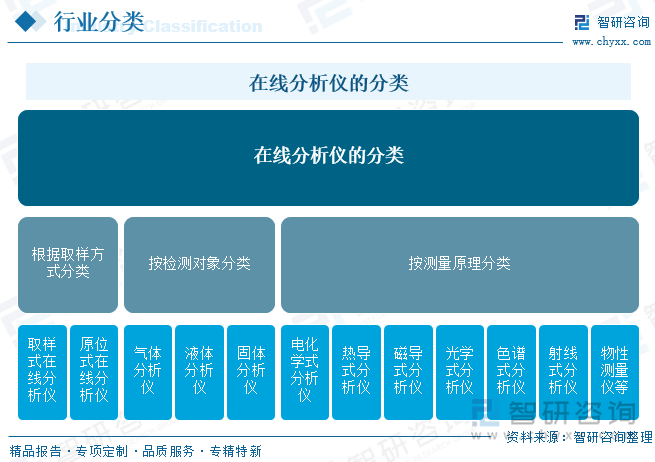
Core Viewpoint - The online analyzer industry is a critical component in industrial automation, environmental monitoring, and process control, with continuous technological advancements and expanding application areas. The market is projected to grow significantly, with production capacity and demand increasing in the coming years [1][8]. Industry Definition and Classification - Online analyzers, also known as process analyzers, are instruments installed directly in industrial production processes for real-time detection of material composition or physical parameters. They are widely used in the petrochemical industry [2][3]. Current Industry Status - In 2024, China's online analyzer production capacity is expected to reach 162,000 units, with a production volume of 128,800 units and a demand of 136,300 units, resulting in a market size of 11.44 billion yuan. The liquid analyzer segment holds the largest market share at 4.83 billion yuan [1][8]. Industry Development Trends - The online analyzer industry is expected to evolve towards smart, integrated, and networked solutions. This includes enhanced data processing capabilities, multi-functional integration, and real-time data transmission for remote monitoring and management [25][26]. Competitive Landscape - The global online analyzer market is competitive, with significant advantages held by European and American companies in technology and market share. However, Chinese companies are gradually increasing their market position due to strong domestic demand and a well-established industrial chain [18][21]. Production Business Models - The production business models in the online analyzer industry include independent research and development, OEM, customized production, standardized production, and industry-academia collaboration [10][12]. Industry Chain - The upstream of the online analyzer industry consists of raw material suppliers, including metals, plastics, and core components like high-precision sensors and specialized light sources. The midstream involves the production of online analyzers, while the downstream applications span various sectors such as petrochemicals, metallurgy, food, pharmaceuticals, and environmental protection [14].