增强型X射线时变与偏振空间天文台

Search documents
“鸿蒙”初开 “夸父”追日 星河问源(瞰前沿)
Ren Min Ri Bao· 2025-12-05 22:03
Core Insights - The China Academy of Sciences National Space Science Center held a press conference on November 24, showcasing significant advancements in space science, focusing on cosmic origins, space weather, and the origins of life [3][10]. Group 1: Satellite Missions and Achievements - Since the launch of the space science pilot project in January 2011, eight scientific satellite missions have been completed, including "Wukong," "Shijian-10," "Micius," "Huiyan," "Taiji-1," "Huairou-1," "Kuafu-1," and "Tianguan," achieving multiple "firsts" for China and the world [5]. - "Wukong," launched on December 17, 2015, is China's first dark matter particle detection satellite, which has provided the most precise secondary cosmic ray boron energy spectrum in the TeV/n range based on eight years of data [5]. - "Huiyan," China's first X-ray astronomical satellite, launched on June 15, 2017, has made significant discoveries regarding black hole accretion bursts and neutron star surface nuclear burning [6]. - "Huairou-1," launched on December 10, 2020, has identified new subtypes of gamma-ray bursts and provided insights into the radiation environment near Earth [6]. - "Kuafu-1," launched on October 9, 2022, has revealed a lower-than-expected correlation rate between high-energy C-class flares and coronal mass ejections, offering new insights into solar eruption mechanisms [7]. - "Tianguan," launched on January 9, 2024, has detected 165 significant X-ray transient sources, contributing to the understanding of X-ray phenomena in the galaxy [7]. Group 2: Future Missions and Goals - The "14th Five-Year Plan" will focus on the "Harmonious Plan," which includes a low-frequency radio telescope array of ten satellites aimed at capturing weak signals from the early universe [8]. - "Kuafu-2" will explore solar magnetic activity and its relationship with solar storms by orbiting the sun's poles [9]. - The exoplanet survey satellite aims to find Earth-like planets in habitable zones, while the enhanced X-ray time-variable and polarization space observatory will study extreme conditions in the universe [9]. Group 3: Development and International Collaboration - The space science sector in China has shown robust growth, achieving breakthroughs in various fields, including macro, micro, extreme conditions, and interdisciplinary research [10]. - The project has led to significant advancements in satellite technology and payloads, establishing a national-level X-ray calibration beamline and developing high-sensitivity X-ray telescopes [10]. - International collaborations, such as the "Smile" satellite project with the European Space Agency, have enhanced China's scientific influence and effectiveness in space science [11].

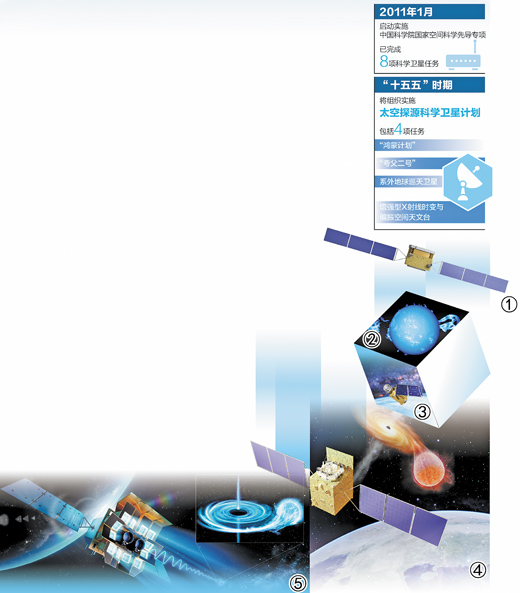
我国空间科学先导专项最新亮点成果发布 “鸿蒙”初开 “夸父”追日 星河问源(瞰前沿)
Ren Min Ri Bao· 2025-12-05 21:59
Core Insights - The recent press conference by the National Space Science Center of China highlighted significant advancements in space science, focusing on the origins of the universe, space weather, and life [2][8] - The "14th Five-Year Plan" will implement the Space Exploration Science Satellite Program, which includes four major missions aimed at achieving breakthroughs in understanding the dark ages of the universe, solar magnetic activity cycles, and exoplanet detection [2][8] Group 1: Satellite Missions and Achievements - Since the launch of the Space Science Pilot Project in 2011, eight scientific satellite missions have been completed, achieving "China's first" and even "world's first" breakthroughs in various fields [3] - The "Wukong" satellite, launched in December 2015, has provided the most precise secondary cosmic ray boron energy spectrum in the TeV/n range, aiding in the understanding of cosmic ray propagation [4] - The "Huiyan" satellite, launched in June 2017, has made significant contributions to understanding black hole accretion bursts and neutron star surface nuclear burning [5] - The "Huairou-1" satellite, launched in December 2020, discovered new subtypes of gamma-ray bursts and provided insights into the radiation environment near Earth [6] - The "Kuafu-1" satellite, launched in October 2022, revealed a lower-than-expected correlation rate between high-energy C-class flares and coronal mass ejections, offering new insights into solar eruptions [7] - The "Tianguan" satellite, launched in January 2024, has detected 165 significant X-ray transient sources, contributing to the understanding of X-ray phenomena in the galaxy [7] Group 2: Future Missions and Goals - The "Hongmeng Plan" aims to capture weak signals from the early universe using a low-frequency radio telescope array consisting of ten satellites [9] - The "Kuafu-2" mission will explore solar magnetic activity and its relationship with solar wind, enhancing understanding of the Earth-sun relationship [9] - The Exoplanet Survey Satellite will search for Earth-like planets in habitable zones, referred to as "Earth 2.0" [9] - The Enhanced X-ray Time-Variable and Polarization Space Observatory will study extreme conditions in the universe, such as black hole event horizons and neutron star surfaces [9] Group 3: Overall Impact and Development - The Space Science Pilot Project has demonstrated a strong development trend in China's space science, achieving breakthroughs across multiple dimensions [10] - The project has led to advancements in satellite technology and international collaboration, enhancing China's influence in global space science [10] - The transition from "catching up" to "keeping pace" and now to "leading" in certain areas reflects the growing importance of China's space science satellite cluster in exploring the unknown universe [10]
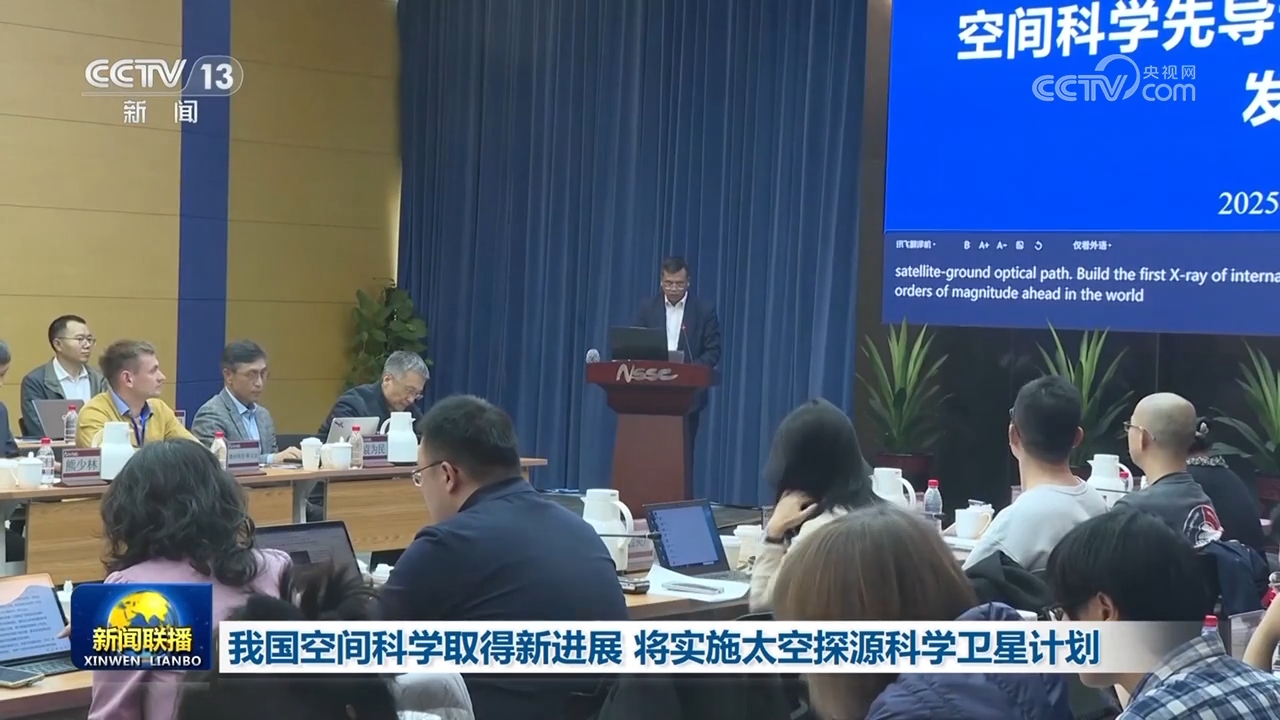
我国空间科学取得新进展 将实施太空探源科学卫星计划
Yang Shi Wang· 2025-11-24 12:26
Core Viewpoint - The Chinese Academy of Sciences is set to implement a space exploration satellite program during the 14th Five-Year Plan, focusing on significant scientific breakthroughs in space science [1][3]. Group 1: Space Science Satellite Program - The program will include the development and launch of four space science satellite missions aimed at exploring cosmic mysteries [3]. - The four missions are: 1. "Hongmeng Plan" for detecting the cosmic dark age and dawn 2. "Kuafu-2" for direct imaging of the solar polar regions 3. An exoplanet survey mission to find "Earth 2.0" 4. An enhanced X-ray time-variable and polarization space observatory to study physical laws under extreme cosmic conditions [3]. Group 2: Achievements of Previous Missions - Since its launch in 2011, the space science pilot project has successfully developed and launched eight scientific satellite missions, including "Wukong," "Shijian-10," "Micius," "Huiyan," "Taiji-1," "Huairou-1," "Kuafu-1," and "Tianguan" [5]. - These missions have led to significant achievements, such as creating the world's first all-sky X-ray map, obtaining the most precise cosmic ray electron and proton energy spectrum structures, and directly measuring the strongest magnetic fields in the universe [5]. - The program has also made groundbreaking discoveries in areas like transient celestial bodies and solar eruptions, propelling China's space science innovation into a rapid development phase [5].