
大悦城

Search documents
结束12年上市路!大悦城地产明天告别港股
Shen Zhen Shang Bao· 2025-11-26 05:49
Core Viewpoint - Dalian Wanda's subsidiary, Dalian Wanda Commercial Properties, is set to delist from the Hong Kong Stock Exchange after a buyback of shares, marking the end of its 12-year presence in the market [1][2]. Group 1: Company Overview - Dalian Wanda Commercial Properties was listed on the Hong Kong Stock Exchange in 2013 and is a commercial real estate platform under COFCO Group, primarily engaged in the development, operation, sales, leasing, and management of commercial properties [2]. - As of the end of 2024, Dalian Wanda Commercial Properties has established a presence in five major city clusters in China, managing 32 commercial projects, including Dalian Wanda Plaza and luxury hotels [2]. Group 2: Financial Performance - In the first half of the year, Dalian Wanda Commercial Properties reported total revenue of 8.124 billion yuan, a year-on-year decrease of 5.8%, and a net profit of 105 million yuan, down 26.6% year-on-year [2]. Group 3: Privatization Details - The buyback plan involves a total cost of approximately 29.32 billion Hong Kong dollars, with the aim to enhance the governance framework and optimize the organizational structure post-privatization [2][3]. - Following the completion of the privatization, Dalian Wanda's ownership in Dalian Wanda Commercial Properties will increase from 64.18% to 96.13%, effectively giving it near-total control [3]. Group 4: Industry Context - The trend of privatization and delisting among real estate companies has been notable, with 23 companies being forced to delist and 7 opting for voluntary privatization in recent years [4]. - Factors driving this trend include market pressures, lack of liquidity, and the need for strategic flexibility amid a challenging real estate environment [5].

12年上市路终结,大悦城地产即将正式退市
第一财经· 2025-11-19 12:27
Core Viewpoint - Daxiyucheng Real Estate is set to privatize, ending its listing journey that began in 2013, with the decision approved by shareholders on November 17, 2025 [3][5]. Company Overview - Daxiyucheng Real Estate, a commercial real estate platform under COFCO Group, has established a presence in five major city clusters across China, managing 32 projects including Daxiyucheng and Daxiyuhui, along with luxury hotels and investment properties in first-tier cities [4]. Privatization Details - The total cost for the share repurchase is approximately HKD 29.32 billion, with the aim to enhance shareholder value and provide an exit opportunity for investors due to low stock liquidity and governance complexities [5]. - Post-privatization, COFCO Group's ownership in Daxiyucheng Real Estate will increase from 64.18% to 96.13%, significantly consolidating control [5]. Financial Performance - Daxiyucheng Holdings has reported continuous losses over the past three years, with losses of CNY 28.82 billion in 2022, CNY 14.65 billion in 2023, and an estimated CNY 29.77 billion in 2024, totaling over CNY 70 billion [5]. - However, Daxiyucheng Holdings is projected to turn a profit by the first half of 2025, benefiting from the privatization of Daxiyucheng Real Estate [5]. Industry Trends - The trend of privatization among real estate companies has been increasing, with several firms like Shouchuang Real Estate and China Hongtai Development following suit since 2021 [6]. - Key reasons for this trend include insufficient stock liquidity, loss of financing capabilities, and the need for strategic flexibility amid a challenging market environment [7].

即将退市!历时四个月,大悦城地产私有化进入尾声
Nan Fang Du Shi Bao· 2025-11-18 08:18
Core Viewpoint - The privatization decision of Joy City Property, a subsidiary of COFCO Group, has been approved, marking the end of its 12-year listing on the Hong Kong Stock Exchange, with the delisting scheduled for November 27, 2023 [1][3]. Group 1: Privatization Details - The privatization process has been approved after four months of progress, with a total buyback amount of approximately HKD 29.32 billion, at a price of HKD 0.62 per share for non-affiliated shareholders [3][5]. - Post-privatization, Joy City Holdings' ownership will increase to 96.13%, while the stake of its subsidiary, De Mao, will decrease to 3.87%, leading to effective full control of the platform [3][4]. - Joy City Property, established in 1992 and listed in 2013, has developed a nationwide presence with 32 commercial projects across major urban clusters in China [4]. Group 2: Motivations for Privatization - The privatization is a strategic response to the cyclical downturn in the real estate market, which has pressured liquidity and market performance [5][6]. - Joy City Holdings aims to simplify governance and improve operational efficiency by consolidating control over its real estate platform, reducing regulatory compliance costs [5][6]. - Financially, Joy City Holdings has faced significant losses over the past three years, totaling over 7 billion yuan, making this privatization a crucial step towards improving profitability [5][6]. Group 3: Industry Context - The trend of privatization among real estate companies has been growing, with several firms opting to delist from the Hong Kong Stock Exchange due to market pressures and operational challenges [7]. - Key factors driving this trend include insufficient stock liquidity, narrowed financing channels, and the need for companies to adapt to a challenging market environment [7]. - The real estate sector is undergoing significant adjustments, and the trend of privatization is expected to continue over the next 2-3 years as companies seek to optimize operations and respond to market changes [7].
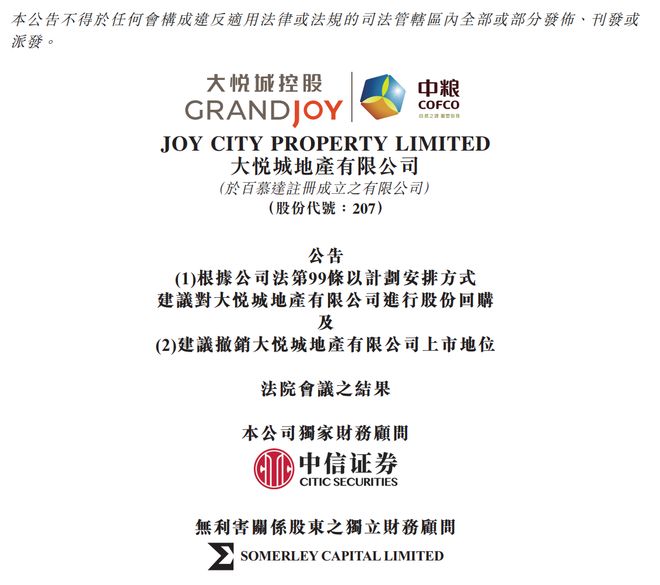
上市12年后,大悦城地产即将退市
2 1 Shi Ji Jing Ji Bao Dao· 2025-11-18 07:18
Core Viewpoint - Dalian Wanda Commercial Properties has received shareholder approval for privatization, with plans to delist from the Hong Kong Stock Exchange effective November 27, 2023 [1][4]. Group 1: Privatization and Delisting - The court meeting held on November 17 saw 30 representatives voting in favor of the delisting, holding a total of 2.67 billion shares, while 4 representatives opposed it with 16.78 million shares [2]. - Dalian Wanda Commercial Properties has a total of 14.23 billion shares issued, with 4.73 billion shares eligible for voting at the court meeting [1]. Group 2: Company Overview and Financial Performance - Dalian Wanda Commercial Properties, a subsidiary of COFCO Group, focuses on the development, operation, sales, leasing, and management of mixed-use and commercial properties, including shopping centers, hotels, and office buildings [4]. - As of mid-2025, the company has established a presence in 24 cities in mainland China and Hong Kong, managing 32 commercial projects [4]. - In 2024, the company reported revenue of 19.83 billion yuan, a year-on-year increase of 49.42%, but recorded a net loss of 290 million yuan, marking its first loss in years [4]. Group 3: Strategic Rationale for Privatization - The company aims to enhance its equity position and improve overall operational efficiency through the privatization process, which is expected to optimize resource allocation across different business segments [4]. - The decision to delist is attributed to market performance fluctuations and liquidity pressures resulting from cyclical industry developments [4].
上市12年后 这家央企开发商将于下周正式退市
2 1 Shi Ji Jing Ji Bao Dao· 2025-11-18 06:13
Core Viewpoint - Dalian Real Estate Co., Ltd. has received approval for privatization from shareholders during a court meeting, with plans to delist from the Hong Kong Stock Exchange effective November 27 [1][2] Group 1: Privatization and Delisting - The court meeting allowed shareholders to vote on the privatization resolution, with 30 representatives holding a total of 2.67 billion shares voting in favor of delisting, while 4 representatives with 16.78 million shares opposed it [1] - The total number of shares issued by Dalian Real Estate is 14.23 billion, with 4.73 billion shares eligible for voting at the court meeting [1] Group 2: Company Background and Market Position - Dalian Real Estate is a subsidiary of COFCO Group, primarily engaged in the development, operation, sale, leasing, and management of mixed-use and commercial properties, including shopping centers, hotels, and office buildings [1] - The company has established a presence in 24 cities across mainland China and Hong Kong, managing 32 commercial projects and developing residential and hotel projects [1] Group 3: Financial Performance and Strategic Moves - In 2024, Dalian Real Estate reported revenue of 19.83 billion yuan, a year-on-year increase of 49.42%, but recorded a net loss of 290 million yuan, marking its first loss in years [2] - The company plans to repurchase shares for approximately 2.932 billion HKD and aims to enhance its asset management capabilities and operational efficiency through this transaction [2]
大悦城港股将退市 央企地产“A控红筹”模式迎大考
Jing Ji Guan Cha Wang· 2025-11-18 04:28
Core Viewpoint - Dalian Wanda's real estate subsidiary is set to go private, marking the end of its 12-year listing on the Hong Kong Stock Exchange, as part of a strategic optimization during a period of deep adjustment in the real estate industry [1][2][3] Company Summary - Dalian Wanda's real estate platform, under COFCO Group, has established a presence in five major city clusters across China, managing 32 commercial projects and luxury hotels [2] - The privatization plan involves a total buyback cost of approximately HKD 29.32 billion, with the company’s listing status expected to be officially revoked on November 27 [2][3] - Following the privatization, COFCO Group's ownership in Dalian Wanda will increase from 64.18% to 96.13%, achieving absolute control over the subsidiary [3] Industry Summary - The privatization of Dalian Wanda is seen as a response to market pressures, strategic needs, and changes in the industry environment, highlighting the limitations of the "A-share controlled red-chip" structure during industry adjustments [4] - The company has faced significant losses over the past three years, with total losses exceeding 7 billion yuan, but is projected to return to profitability by mid-2025 [4][5] - The trend of privatization among state-owned real estate companies is expected to continue, with 29 listed real estate firms already confirmed to delist between April 2023 and October 2025, indicating a shift from being a "capital springboard" to a "cost burden" [5][6]
地产央企大悦城即将正式退市
Di Yi Cai Jing Zi Xun· 2025-11-17 16:19
Core Viewpoint - Dalian City Real Estate is set to privatize, ending its listing journey that began in 2013, with the delisting expected on November 27, 2023 [2] Company Overview - Dalian City Real Estate, a commercial real estate platform under COFCO Group, manages 32 projects across five major city clusters in China, including first-tier city investment properties and luxury hotels [2] - The company is a consolidated subsidiary of Dalian City Holdings, which is listed on the A-share market [2] Privatization Details - The privatization resolution was approved by shareholders during a court meeting on November 17, 2023 [2] - The total cost for the share buyback is approximately HKD 29.32 billion [2] Shareholding Structure - Before the agreement, COFCO Group held 64.18% of shares, while after the privatization, its stake will increase to 96.13% [3] - This change indicates that Dalian City Holdings will have almost complete control over Dalian City Real Estate post-privatization [3] Financial Performance - Dalian City Holdings has reported continuous losses over the past three years, with losses of CNY 2.882 billion in 2022, CNY 1.465 billion in 2023, and an estimated CNY 2.977 billion in 2024, totaling over CNY 7 billion [4] - The company anticipates turning a profit by the first half of 2025, aided by the privatization [4] Industry Trends - The trend of privatization among real estate companies has been increasing, with several firms, including China Hongtai Development and Huafa Property, announcing similar moves [4][5] - Key reasons for privatization include insufficient stock liquidity, loss of financing capabilities, and the need for strategic flexibility amid a challenging market environment [5] - The real estate industry is undergoing significant adjustments, with expectations of continued consolidation and restructuring in the next 2-3 years [5]
地产央企大悦城即将正式退市
第一财经· 2025-11-17 16:08
Core Viewpoint - Daxiyucheng Real Estate is set to privatize, ending its public listing after being established in 2013 and planning to delist by November 27, 2025, following shareholder approval at a court meeting [3][4]. Group 1: Company Overview - Daxiyucheng Real Estate, a commercial real estate platform under COFCO Group, manages 32 projects across five major city clusters in China, including luxury hotels and investment properties in first-tier cities [4]. - The company is a subsidiary of Daxiyucheng Holdings, which is listed on the A-share market, representing a less common "A-share controlled red chip" structure in the industry [4]. Group 2: Privatization Details - The total cost for the share buyback and delisting is approximately HKD 29.32 billion, driven by low stock liquidity, limited financing capabilities, and increased governance complexity [5]. - Post-privatization, Daxiyucheng Holdings' ownership in Daxiyucheng Real Estate will increase from 64.18% to 96.13%, significantly enhancing its control and potential profit margins [5]. Group 3: Financial Performance - Daxiyucheng Holdings has reported continuous losses over the past three years, with losses of CNY 2.882 billion in 2022, CNY 1.465 billion in 2023, and an estimated CNY 2.977 billion in 2024, totaling over CNY 7 billion [5]. - The company anticipates a turnaround to profitability by the first half of 2025, aided by the privatization plan which is expected to bolster its financial performance [5]. Group 4: Industry Trends - The trend of privatization among real estate companies has been increasing, with several firms like China Hongtai Development and Huafa Property also opting for delisting due to market pressures and operational challenges [6][7]. - Key reasons for this trend include insufficient stock liquidity, loss of financing capabilities, and the need for strategic flexibility amid a challenging real estate market environment [7].
12年上市路终结 地产央企大悦城即将正式退市
Di Yi Cai Jing· 2025-11-17 14:09
Core Viewpoint - Dalian City Real Estate is set to privatize after being listed since 2013, with the decision approved by shareholders during a court meeting on November 17, 2023 [2][3]. Group 1: Company Overview - Dalian City Real Estate, a commercial real estate platform under COFCO Group, has established a presence in five major city clusters across China, managing 32 commercial projects and luxury hotels [3]. - The company plans to delist from the Hong Kong Stock Exchange on November 27, 2023, following a share buyback agreement valued at approximately HKD 29.32 billion [3]. Group 2: Financial Performance - Dalian City Real Estate has faced significant losses over the past three years, with reported losses of CNY 2.882 billion in 2022, CNY 1.465 billion in 2023, and an estimated CNY 2.977 billion in 2024, totaling over CNY 7 billion [4]. - The company aims to achieve profitability by the first half of 2025, with the privatization expected to enhance its equity and improve net profit margins [4]. Group 3: Industry Context - The trend of privatization among real estate companies has been increasing, with several firms, including China Hongtai Development and Huafa Property, announcing similar plans in recent years [4][6]. - Key reasons for this trend include insufficient stock liquidity, loss of financing capabilities, and the need for strategic flexibility amid a challenging market environment [5][6].
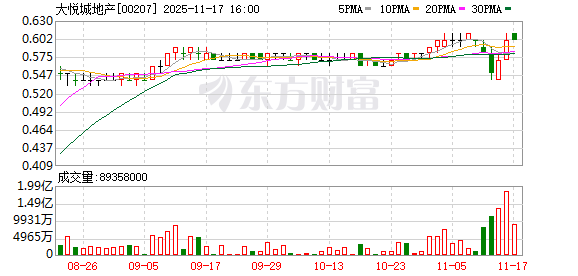
12年上市路终结,地产央企大悦城即将正式退市
Di Yi Cai Jing· 2025-11-17 14:04
Core Viewpoint - The trend of real estate companies delisting is expected to continue over the next 2-3 years, with Dalian City Real Estate's privatization plan set to conclude its public listing journey by 2025 [1][4]. Company Summary - Dalian City Real Estate (00207.HK) announced that shareholders approved the privatization resolution during a court meeting on November 17, 2023 [1]. - The company's listing status on the Hong Kong Stock Exchange is expected to be officially revoked on November 27, 2023 [2]. - Dalian City Real Estate is a commercial real estate platform under COFCO Group, managing 32 projects across five major city clusters in China, including luxury hotels and investment properties [2]. - The total cost for the share repurchase plan is approximately HKD 29.32 billion [2]. - Prior to the agreement, COFCO Group held 64.18% of the shares, which will increase to 96.13% post-privatization [2]. Financial Performance - Dalian City Real Estate has reported continuous losses over the past three years, with losses of CNY 2.882 billion in 2022, CNY 1.465 billion in 2023, and an estimated CNY 2.977 billion in 2024, totaling over CNY 7 billion [3]. - Dalian City Holdings is expected to turn profitable by mid-2025, benefiting from the increased equity in Dalian City Real Estate post-privatization [3]. Industry Trends - The increase in privatization and delisting among real estate companies is attributed to several factors: insufficient stock liquidity, loss of financing capabilities, and ongoing losses and debt crises [4]. - Privatization allows companies to implement long-term strategies and enhance operational flexibility while reducing regulatory costs [4]. - The real estate industry is undergoing significant adjustments, with declining sales and a complex market environment, indicating that the trend of privatization will likely persist [4].