
天行II轻商低温版

Search documents
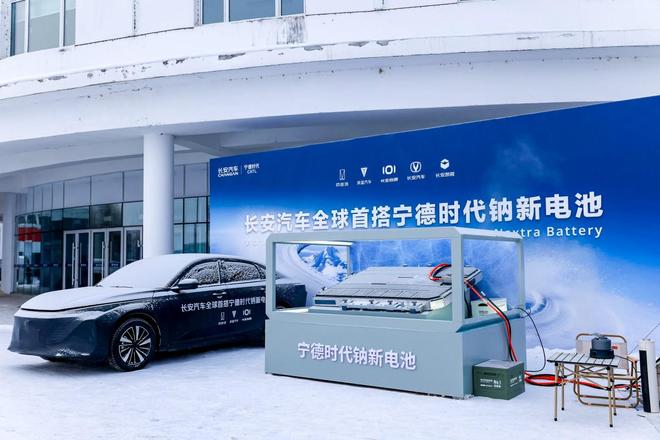
纳电走向量产乘用车,耐低温性能或拓展新能源边界
Guan Cha Zhe Wang· 2026-02-05 08:35
Core Viewpoint - Changan Automobile and CATL have officially launched the sodium-ion battery strategy and the world's first mass-produced passenger vehicle equipped with sodium-ion batteries, marking a significant step in the commercialization of sodium-ion battery technology [1][3]. Group 1: Sodium-Ion Battery Strategy - CATL will be the sole partner for Changan's sodium-ion battery strategy, with plans to equip multiple brands including Avita, Deep Blue, Qiyuan, and Gravity with "sodium new" batteries, with the first model expected to launch mid-year [3]. - The mass production of passenger vehicles using sodium-ion batteries represents a critical milestone in the commercialization of this technology, following CATL's earlier release of sodium-ion batteries for light commercial vehicles [3][4]. Group 2: Market Context and Demand - The demand for sodium-ion batteries is driven by the need for car manufacturers to compete with fuel vehicles, especially as the sales of new energy vehicles in China surpassed 50% last year, and as subsidies for new energy vehicles decline [4]. - The low-temperature performance and high safety characteristics of sodium-ion batteries are seen as a new technological pathway to activate more usage scenarios, particularly in cold northern regions where lithium batteries face challenges [6]. Group 3: Technical Specifications and Performance - The first mass-produced passenger vehicle with sodium-ion batteries has completed winter testing, featuring a pure electric range exceeding 400 kilometers and a maximum energy density of 175 Wh/kg [6]. - The sodium-ion battery demonstrates superior low-temperature performance, with discharge power nearly three times higher than lithium iron phosphate models at -30°C, and a capacity retention rate exceeding 90% at -40°C [8]. Group 4: Future Developments and Market Positioning - CATL plans to establish over 3,000 chocolate battery swap stations by 2026, focusing on northern cold regions to support the sodium-ion battery ecosystem, while also enhancing the lithium battery charging infrastructure [12]. - The future of electric vehicles is expected to feature a dual approach, with lithium batteries dominating long-range and high-performance models, while sodium-ion batteries will cater to medium-range, cold-weather, and high-safety demand vehicles [12].



机构:钠离子电池有望迎来发展新周期
Zheng Quan Shi Bao Wang· 2026-01-27 01:15
日前,宁德时代(300750)"天行II轻商"新品发布会推出四款定制化产品——"天行II轻商"超充版、长 续航版、高温超充版、低温版。ICC鑫椤钠电数据库显示,2025年中国钠离子电池产量为3.45GWh,同 比增长96%。2025年钠离子电池实际落地产能约20GWh,考虑到多数产能实际释放时间节点在2025年二 季度后,2025年市场产能利用率不足40%。 国海证券认为,性能适配与经济性共振,钠离子电池有望迎来发展新周期。钠离子电池具备低温性能、 倍率性能等优势,潜在经济性优异。龙头厂商积极推进新品研发和产业化进程,持续与下游客户及上游 供应商进行磨合迭代,产品性能不断优化,后续钠离子电池增长空间广阔,研发制造实力强、下游客户 卡位坚实的材料厂商及把握前沿技术的电池厂商均有优质发展机遇。 招商证券认为,过去几年,钠离子电池成本快速下降,能量密度也有较大提升,其应用场景与规模在不 断扩大。从终端场景来看,整车基于低温性能和成本的考虑,开始在A0/A00车型使用,并扩展到混动 车型。在二轮车市场,钠电较锂电有安全和成本优势;在储能领域,钠电从户储进入到大储应用。在动 力、储能等多个市场,钠离子电池有望逐步走向规 ...
商用车电动化迈入奇点时刻
Hua Er Jie Jian Wen· 2026-01-23 02:31
Core Viewpoint - CATL is expanding its presence in the commercial vehicle sector with the launch of the Tianxing II light commercial vehicle solution, aiming to redefine its role from a hardware supplier to a smart manufacturing platform [1][2]. Group 1: Market Overview - The commercial vehicle market in China is projected to reach 4.25 million units in sales this year, with a penetration rate of new energy vehicles exceeding 35% [1]. - By the end of 2024, the penetration rate is expected to be only 10% [1]. Group 2: Product Launch and Features - CATL has launched the Tianxing II light commercial series, collaborating with 46 automakers and producing 678 new models, with a cumulative shipment of over 210,000 units [2]. - The Tianxing II features a long-range version with a 253 kWh battery, achieving a real-world range of 800 kilometers, targeting the intercity freight market [2][3]. Group 3: Cost Savings and Warranty - Utilizing off-peak electricity for charging, a single light truck can save up to 150,000 yuan in fuel costs annually [3]. - CATL offers a warranty of "10 years or 1 million kilometers" with a promise of no degradation in the first year, addressing concerns of long-distance drivers [3]. Group 4: Technological Innovations - The Tianxing II introduces the industry's first mass-produced sodium battery, which performs well in extreme cold, retaining over 92% usable capacity at -20 degrees Celsius [3]. - The supercharging version can charge to 80% in 30 minutes at -15 degrees Celsius, while the high-temperature version maintains a cycle life of 5,000 times at 45 degrees Celsius [3]. Group 5: Digital Solutions and Asset Management - CATL has launched the "Battery Manager" app, which generates health scores for batteries and addresses trust issues in second-hand vehicle transactions [4]. - The app is part of a broader strategy to improve the residual value of vehicles equipped with CATL batteries, potentially exceeding 10,000 yuan compared to competitors [4]. Group 6: Future Plans and Market Strategy - CATL plans to establish 3,000 battery swap stations by 2026, aiming to reduce vehicle purchase costs by 10% through a "separation of vehicle and battery" model [5]. - The company emphasizes that future competition will focus on systematic victories based on real operational scenarios rather than just battery specifications [5]. - The upcoming "trade-in" policy in 2026 is expected to enhance subsidies for new energy commercial vehicles, further accelerating user adoption [5].