宇树G1型号机器人

Search documents
春晚机器人解读专家会议
2026-02-24 14:16
Summary of Conference Call Records Company and Industry Overview - **Company**: Yushu Robotics and Galaxy General Robotics - **Industry**: Robotics, focusing on humanoid robots and their applications in various sectors Key Points and Arguments Yushu Robotics Performance - Yushu Robotics showcased high consistency and stability during the Spring Festival performance, attributed to excellent product structure design, reducing hardware iteration needs and balancing mobility with human-like features [1][2] - The self-developed joint technology enhances flexibility and consistency while reducing overall weight by approximately 8 kg [3] - The G1 model robot utilized a combination of imitation learning and reinforcement learning to master complex movements in a short time [1][3] Technological Advancements - Pre-training and remote control do not significantly affect the practical application of robots, as perception, planning, and decision-making technologies have matured [4] - The integration of planning paths with movement capabilities is crucial to avoid falls, and the model emergence effect allows robots to quickly learn new skills once one robot masters them [4] - The availability and control capabilities of brain models have significantly improved, with open-source models enhancing efficiency in perception, planning, and decision-making [2][23] Challenges in the Robotics Industry - The robotics industry faces challenges in motion control and consistency, particularly with the consistency of reducers and motors, which can lead to variations in kinematic characteristics among robots [5] - Companies like Qiao Jie are using reinforcement learning to improve robot consistency, but this requires substantial time and resource investment [5] - The relationship between pre-training and autonomous decision-making remains complex, with a need for accurate data to support model development [6] Market Position and Strategies - Galaxy General Robotics is positioned as a leader in the domestic market, leveraging strong financing capabilities and unique development strategies, such as using virtual simulation data for model training [8] - The company has successfully implemented maintenance-free robots in actual operations, which has provided a significant market advantage [8][9] - Galaxy Robotics has improved sales efficiency by pre-setting certain functions, reducing the time taken for tasks from 90 seconds to 30 seconds [12] Future Prospects and Industry Trends - The growth potential for robots in retail, factory operations, and other sectors is expected to increase, despite current efficiency not matching human levels [20] - The industry is still in the early stages of humanoid robot development, with companies not yet reaching a level where robots can be reliably used in commercial settings [21] - The focus on lightweight materials and structural optimization continues, with advancements in joint capabilities and the use of magnesium-aluminum materials for skeletons [26] Conclusion - The robotics industry is evolving rapidly, with significant advancements in technology and performance. However, challenges remain in achieving consistency and practical application in real-world scenarios. Companies are adopting various strategies to enhance their market position and improve product offerings, indicating a competitive landscape with ongoing innovation.

宇树科技“朋友圈” 多了腾讯
Shang Hai Zheng Quan Bao· 2026-01-08 00:29
Group 1 - Tencent's Robotics X Lab has formed a strategic partnership with Yushu Technology to enhance the application of Yushu's robots in various scenarios such as cultural tourism sites, shopping malls, and corporate exhibition halls [1] - The collaboration will leverage Tencent's Tairos embodied intelligent model to provide user-friendly tour guide and shopping services through Yushu's robots, aiming to set industry benchmarks [1] - Tencent participated in Yushu Technology's Series C financing, which was completed in June 2025, with major investors including China Mobile's fund, Tencent, Alibaba, Ant Group, and Geely Capital [1] Group 2 - The Tairos embodied model has been deployed in Yushu's G1 AI guide robot, named "Xiao Mo," which began its internship as a tour guide at the Dunhuang Mogao Grottoes Digital Exhibition Center on New Year's Day 2026 [2] - In Shanghai, the G1 robot also serves as a guide at the global headquarters of Guoling Law Firm, providing information about the firm's history and allowing clients to interact with the robot for inquiries [2] Group 3 - Other companies have also announced collaborations with Yushu Technology, including iFlytek, which offers AI services based on its Super Brain 2030 platform, covering over 500 smart robot manufacturers [3] - JD.com launched its first offline store in partnership with Yushu Technology, featuring products like the Go2 robotic dog and G1 humanoid robot, marking an expansion of the robot ecosystem into offline scenarios [3] - Rockchip has reported a high market share for its flagship product RK3588 in the robotics sector, collaborating with Yushu Technology and other notable clients on various types of robots [3]

推出App Store,宇树会迎来它的“苹果商店”时刻吗?
3 6 Ke· 2025-12-26 03:14
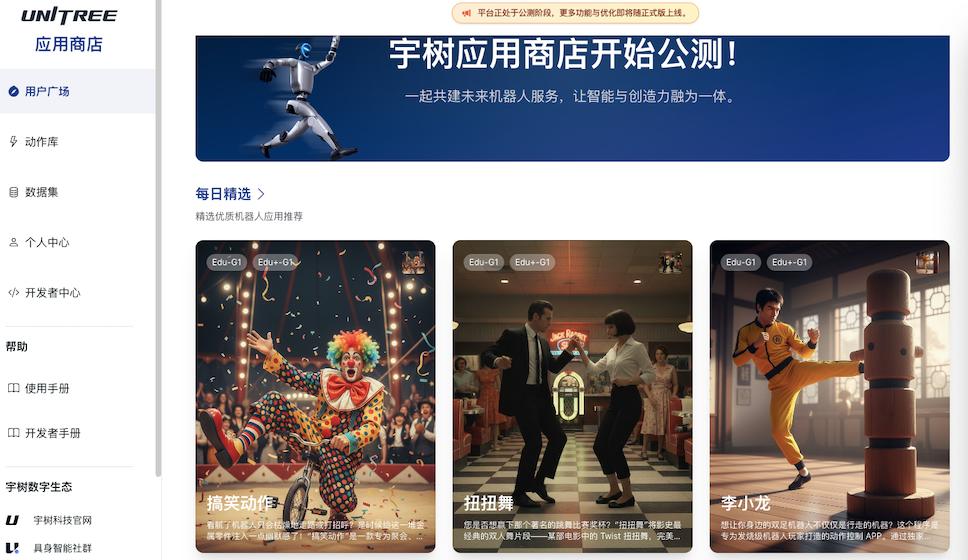
Core Viewpoint - Yushu Technology is making strides in the robotics industry by launching its own "App Store" for humanoid robots, aiming to enhance user engagement and expand its ecosystem [1][5]. Group 1: Company Developments - Yushu Technology has gained attention for its participation in high-profile events, such as the Spring Festival Gala and a concert by Wang Lihong, showcasing the impressive capabilities of its robots [1]. - The newly launched "App Store" allows users to upload and share trained models for various actions, promoting a two-way interaction model [1][2]. - The App Store currently features modules like "User Square," "Action Library," and "Developer Center," with initial offerings including dance and martial arts actions [2][4]. Group 2: User Engagement and Accessibility - The App Store is designed to lower the barrier for users, enabling them to connect their robots via a mobile app without needing coding skills [7]. - Users can upload and download data sets for training and optimizing robot algorithms, enhancing the overall user experience [7]. - This model aims to reduce the costs associated with robot usage, making it more accessible to both individual and enterprise users [7]. Group 3: Industry Implications - The introduction of the App Store model is expected to transform the robotics industry by shifting from high-cost, one-time sales to affordable, standardized hardware and software services [9]. - It may also increase orders from small and medium-sized clients, accelerating the deployment of robots in everyday scenarios [9]. - The platform could facilitate the collection and optimization of action model data, enhancing the capabilities of compatible robot models [9][10].