
安全生产责任保险(安责险)

Search documents
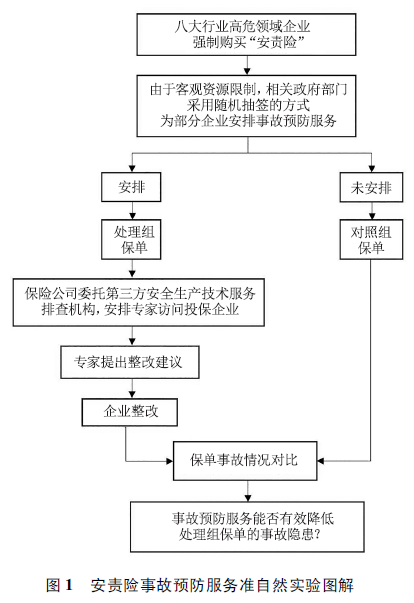
绿色保险中事故预防服务的效果研究——基于安责险的一项准自然实验
Sou Hu Cai Jing· 2026-02-27 02:40
Core Insights - Green finance is a crucial component in promoting a comprehensive green transformation of the economy and society, with China leading globally in green loans and bonds [1][2] - Green insurance, as an essential part of green finance, plays a significant role in risk-sharing for enterprises and industries, although its research is less developed compared to green loans and bonds [1][2] Policy Background - Safety production liability insurance (referred to as "Anze Insurance") compensates for economic losses and casualties from production safety accidents while providing accident prevention services [3] - The implementation of Anze Insurance is a key measure to prevent and reduce production safety accidents and support green development in enterprises [3] Research Design - Data for the study is sourced from Anze Insurance policy data from 2015 to 2023 and macroeconomic variables from the China Urban Statistical Yearbook [5] - The study examines the impact of accident prevention services on insurance claims, including the frequency and amount of claims [6][7] Empirical Results - The results indicate that accident prevention services significantly reduce the probability of claims, with a marginal effect of -0.0385%, leading to a conditional stop-loss ratio of 2.47% for policies with such services [18] - The average number of claims and losses for policies with accident prevention services decreased by 0.0004 times and 0.0007 million yuan, respectively, indicating a more substantial effect on reducing claim probabilities than on the frequency and amount of claims [18] Further Discussion - The analysis shows that the effectiveness of accident prevention services varies by enterprise size, with large enterprises experiencing a significant reduction in claim probabilities [21][23] - The marginal effect for large enterprises is 4.0471%, while medium and small enterprises show lower effects of 1.97% and 2.77%, respectively [21][23] Conclusion and Policy Implications - It is recommended to promote accident prevention services across other green insurance products, enhancing risk management and prevention strategies [26] - Focus should be placed on large enterprises and high-risk industries to maximize the economic benefits of accident prevention services [27]

让安责险回归“安全”本位
Jin Rong Shi Bao· 2026-01-21 01:51
Core Viewpoint - The recent collective interview by the Guangxi Zhuang Autonomous Region's Safety Committee highlights the need for insurance companies to increase the proportion of accident prevention service fees to at least 20% of total premiums, addressing the longstanding issue of prioritizing insurance coverage over prevention [1] Group 1: Current State of Safety Production Responsibility Insurance - The industry is at a critical transition point, shifting from merely providing post-incident economic compensation to offering comprehensive risk management services [1] - Current risk prevention services offered by insurance companies primarily meet regulatory requirements and often lack depth, focusing on superficial checks and generic training rather than thorough risk assessments [2] - The allocation of special prevention funds faces three main challenges: difficulty in quantifying effectiveness, the mismatch between standardized services and diverse industry needs, and the short-term nature of insurance contracts versus the long-term nature of safety improvements [2] Group 2: Proposed Reforms and Solutions - Reforming the service model of safety production responsibility insurance is essential, requiring a collaborative governance ecosystem [3] - There is a need to establish a scientific evaluation system for risk reduction service effectiveness, focusing on multiple dimensions such as service process standardization and risk identification accuracy [3] - Insurance companies should take on the role of resource hubs and service integrators, leveraging advanced technologies like big data and AI to enhance proactive risk management [3] Group 3: Changing Perspectives and Future Directions - Insured enterprises must shift their perception of insurance from a post-incident cost to a strategic partner in enhancing safety management [4] - The industry is transitioning from scale expansion to quality improvement, with the challenges in the use of prevention funds indicating a gap between industry capabilities and modern requirements [4] - Through systematic innovation, enhanced technology application, and improved regulatory incentives, safety production responsibility insurance can evolve into an effective risk management platform that contributes to social safety governance [4]
一地排查安责险,多家险企被约谈,精细化经营待开启
Bei Jing Shang Bao· 2026-01-11 12:54
Core Viewpoint - The recent collective interview held by the Guangxi Zhuang Autonomous Region's Safety Committee highlights significant issues in the implementation of safety production responsibility insurance (安责险), specifically low investment in preventive services and inadequate per capita coverage [1][4][5]. Group 1: Regulatory Actions - The Guangxi Safety Committee has mandated that insurance companies allocate at least 20% of the total premium collected for accident prevention services in their 2026 budget [3][4]. - Insurance companies are required to establish a written commitment to ensure that funds are used specifically for accident prevention and to avoid misallocation for bonuses or other expenses [4][5]. Group 2: Industry Challenges - The insurance sector faces challenges such as low investment in preventive services, with many companies not meeting reasonable expenditure ratios [5][6]. - There is a prevalent issue of inadequate per capita coverage, which fails to meet basic safety requirements, potentially affecting risk management effectiveness [5][6]. Group 3: Market Dynamics - The current regulatory environment emphasizes strict accountability and prevention, indicating a shift from merely focusing on premium collection to enhancing service quality [5][6][8]. - The insurance market has been criticized for prioritizing premium rates over the provision of effective accident prevention services, leading to unhealthy competition among insurers [6][8]. Group 4: Awareness and Adoption - Many small and medium-sized enterprises exhibit a lack of awareness regarding safety production risks, often viewing insurance as a burden rather than a necessity [9]. - There is a need for improved promotion of the value of 安责险, particularly through sharing success stories of accident prevention services and claims, to enhance participation rates [9].

系好企业生产“安全带” 多地优化升级安责险
Shang Hai Zheng Quan Bao· 2025-11-20 10:05
Core Viewpoint - The implementation of safety production responsibility insurance (referred to as "safety insurance") is becoming a crucial task in various regions, aimed at enhancing accident prevention and reducing incidents through optimized policies and services [1][3]. Group 1: Policy Developments - Regions such as Shanxi, Hunan, and Henan have introduced measures to promote the development of safety insurance, focusing on accident prevention and service enhancement [2][3]. - Shanxi has set a budget target for accident prevention service fees at 20% of the actual insurance premium collected, ensuring that these funds are not misappropriated [2]. - Hunan is working on establishing a collaborative system between government departments and insurance companies to improve real-time communication and service evaluation [2]. Group 2: Current Challenges - Despite the growth in safety insurance premiums exceeding 100 billion yuan, it only accounts for about 1% of the total property insurance premium, indicating a significant gap in coverage and capacity [4]. - Key challenges include low proactive participation from companies, product homogeneity, and insufficient collaboration among departments, leading to issues like "data silos" that hinder accurate pricing and risk management [4][5]. - The perception of safety insurance as a cost burden rather than a risk management tool contributes to the low uptake among enterprises [4]. Group 3: Recommendations for Improvement - To address the challenges in safety insurance development, it is recommended to enhance enforcement and inspections to ensure companies comply with insurance requirements [5]. - Strengthening information technology infrastructure to facilitate real-time data sharing between insurance companies and provincial platforms is essential [5]. - Tax incentives and the development of differentiated insurance products are suggested to improve the professionalism and effectiveness of accident prevention services [5].
调费率、重预防,多地力推安责险为企业系好“保险带”
Bei Jing Shang Bao· 2025-11-18 13:11
Core Viewpoint - The implementation of the Safety Production Responsibility Insurance (安责险) is being strengthened across various regions in China, with new policies aimed at enhancing safety management in high-risk industries and ensuring compliance with insurance requirements [1][4][6]. Group 1: Policy Implementation - The Ministry of Emergency Management and six other departments issued the "Implementation Measures for Safety Production Responsibility Insurance" in April, providing clear guidelines for local governments [1][7]. - Multiple regions, including Shanxi and Hunan, are introducing new regulations to enhance the effectiveness of 安责险, focusing on premium adjustments, accident prevention, and stricter supervision [4][5]. - Shanxi Province mandates that the accident prevention service budget must be set at 20% of the actual premium collected for 安责险, with a minimum compensation limit of 400,000 yuan per person for death or disability [4][5]. Group 2: Industry Response - Insurers are encouraged to shift from standardized products to customized solutions, focusing on in-depth research in high-risk sectors and expanding coverage to better meet industry-specific needs [3][6]. - The introduction of dynamic premium adjustment mechanisms based on accident records and safety compliance is being implemented to ensure fair pricing and incentivize better safety practices among insured companies [4][7]. Group 3: Service Enhancement - The focus of the insurance industry is transitioning from claims processing to risk management, with insurers becoming partners in risk management rather than just providers of insurance [8][9]. - Companies are advised to either build their own teams of safety engineers or collaborate with top-tier safety service providers to ensure effective accident prevention services [9]. - A complete risk management cycle is being promoted, encompassing pre-incident training, real-time support during incidents, and post-incident claims assistance [9].
提高保障额度 扩大保障范围 七部门出手升级安责险保障力度
Zhong Guo Zheng Quan Bao· 2025-08-08 07:26
Core Viewpoint - The revised "Implementation Measures for Safety Production Liability Insurance" aims to enhance the insurance coverage, expand the scope of protection, and improve accident prevention services to better safeguard public life and property safety [1][2]. Group 1: Insurance Coverage and Scope - The minimum compensation limit for each death or disability due to production safety accidents has been raised from 300,000 yuan to 400,000 yuan, with some regions setting limits as high as 800,000 yuan [2]. - The insurance must cover all employees of the insured enterprises, including temporary and dispatched workers, ensuring uniform insurance amounts regardless of employment type or job position [2]. Group 2: Regulatory and Service Enhancements - The measures require the establishment of industry standard clauses for safety production liability insurance, which will be developed by the China Insurance Industry Association with input from relevant government departments [2]. - A rapid claims mechanism for major or typical accidents has been introduced, allowing for quick payment of insurance compensation as per legal and contractual agreements [2]. Group 3: Accident Prevention Services - A dedicated chapter on "accident prevention services" has been added, focusing on building a collaborative safety production governance system involving multiple stakeholders [3]. - Responsibilities of production and operation units are clarified, and the role of technical service institutions in accident prevention is emphasized [3].