定制ASIC

Search documents
高盛闭门会-人工智能-数据中心与美国电力需求展望
Goldman Sachs· 2026-03-13 04:46
Investment Rating - The report indicates a strong investment outlook for the AI and data center sectors, with significant capital expenditure expected from major players [1][2]. Core Insights - AI computing demand continues to exceed supply, with capital expenditures from the top five hyperscale companies projected to reach $700 billion by 2026, a year-on-year increase of over 60% [1]. - The electricity demand from data centers is expected to grow by 220% from 2023 to 2030, driven by the expansion of data center capacity and the increasing power density of AI servers [7][8]. - Labor shortages are identified as the primary constraint in data center construction, with companies like Quanta and Mastac leveraging internal training systems to gain a competitive edge [1][13]. Summary by Sections Section 1: AI and Data Center Demand - The global data center power supply is currently around 80 GW, expected to exceed 170 GW by 2030, with over half of the new capacity located in North America [3]. - The demand from hyperscale companies involved in AI, such as Amazon, Meta, Google, Microsoft, and Oracle, is projected to drive capital expenditures significantly [3][4]. Section 2: Electricity Demand and Supply - U.S. electricity demand is forecasted to grow at a compound annual growth rate (CAGR) of 3.2% from 2024 to 2030, with data centers contributing 200 basis points to this growth [7]. - Natural gas generation capacity is expected to increase by approximately 75 GW to meet the rising demand [8]. Section 3: Cost Dynamics - The cost burden is shifting from residential to commercial users, with data center clients showing low price sensitivity and willing to pay a "green reliability premium" [1][12]. - By 2030, the price paid for electricity is expected to be $40/MWh higher than in 2023, impacting ROI minimally [1]. Section 4: Labor and Supply Chain Constraints - Labor is the most significant constraint in data center construction, with companies like Quanta implementing various strategies to address workforce challenges [13][14]. - Supply chain issues, particularly in memory and components, are affecting multiple industries, but the demand for AI infrastructure remains robust [5][6]. Section 5: Investment Opportunities - Key investment opportunities include companies in AI networking and ASICs, such as Celestica, and data center REITs like Digital Realty [16]. - Utility companies like NextEra and independent power producers such as NRG are also highlighted as potential beneficiaries of the growing demand for data center power [16][17].
博通 220 亿美元指引背后:AI 牛市进入“质量验证期”
美股研究社· 2026-03-05 13:48
Core Viewpoint - The article emphasizes that the AI market is not in a bubble but is experiencing a controlled acceleration, as evidenced by Broadcom's recent earnings report, which aligns closely with market expectations [1][2][3]. Financial Performance - Broadcom reported revenue of $19.31 billion for the first fiscal quarter, slightly exceeding market expectations, with semiconductor solutions revenue reaching $12.52 billion, also surpassing forecasts [5]. - The guidance for the second fiscal quarter is approximately $22 billion, indicating management's confidence in visible orders rather than emotional growth [7][8]. AI Market Insights - The earnings report signals three key insights for investors regarding the AI industry: 1. **Continuity of AI Revenue**: Concerns about quarterly fluctuations in AI server demand are alleviated, as Broadcom's guidance indicates that large customer orders have not slowed down [9][10]. 2. **Confidence in Capital Returns**: Broadcom announced a share buyback plan of up to $10 billion, suggesting that management believes current cash flow can support expansion while the stock is not overvalued [11][12]. 3. **Structural Stability**: Broadcom's business spans both semiconductors and enterprise software, providing a more resilient earnings structure compared to single-focus companies [14][15]. Valuation Considerations - The article raises questions about Broadcom's valuation in light of its significant revenue growth, suggesting that valuation should be viewed through the lens of growth certainty rather than traditional metrics like PE ratios [17][18]. - Broadcom's revenue model is not solely driven by AI but includes a mix of high-margin custom chips and stable software business, which contributes to smoother profit fluctuations [18]. ASIC Development and Future Trends - The focus is shifting from general-purpose GPUs to custom ASICs as AI hardware evolves, with Broadcom positioned as a key player in this transition [20][21]. - Collaborations with major clients to develop AI ASICs could create long-term lock-in effects, as the complexity of chip design makes switching suppliers costly [21]. Conclusion - The article concludes that the AI market is entering a second phase characterized by systematic expansion rather than speculative frenzy, with Broadcom redefining itself from a cyclical semiconductor company to a growth-oriented infrastructure company [22][25][26].



英特尔业绩电话会议实录:CEO陈立武坦言很失望!AI需求爆棚但英特尔产能告急!
Xin Lang Cai Jing· 2026-01-23 04:57
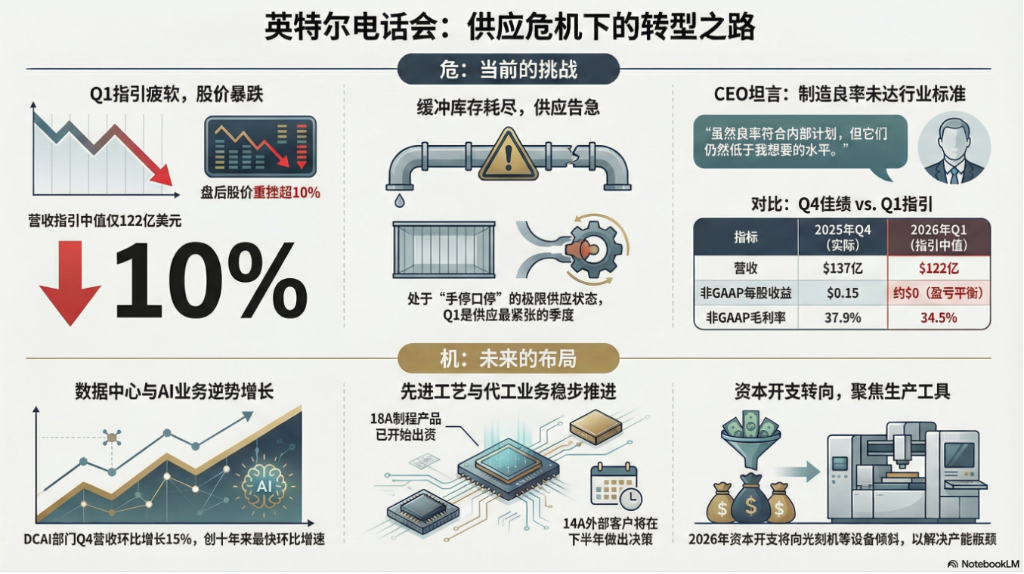
Core Insights - Intel's Q4 performance exceeded expectations, but weak Q1 guidance led to a significant stock drop, with CEO expressing disappointment over unmet market demand [1][6][8] - Despite strong AI demand, Intel faces severe supply bottlenecks, with depleted buffer inventory and manufacturing yields not meeting internal standards [1][3][8] Financial Performance - Q4 revenue reached $13.7 billion, with a non-GAAP gross margin of 37.9% and non-GAAP EPS of $0.15; Q1 revenue guidance is set at $11.7 to $12.7 billion, with a midpoint of $12.2 billion [16][34][41] - DCAI (Data Center and AI) revenue grew 15% quarter-over-quarter, but supply constraints prevented capturing higher potential revenue [4][12][38] Supply Chain and Inventory Issues - The company acknowledged that buffer inventory has been exhausted, leading to a "hand to mouth" operational state, particularly in Q1 [8][9][12] - Manufacturing yield improvements of 7%-8% per month are ongoing, but still below industry-leading levels, with a focus on optimizing yields by 2026 [3][9][19] Strategic Focus and Business Development - Intel is prioritizing high-margin data center business over client computing, with DCAI revenue showing the fastest growth in a decade [12][38] - The company is committed to enhancing its foundry business, with expectations for customer orders for the 14A process to materialize in late 2026 or early 2027 [14][15][40] AI and CPU Role - Management emphasized the underestimated role of CPUs in the AI era, highlighting their critical function in workload orchestration and control [11][12][29] - The shift towards "mixed AI" architectures necessitates robust CPU capabilities, driving demand for traditional server upgrades [11][12][29] Capital Expenditure and Future Outlook - Capital expenditures for 2026 are expected to remain flat or slightly decrease, with a shift towards spending on manufacturing tools rather than facility construction [15][44] - The company anticipates gradual supply improvements starting in Q2 2026, with a focus on meeting the strong demand in the data center and AI sectors [22][42]

英特尔电话会:CPU需求激增却有单无货!CEO坦言库存耗尽且良率未达标,“我很失望无法满足需求”
Hua Er Jie Jian Wen· 2026-01-23 01:29
Core Insights - Intel reported mixed Q4 results, exceeding Wall Street expectations for revenue and profit, but provided disappointing guidance for Q1 2026 due to manufacturing yield issues and depleted inventory, leading to a stock drop of over 10% in after-hours trading [3][4][5] - CEO Pat Gelsinger expressed disappointment over the inability to meet market demand, highlighting that while semiconductor demand is unprecedented in the AI era, manufacturing yields are below desired levels [3][7] - Despite short-term challenges, Intel emphasized its long-term transformation is on track, particularly with the launch of the Core Ultra Series 3 based on the advanced 18A process and a strong recovery in the data center business [3][4][10] Financial Performance - In Q4, Intel achieved revenue of $13.7 billion, at the high end of prior guidance, with a non-GAAP EPS of $0.15, significantly above the expected $0.08 [4][29] - For Q1, Intel expects revenue between $11.7 billion and $12.7 billion, with a midpoint of $12.2 billion, indicating a decline from seasonal norms, and a non-GAAP gross margin forecasted to drop to 34.5% [4][36] - The company reported a Q4 operating cash flow of $4.3 billion and total capital expenditures of $4 billion, with adjusted free cash flow of $2.2 billion [29][30] Supply Chain and Inventory Issues - Intel acknowledged that its buffer inventory has been depleted, leading to a "hand to mouth" supply situation, particularly in Q1, which is expected to be the tightest quarter for supply [5][7] - The transition of wafer production towards server products began in Q3 but will not yield results until later in Q1, exacerbating supply constraints [7][36] - Manufacturing yield improvements are critical for addressing supply limitations, with current yields meeting internal plans but still below industry standards [7][8][12] AI and Data Center Strategy - Intel's management emphasized the underestimated role of CPUs in the AI era, stating that diverse AI workloads are creating significant capacity constraints, reinforcing the CPU's central role [9][10] - The DCAI (Data Center and AI) segment saw a 15% sequential revenue increase in Q4, but supply shortages prevented capturing even higher revenue [10][33] - The company is prioritizing high-margin data center business over client computing, with DCAI revenue reaching $4.7 billion in Q4, while client computing revenue declined by 4% [10][32] Future Outlook and Capital Expenditure - Intel plans to maintain or slightly reduce capital expenditures in 2026, focusing spending on wafer manufacturing tools rather than facility construction to address immediate capacity shortages [12][13] - The company expects external foundry customers to begin making firm supplier decisions in the second half of 2026, with significant advancements in the 14A process anticipated [12][36] - Intel's long-term goal is to establish a world-class foundry business, with early milestones achieved in advanced packaging and process technology [12][24]
博通上调一季度营收展望,预计当季AI芯片收入翻倍至82亿美元
Di Yi Cai Jing· 2025-12-12 00:00
Core Insights - Broadcom reported Q4 earnings with revenue of $18.02 billion, exceeding market expectations of $17.49 billion [1] - Non-GAAP EPS was approximately $1.95, also above the expected $1.87 [1] - Semiconductor revenue reached about $11.1 billion, with AI chip contributions surpassing 50% for the first time, showing a year-over-year growth of approximately 74% [1] - Infrastructure software revenue grew by about 17%, primarily driven by VMware business [1] - The company raised its Q1 FY2026 outlook, projecting revenue of approximately $19.1 billion, significantly above the market expectation of $18.27 billion [1] - AI semiconductor revenue is expected to double year-over-year to $8.2 billion, driven by strong demand for custom ASICs and high-speed networking chips [1] - CEO Hock Tan indicated that demand for AI semiconductors will continue to strengthen in the coming quarters [1] - Following the announcement, Broadcom's stock initially rose but later fell nearly 5% [1]
OpenAI再出手!博通盘中涨超10%,双方达成AI芯片合作
Di Yi Cai Jing· 2025-10-13 14:52
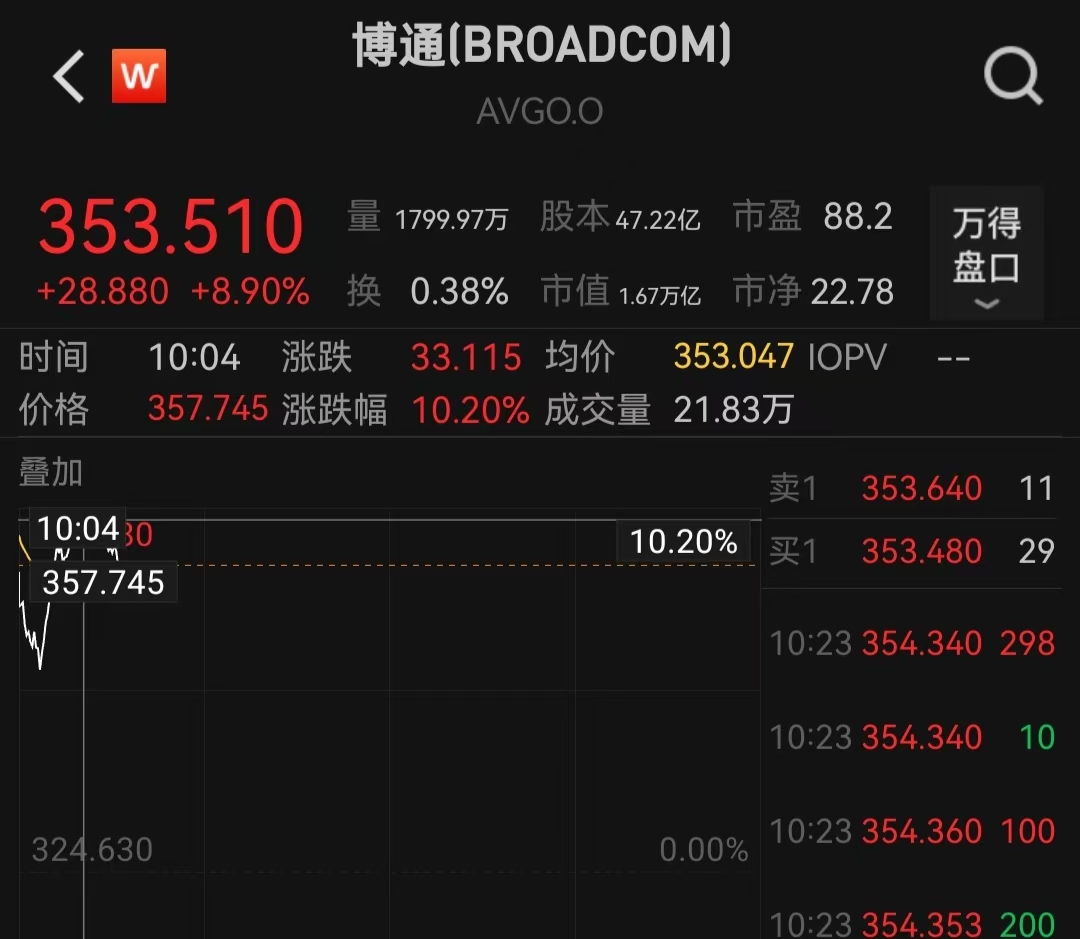
Core Insights - OpenAI has formed partnerships with multiple companies to secure its AI computing power, including a recent collaboration with Broadcom to develop a 10-gigawatt custom AI accelerator [1][2] - The total computing power from OpenAI's collaborations with Broadcom, AMD, and NVIDIA amounts to 26 gigawatts [1] - OpenAI's CEO emphasized the strategic importance of massive investments in infrastructure to achieve the company's mission of building powerful AI systems [3] Group 1: Partnerships and Collaborations - OpenAI and Broadcom will work together to create a custom AI accelerator, with deployment expected to start in the second half of 2026 and complete by the end of 2029 [1][2] - Earlier this month, OpenAI partnered with AMD to deploy 6 gigawatts of AMD GPUs, and in September, it collaborated with NVIDIA for at least 10 gigawatts of AI data center support [1] - Broadcom's CEO hinted at a significant new customer order exceeding $10 billion for AI chips, which was speculated to be OpenAI [2] Group 2: Technological Developments - The collaboration with Broadcom will integrate custom accelerators with Ethernet solutions, enhancing the next-generation AI infrastructure's cost and performance [2] - OpenAI's strategy includes developing its own AI chips in collaboration with Broadcom, diversifying its computing power sources beyond just NVIDIA and AMD [3] - OpenAI is also working with storage chip manufacturers like Samsung and SK Hynix to ensure the supply of high-bandwidth memory (HBM) for its infrastructure [4] Group 3: Financial Implications - The agreement with AMD includes warrants for up to 160 million shares at a price of $0.01 each, while NVIDIA plans to invest up to $100 billion in OpenAI [4] - OpenAI's partnerships are expected to significantly improve Broadcom's AI revenue in the fiscal year 2026 [2]
万芯大战
小熊跑的快· 2025-09-15 00:32
Group 1 - The core viewpoint is that after three years, the competition in the model arena has not escalated as expected, and the models have started to converge, indicating that the first round of eliminations globally has concluded [1] Group 2 - Currently, the industry is experiencing a "battle of chips," with various companies involved in the production of general-purpose GPUs, including Nvidia, AMD, and others, as well as ASICs from companies like Google, Meta, ByteDance, OpenAI, AWS, Microsoft, Alibaba, and Baidu [2] Group 3 - In the domestic market, there are still dozens of well-known and lesser-known companies producing general-purpose GPUs and custom ASICs, with TSMC being highlighted as the best in this space [3]

迈威尔科技:再给AI“泼冷水”,ASIC拉响了警报
美股研究社· 2025-03-06 10:32
Overall Performance - Marvell Technology reported Q4 FY2025 revenue of $1.82 billion, a year-over-year increase of 27.4%, meeting market expectations [4][12] - The company achieved a net profit of $200 million, marking a return to profitability, with adjusted operating income reaching $390 million, up from $216 million in the previous quarter [4][16] Business Segments - Data center business is the largest growth driver, accounting for over 70% of total revenue, with Q4 revenue of $1.366 billion, a year-over-year increase of 78.5% [4][10] - AI-related revenue within the data center segment is estimated at approximately $700 million, driven by demand for custom ASICs from clients like Amazon [4][17] - Enterprise networking and carrier infrastructure segments showed signs of recovery, with revenues of $171 million and $106 million, respectively, both experiencing quarter-over-quarter growth [4][20][22] Future Guidance - For Q1 FY2026, Marvell expects revenue of around $1.88 billion, slightly above market expectations [5] - The company anticipates a GAAP gross margin of 50.5% for the upcoming quarter, indicating a stable outlook [5] AI Business Concerns - Market concerns regarding the growth potential of Marvell's AI business have intensified, particularly in light of the company's guidance for a slowdown in AI revenue growth in the next quarter [7][8] - Despite reaffirming a forecast of over $2.5 billion in AI revenue for FY2026, market expectations have risen to around $3.5 billion, creating a potential disconnect [8] Cost Structure - Operating expenses for Q4 FY2025 were $682 million, with R&D expenses at $499 million, reflecting an 8.6% year-over-year increase [14] - Selling and administrative expenses decreased by 7.7% year-over-year, benefiting from revenue growth [14]