定海号盾构机

Search documents
民企定制装备突破施工极限 助力超级工程啃下“硬骨头”
Yang Shi Xin Wen Ke Hu Duan· 2026-02-04 01:30
Core Viewpoint - The news highlights the significant role of private enterprises in the construction of the Ningbo-Zhoushan Railway's underwater tunnel, emphasizing their contributions to innovation and technology in overcoming engineering challenges [1][5]. Group 1: Project Overview - The Ningbo-Zhoushan Railway's underwater tunnel is the world's longest and largest diameter underwater high-speed rail tunnel, set to end the historical lack of railway access in Zhoushan [1]. - Nearly 300 companies are involved in the construction, with over 90% being private enterprises, including national-level specialized "little giant" companies [1]. Group 2: Engineering Challenges - The project faces unprecedented challenges, particularly in the first 5,000 meters of soft soil, which is highly permeable and loose, making it difficult to avoid risks like water ingress and collapse [2]. - The construction goal is to achieve 5.4 kilometers of continuous tunneling without changing the cutting tools, a first in domestic soft soil underwater tunnel construction [2]. Group 3: Technological Innovations - Private enterprises have developed specialized equipment to meet the extreme conditions of the project, including a new transport vehicle capable of navigating a 9% incline, surpassing the traditional 8% limit [3]. - The cutting tools used in the shield machines have been enhanced through private sector innovation, achieving a welding strength of over 240 MPa, allowing them to withstand significant stress [2]. Group 4: Precision and Quality Control - Private companies are responsible for critical components such as the rubber sealing rings, which must endure a water pressure of 2.5 MPa, ensuring the tunnel's longevity and safety [4]. - An intelligent assembly robot developed by a private enterprise has improved the precision of box culvert assembly from centimeter-level to millimeter-level, enhancing construction accuracy [4]. Group 5: Collaborative Efforts - The project exemplifies the collaboration between state-owned and private enterprises, with private companies playing a crucial role in supporting national infrastructure projects through innovation and technology [5].
穿越机视角带你感受世界最长海底高铁隧道建设
Xin Hua Wang· 2026-01-13 09:07
Core Viewpoint - The Yongzhou Railway's Jintang Undersea Tunnel, spanning 16.18 kilometers, is set to become the world's longest undersea high-speed rail tunnel, with completion expected in 2026 [1] Group 1 - The tunnel starts from Beilun District in Ningbo, Zhejiang Province, and ends at Jintang Town in Zhoushan City [1] - It utilizes two large-diameter shield machines, named "Dinghai" and "Yongzhou," which will commence excavation from both ends simultaneously [1] - The project aims to achieve high-precision alignment in complex underwater geological conditions [1]
世界最长海底高铁隧道建设取得重大突破
Zhong Guo Xin Wen Wang· 2025-11-28 13:48
Core Insights - The construction of the world's longest underwater high-speed rail tunnel has achieved a significant milestone with the "Dinghai" shield machine surpassing 5,000 meters of excavation, marking approximately 80% completion of the Zhoushan side of the tunnel, which is 6,270 meters long [1][3] Group 1: Project Overview - The Jintang Underwater Tunnel is a key project of the Ningbo-Zhoushan Railway, spanning 16.18 kilometers, with the shield section measuring 11.21 kilometers [3] - Two large-diameter shield machines, "Dinghai" and "Yongzhou," are being used for excavation from both sides, facing complex geological conditions including high water pressure and various soil types [3] Group 2: Construction Challenges - The geological conditions are extremely complex, requiring the shield section to navigate through hard rock, clay, and sandy layers, presenting multiple challenges such as high intensity, high water pressure, and high precision [3] - The construction team has implemented measures such as enhanced tail seal management, optimized excavation parameters, and real-time monitoring to control ground disturbance and ensure safety [3] Group 3: Future Plans - The "Dinghai" shield machine is set to continue its progress towards the seabed connection point, with the "Yongzhou" shield machine also advancing steadily [5] - The project is expected to achieve a successful underwater connection by October 2026, with the Ningbo-Zhoushan Railway projected to be operational by 2028, integrating Zhoushan into the national railway network [5]


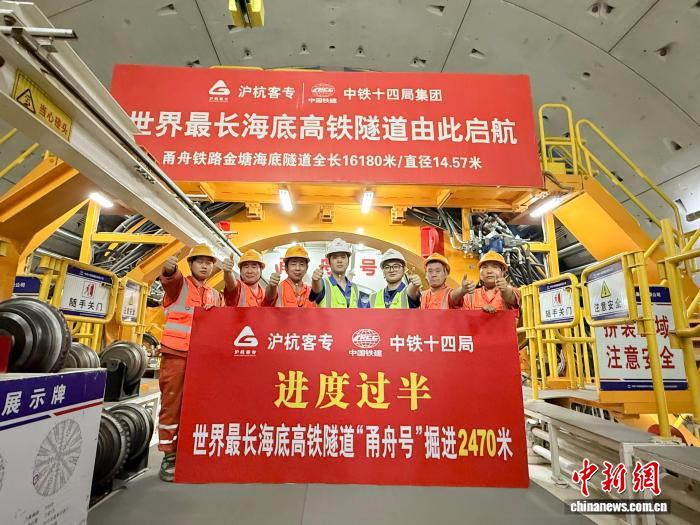
世界最长海底高铁隧道新进展:“甬舟号”盾构机掘进过半
Zhong Guo Xin Wen Wang· 2025-09-22 09:05
Core Insights - The "Yongzhou" shield machine has achieved over half of its tunneling progress for the world's longest underwater high-speed rail tunnel, marking a significant milestone in the construction of the Ningbo-Zhoushan railway [1][3]. Group 1: Project Overview - The Jintang underwater tunnel is a key project of the Yongzhou railway, stretching 16.18 kilometers, with the shield section measuring 11.21 kilometers [3]. - The tunnel employs two shield machines, "Yongzhou" and "Dinghai," which are advancing simultaneously from both Ningbo and Zhoushan sides [3]. Group 2: Technical Challenges - The geological conditions along the Jintang underwater tunnel are extremely complex, requiring the crossing of various risk sources such as sea dikes, docks, and shipping lanes [4]. - The maximum depth of the underwater section reaches 78 meters, with a maximum water pressure of 8.4 bar, equivalent to nearly 1 ton of weight on an adult's palm [4]. - The Ningbo side has experienced frequent geological changes, necessitating high-pressure tool changes, with the "Yongzhou" machine completing 12 geological transitions and changing tools over 2400 times [4]. Group 3: Strategic Importance - The Yongzhou railway is a major project in China's Medium- and Long-term Railway Network Plan (2016-2030), with a total length of 76.4 kilometers and a design speed of 250 kilometers per hour [4]. - Once operational, the project will connect Zhoushan, the only city in the Yangtze River Delta without a railway, to the national railway network, significantly enhancing regional integration and development [4].