宝宝巴士儿歌App

Search documents
获利3元,罚款30万!宝宝巴士因“三女侍一夫”被处罚,还有离谱操作?
新浪财经· 2026-03-18 10:07
Core Viewpoint - BabyBus (Fujian) Network Technology Co., Ltd. faced significant backlash and a fine of 300,000 yuan due to the release of inappropriate advertisements, highlighting ongoing content safety issues within the company [5][7]. Group 1: Incident Overview - The controversy began when BabyBus was reported for displaying vulgar ads, including one that stated "three women serve one husband, with a monthly living expense of 500,000 yuan," which was deemed unsuitable for children [5][7]. - The company was fined 300,000 yuan and had illegal earnings of 3.68 yuan confiscated by the Fuzhou Market Supervision Administration [7][8]. Group 2: Company Background - BabyBus was established in February 2013 and is fully owned by BabyBus Co., Ltd. It has received significant investments from notable firms, including Xiaomi's Shunwei Capital and TAL Education Group [5][18]. - The company has developed over 200 apps and serves 800 million families globally, distributing content in more than 160 countries and regions [17][18]. Group 3: Financial Performance - BabyBus reported revenues of 254 million yuan, 526 million yuan, and 649 million yuan for the years 2018, 2019, and 2020, respectively, with growth rates of 107.09% and 23.38% in 2019 and 2020 [20]. - The company's primary revenue sources are advertising income from free app usage and content licensing, which together account for over 90% of total revenue [20][21]. Group 4: Content Safety Issues - BabyBus has faced multiple content safety controversies, including a previous incident involving a safety-themed children's book that contained potentially dangerous lyrics [10][12]. - Parents have raised concerns about inaccurate pronunciations in educational products and the potential for negative behavioral influences from the content [15][21]. Group 5: IPO and Investment Challenges - BabyBus attempted to go public in 2021 but withdrew its IPO application in June 2022, marking a significant setback for the company [21]. - The exit of major investors like Shunwei Capital and TAL Education Group has raised questions about the company's future and financial stability [19][21].

展示“三女共侍一夫”等内容,宝宝巴士被罚30万、没收违法所得3.68元
21世纪经济报道· 2026-03-17 07:59
Core Viewpoint - The article discusses the recent penalty imposed on "BabyBus," a well-known children's digital content brand, for displaying inappropriate advertisements in its children's app, highlighting the challenges of balancing commercial interests with child protection [1][7]. Group 1: Incident Overview - BabyBus was fined 300,000 yuan and had illegal earnings of 3.68 yuan confiscated due to displaying vulgar advertisements in its children's app, which sparked protests from parents last year [1]. - The incident was triggered by a specific advertisement that included explicit content, which was not properly reviewed by BabyBus staff before being displayed [1][3]. Group 2: Legal and Regulatory Context - The release of such lowbrow advertisements is considered a violation of the Advertising Law of the People's Republic of China, which prohibits obscene and pornographic content [3][4]. - Legal experts emphasize that platforms have a statutory obligation to review the content of advertisements and should proactively prevent the publication of non-compliant ads [4]. Group 3: Business Model Implications - The incident raises questions about BabyBus's reliance on advertising for revenue generation and the need for improved content safety measures to protect children [7]. - The company is reportedly working on enhancing its advertising review processes and implementing mechanisms to block inappropriate content, which is essential for maintaining trust with its audience [7].

展示“三女共侍一夫”等内容,宝宝巴士被罚30万、没收违法所得3.68元
第一财经· 2026-03-17 07:10
Core Viewpoint - The article discusses the recent administrative penalty imposed on "BabyBus" for displaying inappropriate advertisements in its children's app, marking a significant response to public outcry regarding adult content in children's applications [3][5]. Company Overview - BabyBus (Fujian) Network Technology Co., Ltd. was established in February 2013, with a registered capital of 44.9 million RMB. The company is fully owned by BabyBus Co., Ltd. and operates in the fields of animation game development and digital cultural creative software development [3][4]. Administrative Penalty - The company was fined 300,000 RMB and had illegal gains of 3.68 RMB confiscated by the Fuzhou Market Supervision Administration for displaying vulgar advertisements that contradict social morals in its app [3][5]. - The penalty is a formal conclusion to the controversy that arose last year when parents protested against adult advertisements appearing in children's apps [3]. Incident Details - In March 2025, BabyBus signed a service agreement with a Shenzhen-based information technology company to integrate its advertising resources into the app. However, the company failed to review the content of the ads pushed by the partner, leading to the display of inappropriate adult content in the children's app [5].

宝宝巴士擦边广告背后隐形的第三方
Bei Jing Shang Bao· 2025-11-03 13:33
Core Viewpoint - The incident involving "BabyBus" highlights the complex interplay of interests among users, platforms, and advertisers within the advertising ecosystem, revealing regulatory gaps and the potential risks associated with third-party advertising in children's content apps [1][7][12] Group 1: Incident Overview - "BabyBus" faced public backlash after a third-party advertisement for inappropriate content appeared on its "BabyBus Nursery Rhymes" app, raising concerns about the safety of children's digital environments [1][7] - The company acknowledged the issue, stating that the appearance of such ads was an "abnormal situation" and committed to conducting a thorough self-examination and rectification [7][12] Group 2: Revenue Structure - "BabyBus" generates a significant portion of its revenue from advertising partnerships, with 2020 figures showing that app promotion revenue reached 4.98 billion yuan, accounting for 76.76% of total income [7] - The company's top five advertising clients include major players like Baidu, Google, and Tencent, with these clients contributing to over 88% of total revenue from 2018 to 2020 [7] Group 3: Advertising Ecosystem - The advertising model employed by "BabyBus" involves a mix of direct and third-party ad placements, with many apps relying on advertising alliances for revenue generation [9][10] - These advertising alliances act as intermediaries, providing standardized SDKs that facilitate the integration of various advertisements into apps, which can lead to a lack of content control and oversight [10][12] Group 4: Regulatory and Responsibility Issues - The incident underscores the need for clearer regulatory frameworks and accountability among platforms, advertisers, and third-party services to prevent the dissemination of inappropriate content [11][12] - Legal experts emphasize that application platforms should assume primary responsibility for the content they host, as reliance on third-party services can lead to lapses in content oversight [11]
宝宝巴士“低俗广告”牵出背后利益链条!超七成收入来自App广告
Bei Jing Shang Bao· 2025-11-03 12:20
Core Viewpoint - The recent controversy surrounding "BabyBus" highlights the complexities of the advertising ecosystem in children's educational apps, where inappropriate ads have raised concerns about content safety and regulatory gaps [2][10]. Revenue Structure - In 2020, BabyBus generated 1.3 billion yuan from audio and video licensing, accounting for 20.04% of its revenue, while app promotion income reached 4.98 billion yuan, making up 76.76% [1][7]. - The top five advertising clients for BabyBus include major companies like Baidu, Google, Tencent, and ByteDance, with their contributions to total revenue remaining consistently high from 2018 to 2020 [7]. Advertising Issues - BabyBus acknowledged the presence of inappropriate ads in its app, attributing it to potential oversights in their review process and has since taken steps to remove such ads and improve their advertising oversight [3][5]. - The reliance on third-party advertising platforms has led to a lack of control over ad content, resulting in the potential for low-quality or inappropriate ads to appear [9][11]. Regulatory and Responsibility Concerns - The incident has raised questions about the responsibilities of app platforms in ensuring ad content is appropriate, with calls for clearer accountability in the advertising review process [10]. - Experts suggest that the current regulatory framework needs to be strengthened to ensure that all parties involved in the advertising chain are held accountable for the content displayed [10][11].
研发广告强制拦截功能、全面叫停开屏广告合作,独家对话宝宝巴士
Xin Jing Bao· 2025-10-29 14:33
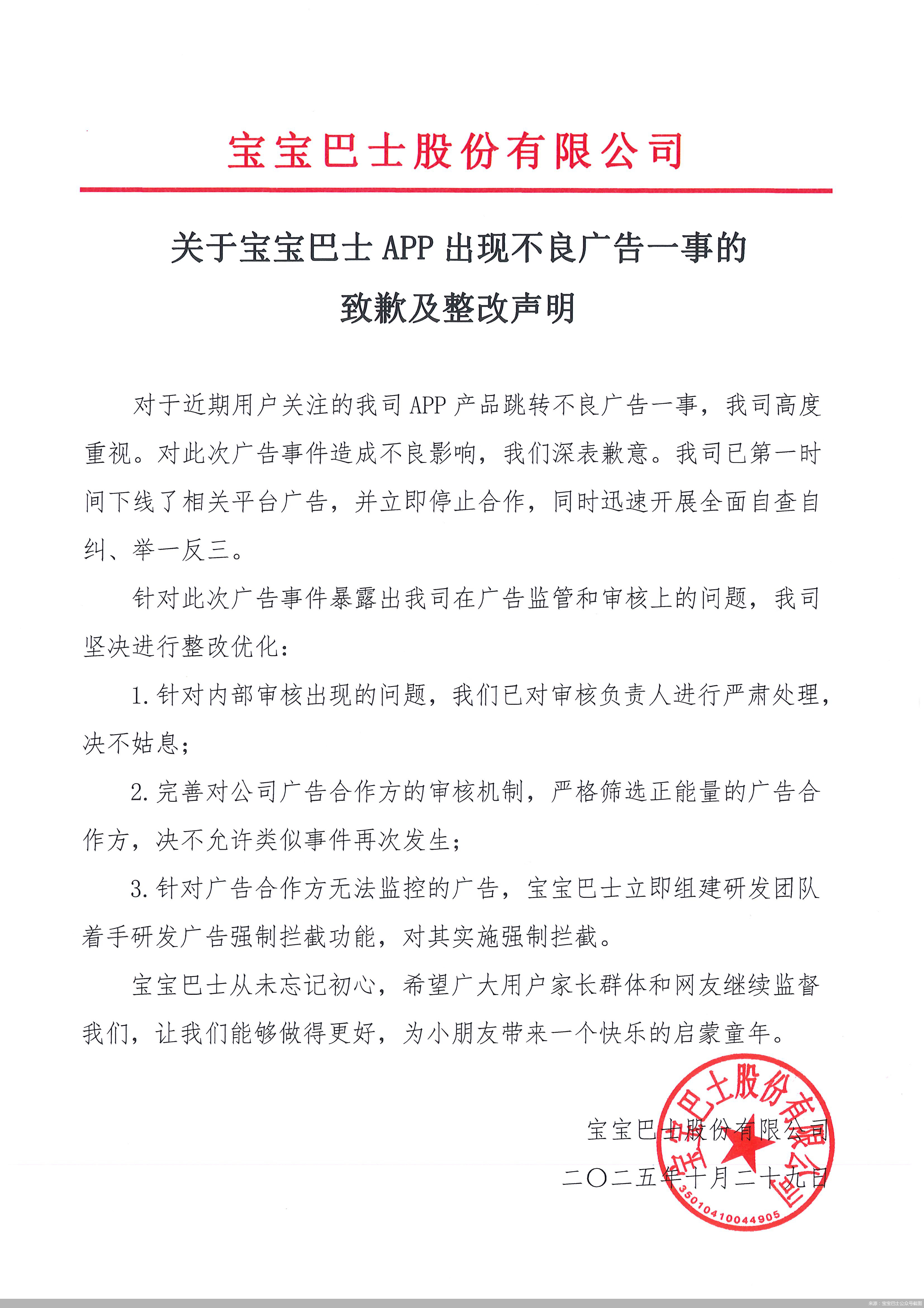
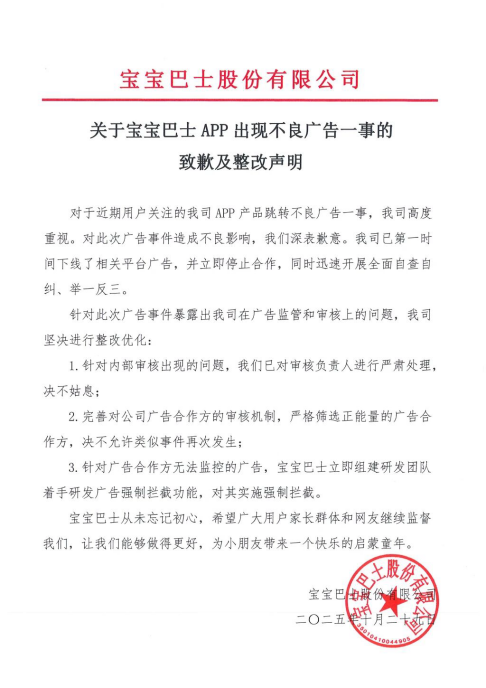
Core Viewpoint - The children's digital product brand BabyBus is facing public backlash due to inappropriate adult content appearing in ads on its children's song app, prompting the company to issue an apology and announce corrective measures [1][2][3]. Company Response - BabyBus has acknowledged the issue and expressed sincere apologies, stating that it has taken immediate action by removing the problematic ads and halting partnerships with the involved advertising platforms [2][5][9]. - The company has committed to a thorough internal review and has taken disciplinary action against the responsible personnel [3][9]. Advertising Regulation and Future Measures - BabyBus plans to implement three key corrective actions: addressing internal review failures, enhancing the vetting process for advertising partners, and developing a mandatory ad interception feature to prevent inappropriate content from being displayed [3][11]. - The company has already begun upgrading its ad screening mechanisms and strategies to prevent similar incidents in the future [5][11]. Legal and Regulatory Context - The incident has raised concerns regarding compliance with the Minor Protection Law and Advertising Law in China, as the inappropriate ads violate regulations aimed at protecting minors [6][7]. - Legal experts suggest that regulatory bodies should improve ad review mechanisms and investigate the advertising platforms used by children's apps to ensure compliance with legal standards [6][7]. Industry Implications - The incident highlights a broader issue within the children's app industry regarding the risks associated with integrating third-party advertising platforms, which may compromise child safety [8][14]. - BabyBus has called for national-level governance to address these industry-wide challenges, suggesting either a ban on children's apps connecting to third-party ad platforms or the development of specialized advertising solutions for children's products [14][15].
超七成收入来自广告,宝宝巴士为不良广告致歉
2 1 Shi Ji Jing Ji Bao Dao· 2025-10-29 11:44
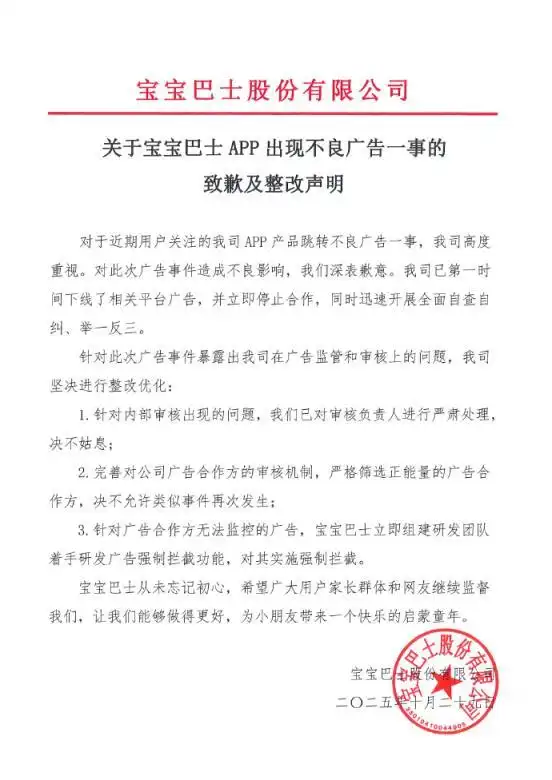
Core Points - The "BabyBus Nursery Rhymes" app has been reported for displaying inappropriate ads that redirect to vulgar live-streaming content or pornographic video ads, raising concerns among parents and sparking public debate [1] - BabyBus acknowledged the issue, stating that the problematic ads were from a third-party platform and expressed sincere apologies for the negative impact on user experience [1] - The company announced corrective measures, including removing the related ads, terminating partnerships, taking serious action against the responsible personnel, improving the ad review mechanism, and developing a mandatory interception feature [1] Company Overview - Founded in 2009, BabyBus focuses on providing digital content for children aged 0-8, primarily developing, producing, and operating audio-visual products and apps [3] - The company attempted an IPO on the ChiNext board in July 2021, which was later terminated by the Shenzhen Stock Exchange [3] - Advertising is the main revenue source for BabyBus, accounting for over 70% of its total revenue [3] Financial Performance - BabyBus's revenue from 2018 to 2020 was reported as follows: 2018: 254 million yuan, 2019: 526 million yuan, 2020: 649 million yuan [3] - Revenue from app cooperation and promotion was 185 million yuan in 2018, 383 million yuan in 2019, and 498 million yuan in 2020, representing 72.7%, 72.87%, and 76.76% of total revenue respectively [3] - The company heavily relies on major advertising clients, with approximately half of its annual revenue coming from Baidu, which contributed 50.74% of total revenue in 2020 [3] Legal Issues - BabyBus has faced multiple lawsuits related to copyright ownership and infringement disputes, including cases involving the infringement of online dissemination rights [4] - Specific cases include disputes with Moonlight Entertainment Co., Ltd. and others, with various stages of legal proceedings noted [4]
宝宝巴士儿歌的“车厢”里,不该有低俗广告身影
Xin Jing Bao· 2025-10-29 09:30
Core Viewpoint - The incident involving inappropriate advertisements on the "BabyBus Nursery Rhymes" app has raised significant public concern regarding the safety of children's online environments and the responsibilities of app providers [1][2]. Group 1: Incident Overview - Users reported that the "BabyBus Nursery Rhymes" app displayed inappropriate third-party advertisements during startup, which are unsuitable for children [1]. - BabyBus acknowledged the issue, attributing the problem to third-party ad integration, and expressed sincere apologies for the negative impact on user experience [1]. Group 2: Industry Implications - The incident highlights a broader issue within the children's educational app sector, where advertising has become a crucial revenue model, often at the expense of content appropriateness [1]. - There is a growing concern that some platforms prioritize monetization over the safety and well-being of children, allowing inappropriate content to infiltrate children's digital spaces [1]. Group 3: Regulatory and Corporate Responsibilities - Existing laws, such as the Minor Protection Law and the Online Protection Regulations, mandate that children's apps must effectively identify harmful content and protect minors' personal information [2]. - Companies should not only market their products as "children-specific" but also implement higher content standards and stricter management practices, including a dedicated review mechanism for children's advertisements [2]. - Regulatory bodies are encouraged to establish clearer advertising guidelines for children's apps and enhance enforcement to hold non-compliant companies accountable [2]. Group 4: Community Involvement - Establishing convenient reporting channels for parents and the community is essential to encourage collective supervision of children's digital environments [3]. - The digital world for children should not be a "lawless" space driven by commercial interests, as every interaction shapes their values and worldview [3].
宝宝巴士道歉!宝宝巴士怎能坑宝宝!
新华网财经· 2025-10-29 08:37
Core Viewpoint - The company has issued an apology and announced corrective measures regarding inappropriate advertisements appearing on its app, emphasizing the importance of maintaining a safe environment for children [4][11]. Summary by Sections Apology and Immediate Actions - The company has promptly taken down the problematic advertisements and ceased collaboration with the advertising partners involved [4][9]. - A thorough internal review and self-correction process has been initiated to address the issues raised by users [4]. Internal Review and Accountability - The company has taken serious action against the responsible personnel in the internal review process, ensuring accountability [4][11]. - There is a commitment to enhance the review mechanism for advertising partners, focusing on selecting positive and appropriate content [4][11]. Development of New Features - A dedicated research and development team has been formed to create a mandatory ad-blocking feature to prevent similar incidents in the future [4][11]. Industry Implications - This incident serves as a reminder for all digital content providers about the necessity of maintaining a clean and safe online environment, especially for children [12].

刚刚,宝宝巴士正式道歉!年收入曾超6亿,创始人称“商务薄弱”
新浪财经· 2025-10-29 06:27
Core Viewpoint - The article discusses the recent controversy surrounding the BabyBus app, particularly regarding inappropriate advertisements targeting children, and highlights the company's ongoing issues with intellectual property disputes and its reliance on advertising revenue. Group 1: Advertisement Controversy - BabyBus issued an apology and announced corrective measures after complaints about inappropriate ads on its "BabyBus Nursery Rhymes" app, which included adult content and misleading links [2][4][8] - The company has taken immediate action by removing the problematic ads, halting partnerships, and implementing a self-audit process [2][8] - The incident has sparked outrage among parents, leading to significant media attention and discussions about the app's content [4][10] Group 2: Intellectual Property Issues - BabyBus has faced multiple intellectual property disputes, including a significant ruling in the U.S. where it was ordered to pay approximately $23.4 million (around 167 million RMB) for copyright infringement against the children's channel CoComelon [14] - The company has been involved in various copyright-related lawsuits, indicating a pattern of legal challenges that could impact its brand reputation and financial stability [13][14] Group 3: Business Model and Revenue Dependence - The company's revenue model heavily relies on advertising, with over 70% of its income coming from app advertising and content licensing, which has raised concerns about the appropriateness of the ads shown to children [11][18] - BabyBus's founder acknowledged the weaknesses in the company's business strategy, particularly the over-reliance on advertising revenue, which has led to the current controversies [18][19] - Analysts criticize the business model as being misaligned with the needs of its target audience, suggesting that the focus on ad revenue compromises the quality and safety of the content provided to children [19]