实践三十二号卫星

Search documents
对商业航天产业发展给予更多耐心
Zheng Quan Ri Bao· 2026-01-19 16:12
Core Viewpoint - The recent failures in the aerospace sector highlight the critical challenges that commercial space development must overcome for high-quality growth [2] Group 1: Technical Challenges - The need to respect technology and accept trial-and-error costs is emphasized, as technological innovation is rarely straightforward [3] - The failure of the Gushenxing-2 rocket, a medium-sized solid launch vehicle, reflects the objective development trajectory of China's commercial aerospace moving from technology validation to maturity [3] - The failure of the Long March 3B rocket serves as a reminder of the inherent risks present throughout the lifecycle of complex aerospace systems [3] Group 2: Systemic Capacity Building - The commercial aerospace sector in China is entering a high-density launch phase, but reliable, low-cost, and high-frequency launch capacity has not yet been fully established [4] - By 2026, commercial space launch activities are expected to become more active, with several private rockets set for their inaugural flights [4] - Overcoming capacity bottlenecks requires not only increasing launch frequency but also enhancing systemic capabilities, including the development of reusable rockets and large thrust engines [5] - Improvements in rocket manufacturing and delivery efficiency through standardization and scaling are necessary to support higher-density mission sequences [5] Group 3: Learning from Failures - The complexity of commercial aerospace development means that setbacks are often part of the process, necessitating a rational approach to launch failures and a focus on troubleshooting progress [6] - China's commercial aerospace industry benefits from a rigorous "zeroing" mechanism that allows for systematic fault diagnosis and accelerated technological iteration [6] - The parallel exploration of diverse technological routes creates a risk-diversification and technology-complementation framework, potentially shortening the technology maturation cycle [6] - Long-term healthy development of the commercial aerospace sector requires patient capital support, focusing on companies with core technological strengths and clear business paths [6]
一天两失利!国家队和民营航天双双遇挫!股民最担心的事来了
Xin Lang Cai Jing· 2026-01-18 02:41
Core Viewpoint - The recent failures of two rocket launches in China have cast a shadow over the commercial aerospace sector, raising concerns among investors and market participants about the stability and maturity of the technology involved [1][3][12]. Group 1: Launch Failures - On January 17, China experienced two significant launch failures within hours: the Long March 3B rocket carrying the Shijian-32 satellite and the private company Starry Sky's Gushenxing-2 rocket, both of which encountered flight anomalies [3][14]. - The Long March 3B rocket had a historical success rate of 110 out of 115 launches, making this failure particularly notable as it breaks a streak of successful launches [3][14]. - The Gushenxing-2 rocket was designed for the small satellite constellation market and its failure represents a significant setback for Starry Sky, which had previously achieved a high success rate with its Gushenxing-1 rocket [5][19]. Group 2: Impact on Starry Sky - Starry Sky is currently in a critical phase as it approaches its IPO, having completed a 2.4 billion yuan Series D financing round in September 2025, with a valuation of 15 billion yuan [7][19]. - The company had successfully launched four satellites just a day before the failure, which had set a positive tone for its upcoming IPO process [19]. - The recent failure may undermine investor confidence and regulatory perceptions regarding the company's technological maturity and operational stability, especially in the context of recent volatility in the A-share commercial aerospace sector [8][19]. Group 3: Industry Context - The global failure rate for new rocket launches is estimated to be between 30% and 50%, with established companies like SpaceX and Rocket Lab having experienced similar setbacks [10][21]. - The aerospace industry is characterized by high risks, and the ability to learn from failures is crucial for future success [10][21]. - China plans to advance multiple reusable rocket launches in 2026, indicating ongoing efforts to develop a reliable and cost-effective space transportation system [10][21].

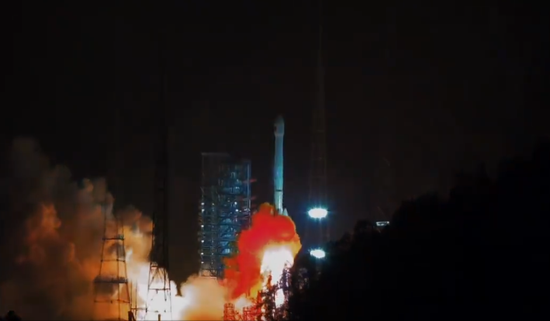
一天两次火箭发射失利,一个三级出问题,一个一级出问题!咋回事?
Xin Lang Cai Jing· 2026-01-17 10:42
Core Viewpoint - On January 17, 2026, China's aerospace sector experienced a rare "double failure" event, with the Long March 3B rocket and the private commercial rocket Gushenxing 2 both encountering flight anomalies on the same day [1][17]. Group 1: National Team (Long March 3B) - The Long March 3B rocket, a veteran in China's Long March series, faced an unexpected failure during the launch of the Practice 32 satellite, which is typically a routine mission [3][19]. - The failure was not a complete loss of control; the first two stages of the rocket operated normally, with issues arising in the third stage [3][19]. - As a mature model, the Long March 3B's design has been validated over time, suggesting that the failure is likely due to a single component fault or minor assembly deviation rather than a systemic issue [5][21]. Group 2: Private Sector (Gushenxing 2) - The Gushenxing 2 rocket's situation is unique as it was its first flight test, and it is designed to carry a payload of 1.6 tons to a 500 km low Earth orbit, emphasizing low cost and quick response [9][25]. - The failure of Gushenxing 2 may be linked to issues with the first stage rocket, likely involving the engine or control systems [12][28]. - The challenges faced by the private sector highlight the common issues of balancing high-frequency launch demands with quality management, as rapid production and testing cycles can lead to errors [11][27]. Group 3: Industry Insights - The dual failures underscore the inherent risks in aerospace, where even minor errors can lead to significant consequences, reflecting the industry's ongoing challenges [12][30]. - Both failures provide valuable lessons for the industry, emphasizing the need for improved detail management in established models and a better balance between rapid iteration and quality stability in the private sector [30][32]. - The exploration of both national and private sectors indicates a diversification in China's aerospace development, with each contributing unique strengths to meet market demands [30][32].
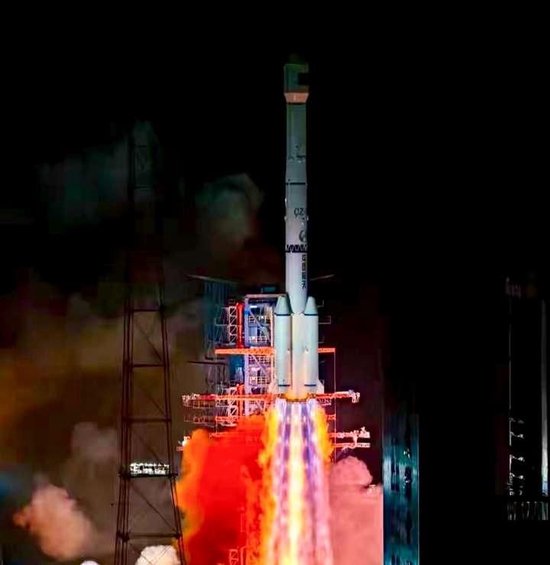
一天两发火箭任务失利
Xin Lang Cai Jing· 2026-01-17 10:42
Core Viewpoint - The recent satellite launch attempts by China's Long March 3B rocket and the private commercial rocket, Gushenxing No. 2, both experienced flight anomalies, resulting in mission failures. The specific causes are currently under investigation [1][3]. Group 1 - On January 17 at 00:55, the Long March 3B rocket launched from the Xichang Satellite Launch Center to deploy the Shijian-32 satellite, but the mission failed due to flight anomalies [1][3]. - At 12:08 on the same day, the Gushenxing No. 2 private commercial rocket was launched from the Jiuquan Satellite Launch Center, also experiencing flight anomalies and resulting in a failed first flight test [1][3]. - Star River Dynamics Aerospace issued a statement regarding the Gushenxing No. 2 mission, expressing sincere apologies to all parties involved and emphasizing their commitment to thoroughly investigate the failure and ensure the success of future launches [1][3].
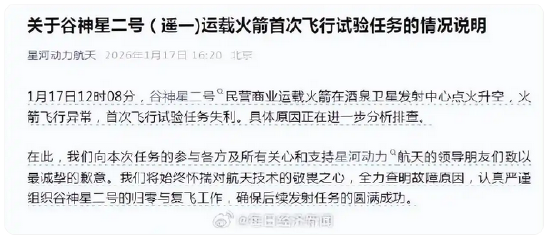
星河动力回应火箭首飞试验任务失利
证券时报· 2026-01-17 10:13
Core Viewpoint - The article discusses the recent failures of two rocket launches in China, highlighting the need for further investigation into the causes of these anomalies and the commitment of the companies involved to rectify the issues and ensure future success [2][3]. Group 1: Rocket Launch Failures - On January 17, at 12:08 PM, the Ceres II private commercial launch vehicle experienced flight anomalies during its maiden flight test, resulting in mission failure. The specific reasons for the failure are under further analysis [2]. - Earlier on the same day, at 00:55 AM, the Long March 3B rocket also faced flight anomalies during the launch of the Shijian-32 satellite, leading to another mission failure. The causes are similarly being investigated [3]. Group 2: Company Responses - Star River Dynamics Aerospace issued a statement expressing sincere apologies to all parties involved in the mission and emphasized their commitment to thoroughly investigate the failure and ensure rigorous organization for the Ceres II's reset and re-launch efforts [2].

发射任务失利,具体原因正在排查
Zhong Guo Ji Jin Bao· 2026-01-17 06:31
Core Viewpoint - The launch of the Shijian-32 satellite using the Long March 3B rocket from the Xichang Satellite Launch Center was unsuccessful due to an anomaly during the flight, with further analysis and investigation ongoing [1]. Group 1 - The satellite was launched on January 17 at 00:55 [1]. - The Long March 3B rocket experienced a flight anomaly, leading to the failure of the launch mission [1]. - The specific reasons for the failure are currently under further analysis and investigation [1].
实践三十二号卫星发射失利
证券时报· 2026-01-17 04:36
Group 1 - The article reports that on January 17, at 00:55, China launched the Shijian-32 satellite using the Long March 3B rocket from the Xichang Satellite Launch Center, but the rocket experienced an anomaly during flight, resulting in a failed mission. The specific reasons for the failure are currently under further analysis and investigation [1]

火箭飞行异常,实践三十二号卫星发射失利,具体原因正在进一步分析排查
Mei Ri Jing Ji Xin Wen· 2026-01-17 04:32
Core Viewpoint - The launch of the Shijian-32 satellite using the Long March 3B rocket from the Xichang Satellite Launch Center was unsuccessful due to an anomaly during the flight, with further analysis and investigation ongoing [1] Group 1 - The satellite was launched on January 17 at 00:55 [1] - The Long March 3B rocket experienced a flight anomaly, leading to the failure of the launch mission [1] - The specific reasons for the failure are currently under further analysis and investigation [1]
快讯:实践三十二号卫星发射失利
Xin Lang Cai Jing· 2026-01-17 03:19
Core Viewpoint - The launch of the Shijian-32 satellite using the Long March 3B rocket from the Xichang Satellite Launch Center was unsuccessful due to an anomaly during the flight, with further analysis underway to determine the specific cause [1]. Group 1 - The satellite launch occurred on January 17 at 00:55 [1]. - The Long March 3B rocket experienced a flight anomaly, leading to the failure of the launch mission [1]. - Investigations are ongoing to analyze and identify the reasons behind the launch failure [1].
实践三十二号卫星,发射失利
Xin Lang Cai Jing· 2026-01-17 03:18
Core Viewpoint - The launch of the Shijian-32 satellite using the Long March 3B rocket from the Xichang Satellite Launch Center was unsuccessful due to an anomaly during the flight, with further analysis underway to determine the specific cause [2] Group 1 - The satellite was launched on January 17 at 00:55 [2] - The Long March 3B rocket experienced a flight anomaly, leading to the failure of the launch mission [2] - Investigations are ongoing to analyze and identify the reasons behind the launch failure [2]