家庭智能机器人

Search documents
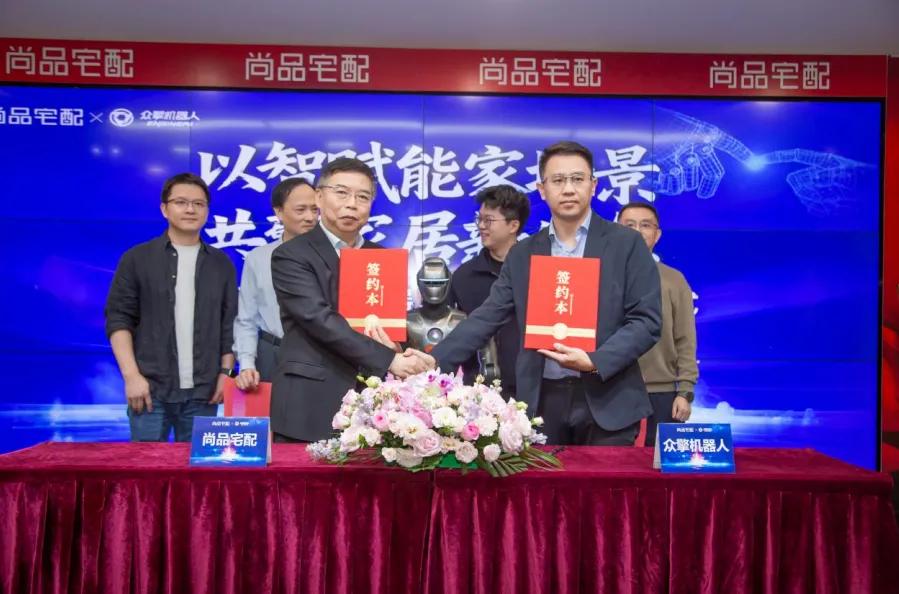
尚品宅配联手众擎机器人,以“机器人+家居”新生态打造企业可持续化发展的“新钥匙”
Cai Jing Wang· 2025-10-31 11:20
Core Insights - The collaboration between Shangpin Home and Zhongqing Robotics aims to create a new ecosystem for smart home robots, focusing on technology empowerment and experience reconstruction [1][3][10] Industry Trends - The rapid advancements in artificial intelligence, sensor technology, and machine vision are driving the emergence of smart home robots, which are becoming integral to modern households [1][3] - The market for smart home products is experiencing significant growth, with online sales of digital products increasing by 8.4% in early 2025, and smart robots and smart home systems seeing year-on-year growth of 87.6% and 16% respectively [3][9] Strategic Focus - Shangpin Home is concentrating on two main areas: integrating robots as "new family members" into daily home life and enhancing commercial scenarios through technology-driven service upgrades [5][7] - The partnership emphasizes joint research and development, leveraging Shangpin Home's data advantages and Zhongqing Robotics' cutting-edge technology to address key challenges in the home robotics sector [5][7] Market Potential - The demand for household smart robots is on the rise, with projections indicating that the market size for humanoid robots in China could reach approximately 5.3 billion yuan by 2025 and 75 billion yuan by 2029, capturing 32.7% of the global market [9][10] - Government policies are also supporting the growth of the smart home sector, with initiatives aimed at promoting artificial intelligence and smart product ecosystems [8][9] Future Outlook - The integration of robotics and home environments is expected to transform homes into interactive and evolving smart entities, marking the beginning of a new era in smart home technology [10][11]


共赴碳硅融合的时代之约
Sou Hu Wang· 2025-10-10 01:07
Core Insights - The integration of artificial intelligence (AI) into human society is accelerating, leading to a concept known as "carbon-silicon symbiosis," which outlines potential future directions for human civilization [1] - The Chinese government's strategic initiatives emphasize the deep integration of AI with the economy and society, aiming for a significant increase in the digital economy's contribution to GDP [2] Group 1: Carbon-Silicon Symbiosis - Carbon-silicon symbiosis is categorized into four stages: tool-based, physiological, cognitive, and existential symbiosis, each representing different levels of integration between humans and AI [1] - The current stage is tool-based symbiosis, where AI serves as a powerful tool that extends human capabilities while maintaining human control [1] - The evolution of carbon-silicon symbiosis is influenced by technological advancements and the trajectory of human destiny, with a notable policy shift in China by 2025 [1] Group 2: National Strategy and Policy - The State Council's opinion on implementing "AI+" action incorporates the deep integration of AI into national strategy, linking it with the "Digital China Construction 2025 Action Plan" [2] - The policy aims to transform the technological vitality of silicon-based intelligence into developmental momentum for carbon-based society, positioning "symbiosis" as a core driver of new productive forces [2] - AI's application across various industries, such as manufacturing and agriculture, is expected to enhance production efficiency and drive industrial upgrades [2] Group 3: AI for Life, Production, and Governance - China Mobile is actively implementing the "AI+" initiative, focusing on integrating AI into life, production, and governance to foster high-quality and sustainable development [5] - In the "AI for Life" dimension, AI evolves from a tool to a proactive collaborator, enhancing smart living experiences through various applications [6] - The "AI for Production" aspect emphasizes transforming industrial operations through an integrated intelligent production system, facilitating collaboration across the entire production chain [6] - The "AI for Governance" initiative aims to create a "human-machine co-governance" model, enhancing resource allocation and decision-making in urban and rural settings [6] Group 4: China Mobile's Initiatives and Events - China Mobile has showcased its progress in carbon-silicon symbiosis at major events, demonstrating AI applications in various sectors and promoting digital governance [7] - The upcoming 2025 China Mobile Global Partner Conference will focus on exploring the collaborative development between humans and AI, addressing the future of "AI+" [8] - The conference will feature expert insights, industry discussions, and practical demonstrations of AI's impact on daily life and production processes [9]

红星美凯龙:锚定“场景化生态” 破局存量竞争
Zheng Quan Ri Bao· 2025-06-09 16:36
Core Insights - The cyclical fluctuations in the real estate market present unprecedented challenges to the industry chain, prompting companies to seek new growth points [1] - Red Star Macalline is leveraging opportunities in high-end home appliances to explore new growth avenues, launching a three-year strategy to establish 40 high-end appliance ecological benchmarks nationwide [1][6] - The company aims to integrate home appliances with home decoration and furniture to enhance its competitive edge in the retail sector [1][3] Industry Trends - The home appliance market is experiencing a shift towards smart and low-carbon technologies, with the smart home appliance market in China projected to reach approximately 756 billion yuan in 2024, growing by 3% [2] - The demand for home appliances is evolving from single-function products to value creation through integrated scenarios, necessitating enhanced display, demonstration, design, and service capabilities from retailers [4] Competitive Strategy - Red Star Macalline is focusing on creating differentiated competitive advantages through rich experiential offerings, such as integrated home appliance and furniture stores that allow consumers to experience smart home solutions [3][4] - The company has established over 150 smart appliance lifestyle stores across 115 core cities, making high-end appliances one of its fastest-growing business segments [3] Service Enhancement - The company is enhancing its online service capabilities by connecting merchants, service providers, and users through a member app, facilitating seamless transactions and 24-hour service [5] - A new user service center has been introduced in the "Mega-E Smart Electric Oasis," offering comprehensive services such as appliance repair and recycling to foster ongoing consumer engagement [5] Policy Impact - The recent government initiative to provide subsidies of 15% to 20% for replacing old appliances has revitalized the appliance market, with Red Star Macalline's stores becoming key channels for these subsidies [6] - The company plans to replicate its successful "Mega-E Smart Electric Oasis" model in multiple cities, aiming to create the largest and most diverse appliance retail spaces to attract younger consumers [6]