射击类电竞游戏

Search documents
数娱工场 | 2025年中国电竞产业报告解读:高基数增长的“喜”与结构不均衡的“忧”
Xin Hua Cai Jing· 2025-12-05 05:45
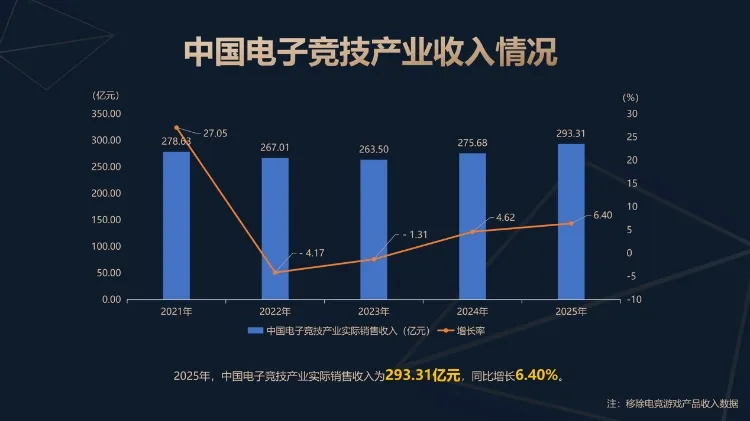
Core Insights - The Chinese esports industry is experiencing a recovery and adjustment phase, with a projected revenue of 293.31 billion yuan in 2025, marking a 6.40% year-on-year increase, the highest growth rate in three years [2][33] - The industry faces structural issues, particularly a heavy reliance on live streaming for revenue, which constitutes 80.81% of total income, while direct revenue from events and clubs only accounts for 15.03% [5][33] - User growth is plateauing, with a projected user base of 495 million in 2025, reflecting a 1.06% increase, indicating future growth will depend more on enhancing existing user engagement rather than acquiring new users [8][33] Industry Overview - The esports industry in China is recovering from a decline in sales revenue experienced in the previous two years, indicating improved monetization capabilities [2] - The dominance of shooting games is evident, comprising 28.3% of esports gameplay types, with mobile platforms leading at 58.6% [9][33] - The number of professional esports events is increasing, with 142 events planned for 2025, a rise of 18 from the previous year, and over half of these events being held offline [14][33] Regional Dynamics - Shanghai maintains its status as the "global esports capital," hosting 19.2% of offline events and having 38 esports clubs, both leading figures nationally [17][33] - Other major cities like Chengdu, Chongqing, Hangzhou, and Beijing form a strong second tier for event hosting, contributing to a significant concentration of esports clubs [22][33] International Expansion and Challenges - The international presence of Chinese esports is growing, with successful events held globally, showcasing the competitive edge of Chinese esports in terms of business models and content operation [25][33] - However, the club ecosystem shows signs of vulnerability, with 54.3% of clubs participating in only one type of event, which raises concerns about their resilience to market changes [29][33] Conclusion - The Chinese esports industry is characterized by stable revenue growth, increased offline events, and significant regional clustering, alongside challenges such as revenue dependency on live streaming and a need for diversified club participation [33]

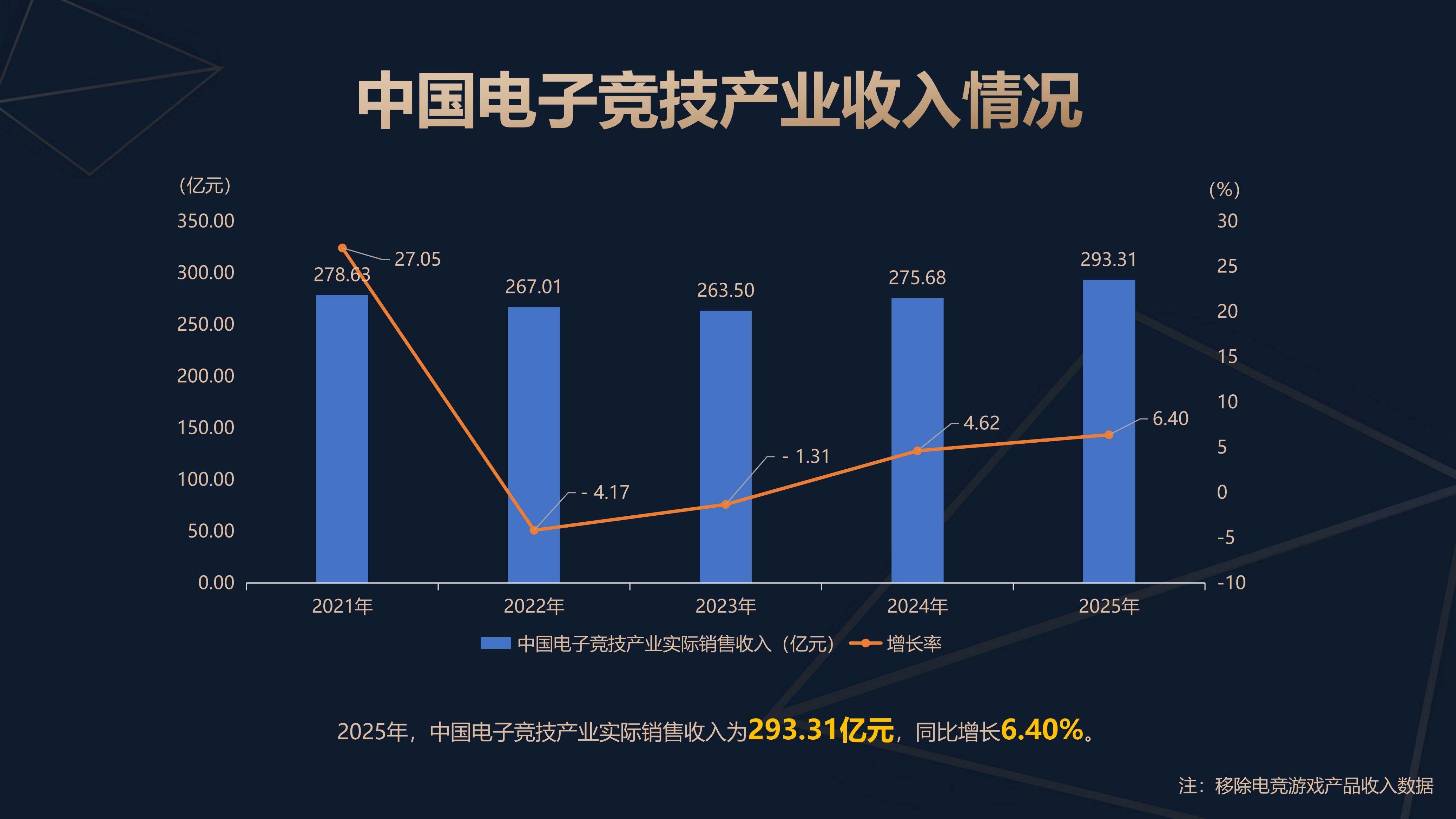
2025年中国电子竞技产业收入293.31亿元,同比增长6.4%
Cai Jing Wang· 2025-12-04 14:36
Core Insights - The report indicates that the Chinese esports industry is projected to generate revenues of 29.331 billion yuan in 2025, reflecting a year-on-year growth of 6.40% [3] Revenue Composition - The largest revenue source remains live streaming, accounting for 80.81% of total revenue, followed by tournament revenue, club revenue, and other income [4] User Growth - By 2025, the number of esports users in China is expected to exceed 495 million, showing a notable growth rate of 1.06% compared to the previous year [6] Game Type Distribution - Among the main types of esports games, shooting games hold the highest share at 28.3%, followed by Multiplayer Online Battle Arena (MOBA) and sports games, each at 14.1% [8] - In terms of platform distribution, mobile games represent 58.6%, client games 25.3%, games with both versions 12.1%, and web games 4.0% [8] Tournament Insights - In 2025, there will be a total of 142 non-performance esports tournaments with professional players at the provincial level and above, an increase of 18 from the previous year [8] - 54% of these tournaments will be held entirely offline, while 37% will adopt a hybrid online-offline model, and 9% will be purely online [8] Event Locations - The majority of offline esports events will be concentrated in East China and Southwest regions, with Shanghai, Chengdu, and Chongqing being the top three cities for event hosting [8] - Shanghai will host 19.2% of offline esports events, while Chengdu and Chongqing will account for 10.6% and 7.9%, respectively [8] Club Statistics - By the end of 2025, there will be 165 esports clubs in China, with cities like Shanghai, Beijing, Guangzhou, and Shenzhen having 10 or more clubs [10] - 54.3% of esports clubs participate in only one type of tournament, while 22.8% engage in two types [10] International Expansion - The Chinese esports industry is continuing to deepen its presence in overseas markets, particularly in Southeast Asia, the Middle East, and Latin America [10] - Several domestic esports games have been selected for international events such as the 2025 Esports World Cup and the 2026 Asian Games, enhancing their global influence [10] - The audience for Chinese self-developed esports events has surpassed 10 million overseas, with peak viewership for top events exceeding 4.13 million [10]