
电子竞技产业

Search documents
卢伟冰:小米汽车出海首站欧洲市场是全球汽车最难的市场|首席资讯日报
首席商业评论· 2025-12-05 04:14
Group 1 - Xiaomi's first overseas market for its automotive venture is Europe, which is considered the most challenging market globally. The company aims to establish a foothold in this difficult market before expanding to others [2] - Xiaomi's president, Lu Weibing, emphasized the importance of learning from Germany's mature automotive industry during his recent visit [2] Group 2 - Bojie Co., Ltd. reported ongoing collaborations with a major client in robotics and automotive sectors, including testing and assembly of vehicle components [3] - The company is also developing electronic skin testing devices, currently in the experimental phase [3] Group 3 - Eight e-commerce platforms, including JD.com and Meituan, signed a commitment to regulate AI technology applications to address misuse risks and maintain order in the live-streaming industry [4][5] - The commitment includes six key measures to establish self-regulatory norms for AI technology in e-commerce [5] Group 4 - Tencent announced the winter testing recruitment for its auto chess game "King of Glory Chess," which will be a large-scale non-billing test [6] Group 5 - The Chinese esports industry is projected to generate revenues of 29.331 billion yuan by 2025, maintaining its position as the largest esports market globally [7] Group 6 - Hong Kong Investment Management Company reported total assets of 64.007 billion HKD and an investment income of 2.345 billion HKD for 2024, with a significant focus on hard technology investments [11] Group 7 - Alibaba's first talent apartment officially opened in Nanjing, offering 565 rooms with various layouts and rental discounts for local youth [12] Group 8 - The General Administration of Sport of China is reforming the professional league system to enhance market-oriented and public welfare development, aiming for a balanced competitive environment [13] - The number of second-hand residential transactions in first-tier cities reached 49,033 in November, marking a seven-month high and a 20% month-on-month increase [14]


2025年中国电子竞技产业收入293.31亿元,同比增长6.4%
Cai Jing Wang· 2025-12-04 14:36
Core Insights - The report indicates that the Chinese esports industry is projected to generate revenues of 29.331 billion yuan in 2025, reflecting a year-on-year growth of 6.40% [3] Revenue Composition - The largest revenue source remains live streaming, accounting for 80.81% of total revenue, followed by tournament revenue, club revenue, and other income [4] User Growth - By 2025, the number of esports users in China is expected to exceed 495 million, showing a notable growth rate of 1.06% compared to the previous year [6] Game Type Distribution - Among the main types of esports games, shooting games hold the highest share at 28.3%, followed by Multiplayer Online Battle Arena (MOBA) and sports games, each at 14.1% [8] - In terms of platform distribution, mobile games represent 58.6%, client games 25.3%, games with both versions 12.1%, and web games 4.0% [8] Tournament Insights - In 2025, there will be a total of 142 non-performance esports tournaments with professional players at the provincial level and above, an increase of 18 from the previous year [8] - 54% of these tournaments will be held entirely offline, while 37% will adopt a hybrid online-offline model, and 9% will be purely online [8] Event Locations - The majority of offline esports events will be concentrated in East China and Southwest regions, with Shanghai, Chengdu, and Chongqing being the top three cities for event hosting [8] - Shanghai will host 19.2% of offline esports events, while Chengdu and Chongqing will account for 10.6% and 7.9%, respectively [8] Club Statistics - By the end of 2025, there will be 165 esports clubs in China, with cities like Shanghai, Beijing, Guangzhou, and Shenzhen having 10 or more clubs [10] - 54.3% of esports clubs participate in only one type of tournament, while 22.8% engage in two types [10] International Expansion - The Chinese esports industry is continuing to deepen its presence in overseas markets, particularly in Southeast Asia, the Middle East, and Latin America [10] - Several domestic esports games have been selected for international events such as the 2025 Esports World Cup and the 2026 Asian Games, enhancing their global influence [10] - The audience for Chinese self-developed esports events has surpassed 10 million overseas, with peak viewership for top events exceeding 4.13 million [10]
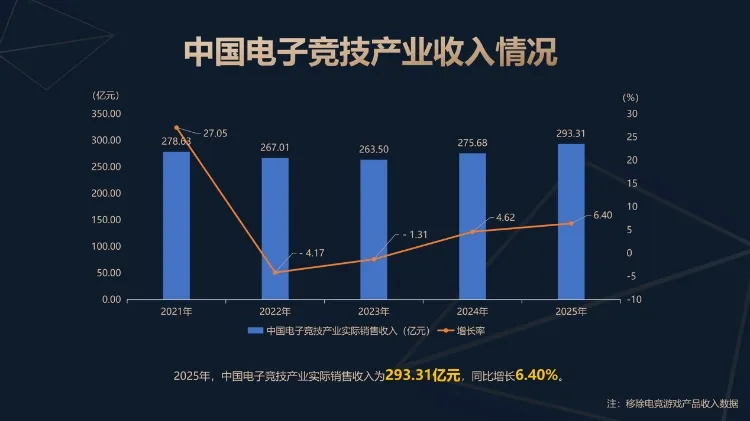
中国音像与数字出版协会:2025年中国电子竞技产业收入为293.31亿元 同比增长6.4%
Zhi Tong Cai Jing· 2025-12-04 12:01
Core Insights - The core viewpoint of the article is that the Chinese esports industry is projected to experience steady growth, with significant increases in revenue and user base by 2025 [1] Industry Overview - By 2025, the revenue of China's esports industry is expected to reach 29.331 billion yuan, representing a year-on-year growth of 6.40% [1] - The user base for esports in China is anticipated to exceed 495 million, showing a notable increase with a growth rate of 1.06% compared to the previous year [1] Game Platform Distribution - Among the main products in the esports gaming sector, mobile games account for 58.6%, client games for 25.3%, games available in both versions for 12.1%, and web games for 4.0% [1] Competitive Landscape - In 2025, there will be a total of 142 non-performance esports events with professional players at the provincial level and above, an increase of 18 events from the previous year [1] - By the end of 2025, there will be 165 esports clubs in China, with cities like Shanghai, Beijing, Guangzhou, and Shenzhen hosting 10 or more clubs each [1] - Shanghai remains the city with the highest number of esports clubs, continuing to lead in this aspect [1]
游戏工委秘书长唐贾军:2025年中国电子竞技产业收入为293.31亿元
Di Yi Cai Jing· 2025-12-04 07:15
Core Insights - The Chinese esports industry is expected to continue its steady progress towards mainstream acceptance, integration, and internationalization by 2025 [1] - China remains the largest esports market globally, with over 60,000 attendees at the KPL annual finals in Beijing, setting a Guinness World Record for the most viewers at a single esports event [1] - Government policies are increasingly supportive, providing incentives across various segments of the industry, which aids in optimizing supply and boosting consumption while fostering innovation in technology and culture [1] Revenue and Growth - The revenue of China's esports industry is projected to reach 29.331 billion yuan in 2025, reflecting a year-on-year growth of 6.40% [1] - Live streaming continues to dominate revenue sources, accounting for 80.81% of total income, followed by event revenue, club revenue, and other income streams [1] User Base - The user base for esports in China is expected to exceed 495 million by 2025, showing a significant increase with a growth rate of 1.06% compared to the previous year [1]
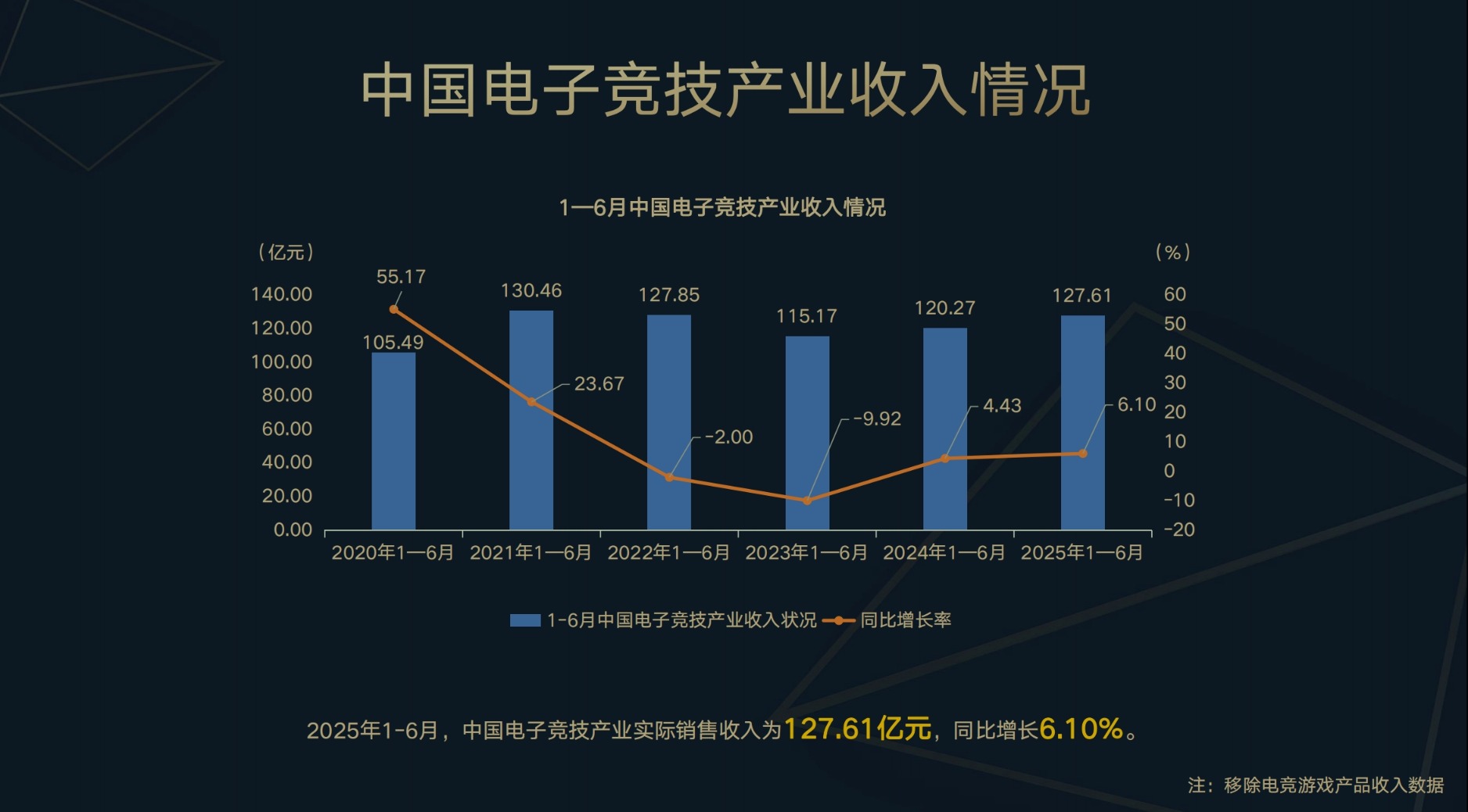
2025年1—6月:电竞产业收入127.61亿元,同比增长6.10%
3 6 Ke· 2025-08-04 09:13
Core Insights - The 2025 Global Esports Conference was held in Shanghai, where the China Audio-Video and Digital Publishing Association released the "2025 China Esports Industry Report" for the first half of the year [1][6] Group 1: Industry Revenue - The actual sales revenue of China's esports industry for the first half of 2025 reached 12.761 billion yuan, representing a year-on-year growth of 6.10% [2][7] - Live streaming revenue accounted for the largest share of the esports industry's income at 80.38%, followed by event revenue at 8.49%, club revenue at 7.03%, and other income at 4.10% [10] Group 2: User Base - The user base of China's esports industry approached 493 million, showing a slight year-on-year increase of 0.59% [2][12] Group 3: Product Composition - In terms of product types, mobile esports games accounted for 58.5%, client-based games for 25.5%, dual-version games for 11.7%, and web games for 4.3% [17][20] - Among the main esports game categories, shooting games held the highest share at 27.7%, followed by multiplayer online tactical games at 14.9%, and sports games at 11.7% [15] Group 4: Event Statistics - A total of 72 non-performance esports events involving professional players were held at the provincial level or above in the first half of 2025, with 51% being fully offline events and 41% being hybrid events [3][25] - Shanghai remained the city with the highest number of esports events, accounting for 22.9% of the total, followed by Chongqing at 14.0%, Hangzhou at 7.0%, and Beijing at 5.3% [29] Group 5: Club Development - As of June 2025, cities with 10 or more esports clubs included Shanghai, Beijing, Guangzhou, and Shenzhen, with Shanghai leading at 34 clubs [4][33] - The proportion of clubs participating in multiple types of events has increased, with 54.2% participating in a single type, 24.3% in two types, and 16.8% in three or more types [36] Group 6: International Expansion - The influence of China's esports industry is expanding internationally, with significant viewership for self-developed esports events overseas, peaking at over 4.13 million viewers for a single event [38]
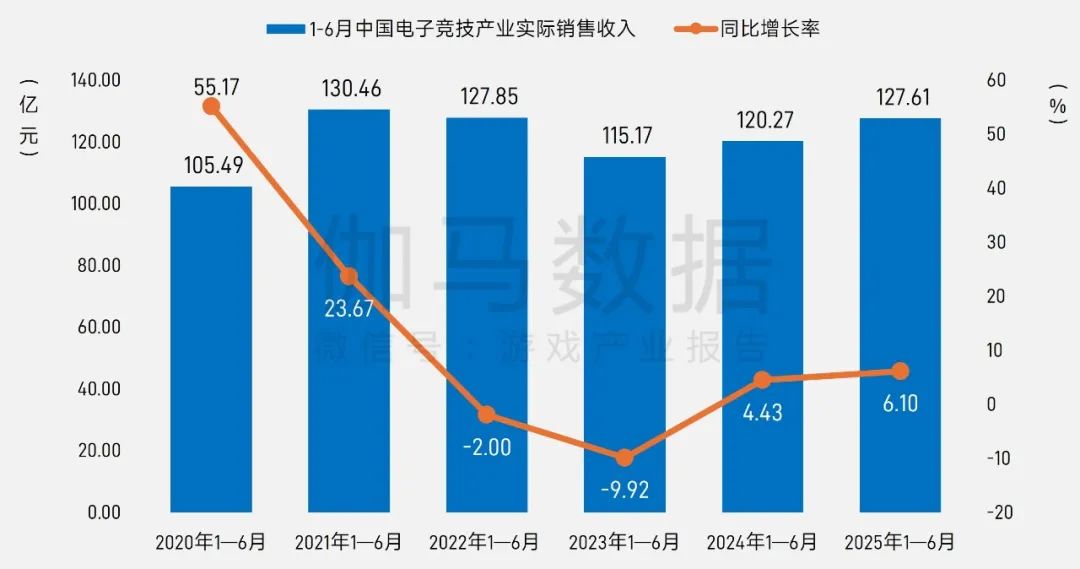
上半年中国电竞收入127.61亿元,用户规模近4.93亿人
Cai Jing Wang· 2025-08-02 05:05
Group 1 - The core viewpoint of the news is the growth and stability of China's esports industry, with a reported revenue of 12.761 billion yuan in the first half of 2025, reflecting a year-on-year increase of 6.10% [1] - The user base of the esports industry reached nearly 493 million, showing slight growth, indicating a stable user base [1] - Live streaming revenue remains the largest segment, accounting for 80.38% of total revenue, while events, clubs, and other income combined make up 19.62%, demonstrating a stable revenue structure [1] Group 2 - A total of 72 non-exhibition esports events involving professional players were held in the first half of the year, maintaining the same level as the previous year, with 51% of these events being fully offline [2] - Shanghai is the city with the most esports events, accounting for 22.9% of the total, followed by Chongqing, Hangzhou, and Beijing [2] - The number of esports clubs in Shanghai is the highest in China, with 34 clubs, while Beijing, Guangzhou, and Shenzhen follow with 11, 10, and 8 clubs respectively [2] Group 3 - The esports industry in China is expanding its influence in overseas markets, particularly in Latin America, in addition to traditional regions like East Asia and Southeast Asia [2] - The peak viewership for major self-developed esports events held overseas has exceeded 4.13 million viewers per match, indicating growing international interest [2]
报告显示:上半年中国电竞产业收入127.61亿元
Zhong Guo Xin Wen Wang· 2025-08-01 16:49
Core Insights - The report indicates that China's esports industry generated a revenue of 12.761 billion RMB in the first half of 2025, reflecting a year-on-year growth of 6.10% and an ongoing expansion into overseas markets [1] Revenue Breakdown - In the first half of 2025, live streaming revenue constituted the largest share of the esports industry's income at 80.38%, while revenue from events, clubs, and other sources combined accounted for 19.62% [1] Event Participation and Impact - The report highlights that the influence of self-developed esports game events in overseas markets has significantly increased, with peak viewership for top events exceeding 4.13 million, setting a new record for single-event viewership of Chinese esports events abroad [1] Geographic Distribution - Shanghai remains the city hosting the most esports events, accounting for 22.9% of the total, followed by Chongqing (14.0%), Hangzhou (7.0%), and Beijing (5.3%) [1] - As of June 2025, Shanghai also leads in the number of esports clubs, with a total of 34, while Beijing, Guangzhou, and Shenzhen follow with 11, 10, and 8 clubs respectively [1] Product Categories - Among major esports products, shooting games hold the highest market share at 27.7%, followed by multiplayer online tactical competition games at 14.9%, and sports games at 11.7% [1]
报告:今年上半年中国电子竞技产业收入同比增长6.10%
Zhong Guo Xin Wen Wang· 2025-08-01 16:41
Core Insights - The Chinese esports industry is experiencing growth in market revenue, new product launches, and international events in the first half of 2025, indicating a complete industry chain that is becoming more standardized, mainstream, and internationalized [1][3]. Industry Performance - In the first half of 2025, the revenue of the Chinese esports industry reached 12.761 billion yuan, representing a year-on-year growth of 6.10% [3]. - The user base for esports in China is nearly 493 million, showing slight growth with a stable base [3]. Event Distribution - The distribution of offline esports events in China is widespread, with Shanghai hosting the most events at 22.9%, followed by Chongqing (14.0%), Hangzhou (7.0%), and Beijing (5.3%) [3]. International Expansion - The Chinese esports industry is actively expanding into overseas markets, particularly in East Asia and Southeast Asia, with growing influence in Latin America. The viewership for top esports events has peaked at over 4.13 million for single matches [3]. Strategic Collaborations - A strategic cooperation memorandum was signed between the China Audio-Video and Digital Publishing Association, the Shanghai Jing'an District Culture and Tourism Bureau, and the Japan Esports Association, focusing on areas such as event operation, content creation, industry research, international standards, talent cultivation, technology development, and data analysis [6]. - Argentina's ambassador to China outlined the country's esports development strategy and called for collaborative efforts to build a new global esports ecosystem, emphasizing the educational and community-building potential of esports [6].
千亿规模市场!中国电竞产业链不断延伸
Xin Hua She· 2025-07-08 12:09
Core Insights - By 2026, China's esports market is expected to exceed 300 billion yuan, driving surrounding industries to surpass 1 trillion yuan, becoming a significant growth point for China's digital economy [1] - The user base for China's esports is projected to reach 490 million by 2024, with major Chinese cities like Shanghai, Beijing, Shenzhen, and Chengdu ranking among the top ten global esports cities [1] Industry Overview - The esports industry chain is continuously expanding, encompassing game development, equipment upgrades, event operations, esports education, and merchandise development, creating vast business opportunities and employment space [1] - The quality of domestic game content production has significantly improved, with titles like "Black Myth: Wukong," "Honor of Kings," "Peacekeeper Elite," and "Valorant" gaining both domestic acclaim and international attention [1] Market Performance - In Q1 2025, China's gaming market revenue reached 85.704 billion yuan, a year-on-year increase of 17.99%, while the actual sales revenue of domestically developed games in overseas markets was 4.805 billion USD, up 17.92% year-on-year [1] Event Operations - The esports event operation is maturing, with venues like the Beijing Smart Esports Event Center achieving an average attendance of 2,500 per event and over 20,000 monthly, stimulating related industry consumption [2] - Hosting esports events is expected to drive network upgrades and promote the adoption of 6G technology [2] Cultural Integration - Esports is increasingly integrating with culture, tourism, and commerce, creating a multiplier effect on consumption [3] - Initiatives like "Follow Wukong to Tour Shanxi" have sparked a trend in cultural tourism linked to gaming, aiming to convert online gaming effects into lasting offline market impacts [3] Policy Support - National policies are encouraging the penetration of digital technology into various sectors, supporting the development of esports, social e-commerce, and live-streaming e-commerce [3] - Cities like Shanghai have hosted major international esports events, while Beijing is enhancing its esports infrastructure to become a leading venue for esports competitions [3] Regulatory Developments - Beijing has introduced measures to improve the quality of game publishing and reduce approval cycles, enhancing the review capacity for domestic games [4] - Financial incentives are being provided in regions like Xiamen, where original games that receive approval can earn rewards, fostering industry growth [5] - Local governments are creating regional esports IPs and aiming to establish themselves as international esports hubs through systematic planning [5]