
巴士拉原油

Search documents
中东原油市场全线承压:现货疲软、沙特阿美连月下调对亚洲售价
智通财经网· 2026-01-06 07:04
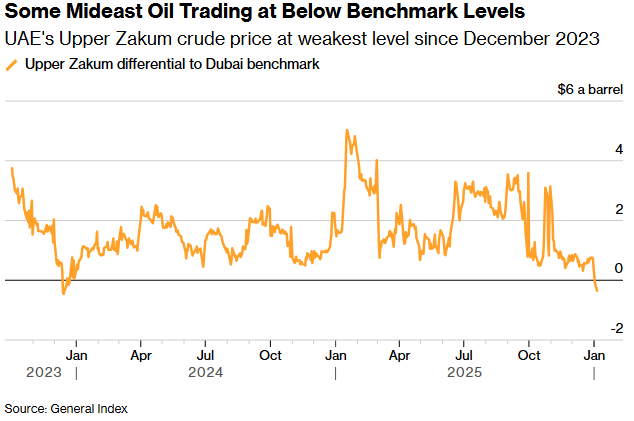
Core Viewpoint - The Middle East oil market is showing signs of weakness, raising concerns about a potential oversupply of global crude oil that could depress prices, while allowing Asian traders to overlook developments in Venezuela [1][5]. Group 1: Market Conditions - The Dubai benchmark crude's discount to Brent futures reached its widest level since August, indicating ample supply [1]. - The forward curve of Dubai swaps has reverted to a contango structure, characterized by recent contract prices being lower than future contracts, signaling bearish sentiment [1]. - The price differential between spot and Dubai benchmark prices is rapidly narrowing, suggesting weak demand [1]. Group 2: Price Trends - The premium for Oman crude, preferred by major importing countries like China, has dropped from nearly $1 per barrel at the end of last month to near parity with Dubai benchmark prices [1]. - The price of UAE's Upper Zakum crude has been set at a discount of $0.35, marking the weakest level since December 2023 [1]. Group 3: Supply and Demand Dynamics - Global crude oil supply has consistently exceeded demand due to increased production from OPEC+ and other oil-producing countries, leading to concerns in the market [5]. - Brent futures fell 18% last year, marking the worst annual performance since 2020, with several banks predicting further declines in oil prices [5]. - Saudi Aramco has lowered prices for its flagship Arab Light crude for the third consecutive month, reaching a five-year low in pricing differentials for major Asian customers [5]. Group 4: Impact of Geopolitical Events - U.S. intervention in Venezuela, including the arrest of Maduro and partial blockade of oil tankers, could have disrupted Venezuelan oil exports, but the ample supply from the Middle East has alleviated such concerns [5]. - Chinese refineries, typically major buyers of Venezuelan crude, have not shown signs of urgently seeking alternatives like Iraqi Basrah crude [5]. Group 5: Sales and Inventory Issues - Approximately 8 million barrels of crude oil scheduled for February shipment remain unsold, including grades like UAE's Upper Zakum and Qatar's Al-Shaheen, which is unusual as such transactions typically conclude by the end of December [6]. - The backlog of unsold oil indicates that Arabian Gulf crude has failed to find buyers for the fourth consecutive month, despite the region's historical ability to sell most of its crude supply [6].

洲际油气(600759.SH)与关联方签署《伊拉克项目原油承销框架协议》
智通财经网· 2025-09-23 11:00
Core Viewpoint - The company has signed a series of contracts with the Iraqi government and various national oil companies to invest in upstream oil and gas projects in Iraq, focusing on the extraction and sale of Basra crude oil [1] Group 1: Project Details - The project involves the extraction of different grades of Basra crude oil, including light, medium, and heavy varieties, in compliance with local regulations [1] - The company has appointed GRL as the exclusive seller of all Basra crude oil extracted from the project until the contract's termination [1] Group 2: Strategic Advantages - The collaboration with GRL, a specialized oil trading company with experienced executives from leading international oil firms, aims to enhance the company's focus on upstream development and production operations [1] - This partnership is expected to mitigate price volatility and payment collection risks, while effectively managing buyer credit risks through a joint venture with a professional trading company [1]

洲际油气:签署伊拉克项目原油承销框架协议
Xin Lang Cai Jing· 2025-09-23 10:09
Core Viewpoint - The company has signed a framework agreement with GEOJADE RESOURCES PTE.LTD. for the exclusive marketing of all Basra crude oil extracted from its Iraq project, which will help the company focus on upstream development and manage various risks effectively [1] Group 1 - The agreement designates GRL as the exclusive seller of the Basra crude oil from the company's Iraq project [1] - GRL is a specialized institution in crude oil trading with extensive marketing channels, professional trading experience, and risk control capabilities [1] - The signing of this agreement is beneficial for the company to reduce price volatility risks and collection time risks, as well as to effectively manage buyer credit risks [1]
传沙特阿美与伊拉克SOMO在欧盟制裁后暂停向印度炼油商Nayara出售原油
智通财经网· 2025-09-01 13:35
Core Viewpoint - The European Union's sanctions against Nayara Energy have led to a halt in crude oil supplies from Saudi Aramco and Iraq's SOMO, resulting in Nayara relying solely on Russian oil imports [1][2]. Group 1: Supply Chain Impact - Following the EU sanctions in July, Nayara Energy's crude oil imports in August were entirely dependent on Russia, with no shipments received from Iraq or Saudi Arabia [1]. - Typically, Nayara would receive approximately 2 million barrels of Iraqi crude and 1 million barrels of Saudi crude monthly, but it received none in August [1]. - The last shipment of Basra crude from SOMO was delivered on July 29, and the last shipment of Saudi crude was on July 18, totaling 1 million barrels of Arab Light crude [2]. Group 2: Operational Challenges - Due to sanctions, Nayara is facing payment difficulties when procuring oil from SOMO, impacting its operations [1]. - Nayara's refinery, located in Vadinar, has a processing capacity of 400,000 barrels per day but is currently operating at only 70%-80% capacity due to challenges in selling refined products [2]. - Nayara's refining capacity accounts for approximately 8% of India's total refining capacity, which averages 5.2 million barrels per day [2]. Group 3: Management Changes - Nayara Energy's CEO resigned in July, and the company has appointed a new CEO from Azerbaijan's state oil company SOCAR [3].