阿曼原油

Search documents
原油博弈下的全球工业体系攻防战
雪球· 2026-03-23 08:32
Group 1 - The article discusses the structural impact of the potential blockage of the Strait of Hormuz on global oil supply, highlighting that while it could theoretically reduce supply by 20%, the actual impact is differentiated, particularly affecting Asia more severely [5] - The pricing dynamics between WTI and Brent crude oil are explored, indicating that a blockage would lead to a significant price gradient, with Brent prices rising sharply due to panic buying, while WTI prices remain suppressed due to physical export limitations [6][9][10] - The article suggests that a prolonged blockage could lead to a split in the global oil market, creating two parallel worlds and resulting in extreme market segmentation and failure of arbitrage mechanisms [11][12] Group 2 - The potential economic consequences of a sustained crisis in the Strait of Hormuz are examined, with a focus on how high oil prices could severely impact manufacturing costs in Eurasia, leading to a significant downturn in industrial capabilities [13][14] - The article outlines China's strategic responses to mitigate reliance on oil, including the promotion of renewable energy, alternative raw material sources, and the development of land-based transportation routes [15][16] - The macroeconomic implications for the U.S. are discussed, emphasizing that while the U.S. may benefit from low WTI prices, it will face high input inflation due to rising costs in Asia, leading to a complex economic dilemma for the Federal Reserve [19][20][21][22]


格林大华期货早盘提示-20260323
Ge Lin Qi Huo· 2026-03-22 23:31
1. Report Industry Investment Rating - Not provided in the given content 2. Core Viewpoints - The geopolitical situation in the Middle East is tense. The US has issued an ultimatum to Iran, and Iran has threatened counter - attacks. Yemen's Houthi rebels may block the Mandeb Strait. The control of the Strait of Hormuz is crucial for the US and the global energy market [1][2][3] - There is a huge supply gap in the oil market due to the obstruction of the Strait of Hormuz. Although the IEA has released a large - scale strategic oil reserve, it cannot fully cover the gap. High oil prices may reach historical highs and impact the global economy [2][3] - The market has shifted to price "indefinite uncertainty". Investors are short - selling low - quality stocks and European assets. The US stock market is at risk, especially with high AI positions and momentum long - term exposure [1][2] - The global economy has passed its peak in late 2025 and is on a downward trend due to the US's wrong policies [3] 3. Summary by Related Catalogs Geopolitical Tensions - The US President demands that Iran open the Strait of Hormuz within 48 hours, otherwise, the US will attack Iranian power plants. Iran warns that it will counter - attack US and its allies' energy facilities, information systems, and desalination plants in the Gulf [1][2] - The US amphibious assault fleet may land in the Strait of Hormuz, and the war duration may exceed expectations. Yemen's Houthi rebels may block the Mandeb Strait to support Iran [1][2] - Bridgewater's Ray Dalio believes that the "ultimate battle" in the Middle East depends on who controls the Strait of Hormuz, which is related to the global energy lifeline and the US hegemony [2][3] Oil Market Situation - The US may lift sanctions on Iranian oil at sea in the next few days, with a reserve of about 140 million barrels [1] - The IEA has released 400 million barrels of strategic oil reserves, but the actual global release speed is no more than 3 million barrels per day, while the supply gap caused by the obstruction of the Strait of Hormuz is 11 - 16 million barrels per day [2][3] - Goldman Sachs warns that under the background of the continuous obstruction of the Strait of Hormuz, Brent crude oil may break through the 2008 historical high of $147.50 per barrel, and oil prices may remain at a high level of $100 for a long time [1][2] - Oman crude oil spot has soared to $173, with a serious disconnection between futures and spot [1] Market Reactions - Asian steam cracking plants using naphtha as raw materials have entered a large - scale shutdown wave, with some operating loads dropping to 60% [1] - The market has shifted to price "indefinite uncertainty". Customers are short - selling low - quality stocks and European assets. The Fed's hawkish stance worsens the situation [1][2] - The risk - return of the US stock market tends to be symmetrical, but AI positions are at a historical peak, and momentum long - term exposure has reached a five - year high. Once it collapses, it may trigger tail risks [1][2] - If the geopolitical situation does not improve within two weeks, the stock market will face a crash - like decline [2] - The Nasdaq futures have broken through support levels. AI's disruptive substitution and the Middle East situation may trigger a new round of large - scale selling in the US stock market, which may have a significant negative impact on US consumption [3]
“虚假的油价”还在100美元徘徊,“真正的油价”已经高达155美元
华尔街见闻· 2026-03-18 10:05
Core Viewpoint - The article discusses a rare divergence in global oil prices, highlighting the significant difference between Brent and WTI crude oil prices, which remain around $100 per barrel, and the soaring prices of Dubai and Oman crude, which have reached $155 per barrel [4][8]. Group 1: Price Dynamics - Morgan Stanley's report indicates that the stability of Brent and WTI prices does not reflect a global supply surplus but is a "false impression" created by regional inventory buffers, pricing structure deviations, and policy interventions [6]. - The current price stability of Brent and WTI is primarily due to their status as "Atlantic basin benchmarks," meaning their pricing is influenced more by local supply and demand in Europe and the U.S. rather than global conditions [7]. - The price divergence is exacerbated by the geopolitical trade dynamics, particularly the critical role of the Strait of Hormuz in global oil transportation, with most oil flowing to Asian markets [10]. Group 2: Regional Supply Shortages - The article emphasizes that the current supply disruptions are concentrated in the Middle East, particularly affecting the prices of Dubai and Oman crude, which are more sensitive to export interruptions [8][9]. - Asia is experiencing immediate physical shortages and price surges due to its reliance on Gulf oil, with imports from the Strait of Hormuz amounting to approximately 11.2 million barrels per day [11]. - The time logistics of transportation further widen the price gap, as shipments to Asia take 10 to 15 days, while those to Europe take significantly longer, allowing Asia to feel the impact of supply disruptions more acutely [12]. Group 3: Future Price Outlook - Morgan Stanley warns that the current stability of Brent and WTI is temporary, supported by short-term factors that do not reflect the true global supply tightness [13]. - If the Strait of Hormuz remains closed, Brent and WTI prices are expected to rise, aligning more closely with Middle Eastern spot prices, potentially leading to a risk premium of over $55 per barrel between Brent and Dubai prices [13].


中东能源行业战略:霍尔木兹海峡长期封锁或将推升油价至超100美元/桶
Haitong Securities International· 2026-03-10 11:47
Investment Rating - The report assigns an "Outperform" rating to several companies in the Middle East energy sector, including Abu Dhabi National Oil Company and various other firms, indicating a positive outlook for their stock performance [2]. Core Insights - The report highlights that a potential long-term blockade of the Strait of Hormuz could drive oil prices above $100 per barrel, with estimates suggesting a nominal supply shock of up to 20 million barrels per day in a pessimistic scenario [5][6]. - In the event of a blockade lasting more than 14-30 days, Brent crude prices could test or exceed the $100-$120 per barrel range due to sustained supply shortages [6]. - The report also discusses the cost of oil production, noting that OPEC's production costs are generally low, with Saudi Aramco's extraction cost around $3-4 per barrel, while the fiscal breakeven price for Saudi Arabia is significantly higher, estimated at $80-90 per barrel [8]. Summary by Sections Investment Focus - Abu Dhabi National Oil Company is rated "Outperform" with a target price of $3.9 and projected P/E ratios of 15.7 for 2026 and 14.9 for 2027 [2]. - Other companies such as Borouge, Fertiglobe, and Clearway Energy also received "Outperform" ratings, indicating strong expected performance in the market [2]. Geopolitical Risks - The report emphasizes the escalating geopolitical tensions in the Middle East, particularly between the U.S. and Iran, which could impact oil supply and prices significantly [5]. - The potential for U.S. underestimating Iran's resolve and capabilities in the region is highlighted as a critical factor influencing market dynamics [5]. Supply and Demand Analysis - The report provides a detailed analysis of global oil supply and demand, projecting that OPEC's production will need to adjust to meet changing market conditions, with specific figures for 2025-2027 demand and supply balances [12]. - It notes that the International Energy Agency and OPEC have differing projections for global oil demand, with slight increases expected over the coming years [12]. Price Trends - Recent price trends indicate fluctuations in Brent crude and WTI prices, with Brent averaging around $72.5 per barrel as of late February 2026, reflecting a 1% increase from the previous week [18]. - The report also discusses the implications of these price movements on various energy products and their respective margins [18].
中东能源战略:霍尔木兹海峡长期封锁或将推升油价至超100美元/桶
Haitong Securities International· 2026-03-10 05:04
Group 1: Oil Price Projections - A prolonged blockade of the Strait of Hormuz could push oil prices above $100 per barrel, with initial estimates suggesting a range of $90-100 per barrel under severe supply disruptions[5] - In a pessimistic scenario, a complete disruption could lead to a nominal supply shock of up to 20 million barrels per day, resulting in a structural net gap of approximately 11 million barrels per day[6] - If disruptions last over 14-30 days, Brent crude prices could test or exceed $100-120 per barrel, contingent on escalating geopolitical tensions lasting over six months[6] Group 2: Supply and Demand Analysis - Global oil demand is projected to reach 106.5 million barrels per day in 2026, reflecting a year-on-year increase of 1.4%[12] - The International Energy Agency (IEA) estimates that OPEC's oil demand will be approximately 42.4 million barrels per day in 2027, with a slight increase of 0.6% from the previous year[12] - Non-OPEC supply is expected to stabilize around 79.1 million barrels per day in 2026, with a net increase of 1.4%[12] Group 3: Cost and Breakeven Analysis - OPEC's production costs are generally below $15-20 per barrel, with Saudi Aramco's costs around $3-4 per barrel[8] - North American shale producers require a breakeven price of $60-70 per barrel for new drilling, while existing wells can operate at $30-40 per barrel[8] - Offshore projects typically need oil prices of $40-50 per barrel to be economically viable, with deepwater developments requiring $45-50 per barrel[8]
API千万桶大幅累库,伊朗问题悬而未决,油市分歧进一步加大
Xin Lang Cai Jing· 2026-02-10 23:24
Core Viewpoint - The oil market is currently in a strong yet chaotic accumulation phase, heavily influenced by geopolitical uncertainties, particularly regarding the U.S.-Iran relations and upcoming negotiations [4][19]. Market Dynamics - WTI crude oil futures closed at $63.96 per barrel, down $0.40 or 0.62%, while Brent crude futures fell by $0.24 or 0.35% to $68.80 per barrel. INE crude futures increased by 0.21% to 473.5 yuan [6][21]. - The API reported a significant increase in U.S. crude oil inventories, rising by 13.4 million barrels for the week ending February 6, which may exert further pressure on oil prices if confirmed by EIA data [4][20]. Supply and Demand Factors - Venezuela's oil production is recovering rapidly, nearing 1 million barrels per day, with the Orinoco heavy oil belt's output exceeding 500,000 barrels per day, an increase of over 100,000 barrels since early January [7][22]. - The supply side remains relatively loose, but recent factors, including the end of a cold snap in North America and the recovery of Kazakhstan's production, are raising supply pressures [4][19]. Geopolitical Influences - The upcoming meeting between Israeli Prime Minister Netanyahu and U.S. President Trump is expected to influence market sentiment, particularly regarding Iran's nuclear capabilities and potential military actions [4][19]. - The geopolitical risks associated with the U.S.-Iran negotiations are causing market participants to remain cautious, especially with the Chinese New Year approaching, which may lead to increased volatility in oil prices [5][20]. Regional Market Insights - Middle Eastern oil prices are stable, supported by Indian refiners' procurement activities aimed at replacing Russian oil, which is improving demand outlooks [8][23]. - Indian state-owned refiners are purchasing two million barrels of Oman and Al-Shaheen crude, with prices approximately $2 per barrel above the April Dubai crude price [8][23]. Technical Analysis - The oil market is showing signs of being overbought, indicating a potential need for price adjustments. The market is currently more concerned about geopolitical risks than the possibility of a price correction [5][20].

原油成品油早报-20260210
Yong An Qi Huo· 2026-02-10 02:41
Report Summary 1. Industry Investment Rating No investment rating information is provided in the report. 2. Core View The report indicates that due to the Middle - East tensions increasing the risk premium, crude oil prices have risen for two consecutive days. The geopolitical tensions this year have overshadowed concerns about global supply surplus. The market will get insights from a series of data this week, starting with the EIA's monthly short - term energy outlook report. The short - term oil prices are still affected by the Iran situation, and the global crude oil supply - demand fundamentals in the first and second quarters remain in a surplus state, not supporting high valuations [3][5]. 3. Summary by Directory 3.1 Daily News - Middle - East tensions have pushed up the risk premium, causing oil prices to rise for two consecutive days. WTI crude oil has traded above $64 per barrel after a 1.7% increase in the past two trading days, and Brent crude oil has closed above $69. The US warned that US - flagged vessels should stay away from Iranian waters when passing through the Strait of Hormuz [3]. - The US Maritime Administration's warning was related to an incident on February 3 when a US - flagged oil tanker was approached by Iranian gunboats in the Strait of Hormuz [4]. - Venezuelan crude oil production has approached 1 million barrels per day after returning to the pre - cut level [4]. - US sanctions have led to a continuous decline in Russian crude oil production. In January, Russia's average daily crude oil production was 9.28 million barrels, 46,000 barrels per day less than in December and nearly 300,000 barrels per day lower than the quota in the OPEC+ agreement. The amount of Russian oil stored on tankers has been increasing [5]. 3.2 Inventory - This week, crude oil has fluctuated at a high level due to the Iran situation, with the month - spread falling and the North Sea Brent basis dropping to $1.005 per barrel. The US and Iran held a six - hour nuclear negotiation on Friday, with Iran calling it a good start. A second round of negotiations is expected in the coming days. - Globally, the total petroleum inventory has decreased. In the US, commercial crude oil inventory decreased by 3.455 million barrels and refined oil inventory decreased by 5.553 million barrels. Saudi Arabia adjusted the official selling prices of Arabian light crude oil for March. - In Singapore, all refined oil products have seen inventory accumulation. In ARA, crude oil inventory has decreased, while refined oil products, diesel, and gasoline have seen inventory accumulation. In China, both gasoline and diesel inventories have increased [5]. 3.3 EIA Report - For the week ending January 30, US crude oil exports decreased by 542,000 barrels per day to 4.047 million barrels per day [15]. - US domestic crude oil production decreased by 481,000 barrels to 13.215 million barrels per day [15]. - Commercial crude oil inventory (excluding strategic reserves) decreased by 3.455 million barrels to 420 million barrels, a decrease of 0.82% [15]. - The four - week average supply of US crude oil products was 20.802 million barrels per day, a year - on - year increase of 0.94% [15]. - The US Strategic Petroleum Reserve (SPR) inventory increased by 214,000 barrels to 415.2 million barrels, an increase of 0.05% [15]. - US imports of commercial crude oil (excluding strategic reserves) were 6.201 million barrels per day, an increase of 559,000 barrels per day compared to the previous week [15].
印度炼油商调整原油进口策略
Zhong Guo Hua Gong Bao· 2026-01-28 02:55
Core Viewpoint - Indian refiners are restructuring their crude oil import strategy to reduce dependence on Russia and increase procurement from the Middle East, potentially facilitating a trade agreement with the United States to lower tariffs [1] Group 1: Changes in Oil Import Strategy - Indian refiners have begun to cut back on Russian oil purchases following discussions in government meetings aimed at accelerating the India-US trade agreement [1] - In December of last year, India's imports of Russian oil fell to a two-year low, while the share of crude oil from OPEC countries reached an 11-month high [1] Group 2: Specific Adjustments by Indian Refiners - Bharat Petroleum, a state-owned refiner, has awarded a one-year contract to Trafigura for the purchase of Iraqi Basra and Omani crude oil and is seeking to buy Murban crude from the UAE [1] - Indian refiners are also increasing purchases of US oil to partially replace Russian oil and reduce the trade deficit with the US, while exploring opportunities for Venezuelan crude [1] Group 3: Market Analysis - Market analysts suggest that the increased production quotas from OPEC member countries are maintaining sufficient global market supply, alongside the US doubling import tariffs on Indian goods last year as a penalty for significant Russian oil purchases, driving the diversification of India's supply chain [1]
俄乌和谈出现进展迹象 原油期货盘面小幅承压
Jin Tou Wang· 2026-01-24 01:31
Group 1 - The main crude oil futures contract closed at 441.9 yuan per barrel, with a weekly increase in open interest by 3,756 contracts [1] - During the week of January 19 to January 23, crude oil futures opened at 443.2 yuan per barrel, reaching a high of 448.6 yuan and a low of 434.4 yuan, resulting in a weekly change of 0.50% [1] Group 2 - The Dubai oil authority set the official discount for April shipments of Dubai crude relative to Oman crude futures at 30 cents per barrel, linked to the average settlement price of the Oman crude near-month contract [2] - The EIA report indicated a decrease in U.S. crude oil exports by 618,000 barrels per day to 3.688 million barrels per day, and a reduction in domestic crude oil production by 21,000 barrels to 1.3732 million barrels per day [2] - Venezuela's proposed oil law reform will allow the state oil company to operate joint ventures with foreign and local partners, enabling direct commercialization of production and receipt of sales revenue [2] Group 3 - Current market dynamics reflect a balance between oversupply and geopolitical risks, with short-term expectations hinging on developments in Iran, where potential U.S. military actions could drive oil prices higher [4] - Increased crude oil inventories and signs of progress in Russia-Ukraine negotiations are putting slight pressure on oil prices, with U.S. gasoline inventories reaching their highest level since 2001 [4] - Venezuelan supply is returning to the market, and Indian refiners are resuming purchases of Russian crude, while cold weather is expected to boost U.S. demand, providing some price support [4]

中东原油市场全线承压:现货疲软、沙特阿美连月下调对亚洲售价
智通财经网· 2026-01-06 07:04
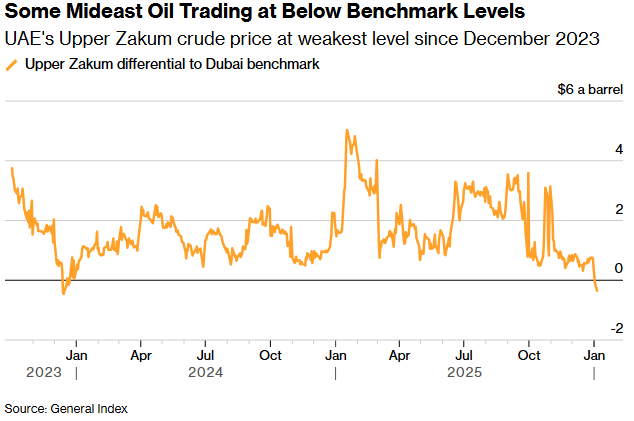
Core Viewpoint - The Middle East oil market is showing signs of weakness, raising concerns about a potential oversupply of global crude oil that could depress prices, while allowing Asian traders to overlook developments in Venezuela [1][5]. Group 1: Market Conditions - The Dubai benchmark crude's discount to Brent futures reached its widest level since August, indicating ample supply [1]. - The forward curve of Dubai swaps has reverted to a contango structure, characterized by recent contract prices being lower than future contracts, signaling bearish sentiment [1]. - The price differential between spot and Dubai benchmark prices is rapidly narrowing, suggesting weak demand [1]. Group 2: Price Trends - The premium for Oman crude, preferred by major importing countries like China, has dropped from nearly $1 per barrel at the end of last month to near parity with Dubai benchmark prices [1]. - The price of UAE's Upper Zakum crude has been set at a discount of $0.35, marking the weakest level since December 2023 [1]. Group 3: Supply and Demand Dynamics - Global crude oil supply has consistently exceeded demand due to increased production from OPEC+ and other oil-producing countries, leading to concerns in the market [5]. - Brent futures fell 18% last year, marking the worst annual performance since 2020, with several banks predicting further declines in oil prices [5]. - Saudi Aramco has lowered prices for its flagship Arab Light crude for the third consecutive month, reaching a five-year low in pricing differentials for major Asian customers [5]. Group 4: Impact of Geopolitical Events - U.S. intervention in Venezuela, including the arrest of Maduro and partial blockade of oil tankers, could have disrupted Venezuelan oil exports, but the ample supply from the Middle East has alleviated such concerns [5]. - Chinese refineries, typically major buyers of Venezuelan crude, have not shown signs of urgently seeking alternatives like Iraqi Basrah crude [5]. Group 5: Sales and Inventory Issues - Approximately 8 million barrels of crude oil scheduled for February shipment remain unsold, including grades like UAE's Upper Zakum and Qatar's Al-Shaheen, which is unusual as such transactions typically conclude by the end of December [6]. - The backlog of unsold oil indicates that Arabian Gulf crude has failed to find buyers for the fourth consecutive month, despite the region's historical ability to sell most of its crude supply [6].