
期货升水

Search documents
One Tiny ETF No One Is Talking About Just Soared 289% on $100 Oil
Yahoo Finance· 2026-03-17 14:37
Group 1: Amplify Commodity Trust ETF (BWET) - BWET has experienced a significant increase of 289% year to date as of March 16, 2026, and a 94% gain in the past month, indicating its leveraged structure amplifies crude price movements rather than tracking them directly [1][6] - The fund has net assets of approximately $21.7 million and was launched in May 2023, with a high expense ratio of 3.5% reflecting the costs associated with maintaining a leveraged position [7] - BWET does not pay dividends, relying solely on price appreciation tied to crude oil movements, which poses a risk of rapid loss if crude prices decline [8] Group 2: Other Investment Instruments - The Credit Suisse Crude Oil Covered Call ETN (USOI) is up 21% year to date, focusing on generating income by selling call options on crude oil futures, which caps potential gains but provides consistent income [9][10] - The United States Natural Gas Fund (UNG) has lost 89% of its value over the past decade due to futures contango, making it a poor long-term hold but potentially beneficial for short-term plays on supply disruptions [15][17] - UNG's price volatility is influenced by geopolitical events, with potential for sharp spikes if supply disruptions occur, but timing such moves is challenging [16][17] Group 3: Market Context and Geopolitical Factors - WTI crude is currently trading around $78 per barrel, up from approximately $63 in early February, driven by geopolitical tensions and warnings from Chevron regarding potential disruptions in the Strait of Hormuz [4][5] - Analysts have raised price targets for Exxon Mobil, suggesting that oil could stabilize above $100 per barrel if conflicts escalate, creating varied risk-reward scenarios across different investment instruments [5][6] - The potential for oil prices to reach $120 to $130 could have broader macroeconomic implications, particularly for Asian markets, highlighting the interconnectedness of energy prices and global market stability [18]
烧碱:期货升水幅度较大,盘面回调为主
Guo Tai Jun An Qi Huo· 2026-03-17 01:40
1. Report Industry Investment Rating - The trend strength for caustic soda is 0, indicating a neutral stance [3] 2. Core View of the Report - In the short term, the caustic soda futures have a large premium, and with two weeks left for the 04 contract to expire, the 32 - alkali delivery issue will suppress the market, leading to a short - term correction and narrowing of the basis. In the long - term, if the situation in the Middle East is not alleviated by the end of March, overseas refining enterprises will increase production cuts, which in turn will cause large - scale production cuts in domestic ethylene - based PVC and lead to passive production cuts in caustic soda through the chlor - alkali balance mechanism. Additionally, due to the disruption of long - term supply contracts in the Middle East, some overseas demand has shifted to China, promoting the recent recovery of caustic soda exports. Although the domestic supply - demand contradiction is expected to improve, the futures premium is large, and short - term basis convergence is expected. Continuous tracking of overseas device dynamics and Chinese export orders is required [2] 3. Summary by Relevant Catalogs 3.1 Fundamental Tracking - The 05 contract futures price is 2547, the cheapest deliverable 32 - alkali spot price in Shandong is 720, the Shandong 32 - alkali spot price converted to the futures price is 2250, and the basis is - 297 [1] 3.2 Spot News - Based on the Shandong region, today, due to factors such as a decrease in the delivery volume of major downstream products and support from export orders, the price of liquid caustic soda in Shandong continued to rise [1] 3.3 Market Condition Analysis - Short - term: The large premium of caustic soda futures and the approaching delivery date of the 04 contract will suppress the market, resulting in a short - term correction and basis convergence. Long - term: Concerns about the Middle East situation. If it is not alleviated by the end of March, it will lead to production cuts in overseas and domestic industries, and also promote caustic soda exports. Although the domestic supply - demand situation is expected to improve, continuous tracking of overseas device dynamics and Chinese export orders is necessary [2] 3.4 Trend Strength - The trend strength of caustic soda is 0, and the range of trend strength is an integer in the interval [- 2,2], with - 2 being the most bearish and 2 being the most bullish [3]
苹果期货日报-20260313
Guo Jin Qi Huo· 2026-03-13 11:45
Report Summary 1. Report Overview - The report is a daily report on apple futures, dated March 12, 2026, written by researcher You Zhenqi [1] 2. Futures Market - The main apple futures contract dropped 3.23% today, closing at 9,984 yuan/ton, down 333 yuan/ton from the previous trading day. The intraday fluctuation range was 9,885 - 10,195 yuan/ton, with an amplitude of 310 yuan/ton. The trading volume was 160,200 lots, and the open interest was 101,100 lots, indicating high market activity. The price trended downward after the opening, reaching a low of 9,885 yuan/ton and closing at 9,984 yuan/ton, showing a weak technical pattern [2] 3. Spot Market - The closing price of the AP2605 futures contract was 9,984 yuan/ton, with a basis of -2,036 yuan/ton, indicating that the futures price was higher than the spot price, showing a significant futures premium [4] 4. Influencing Factors - Price differentiation: The apple market shows a clear two - tiered pattern, with high - quality goods having firm prices and general and poor - quality goods having weak sales and pressured prices [5][6] - Low registered warehouse receipts: The delivery resources are continuously scarce, there is no physical selling pressure in the market, and bullish confidence is enhanced [6] - Quality differentiation suppressing prices: In the 2025/26 production season, the proportion of high - quality fruits is low, with common problems such as fruit rust and small fruit sizes in the main producing areas. The supply of high - quality goods is insufficient, but prices are difficult to increase, and the circulation of inferior fruits is difficult, resulting in weak overall price support [6] 5. Market Outlook - In the short term, apple futures are expected to maintain a volatile pattern. Upward risks include more - than - expected supply contraction, more - than - expected demand recovery, and favorable weather factors. Downward risks include持续疲软的需求, intensified competition from substitutes, and capital outflows [7]
异动点评:地缘情绪降温,盘面“挤升水”等待现货指引
Guang Fa Qi Huo· 2026-03-10 08:24
Report Industry Investment Rating - Not provided Core View of the Report - As of the afternoon close on March 10, 2026, the freight futures price of container shipping on the European route dropped by 13.92%, with the main contract at 1848.9 points and a daily reduction of 3,397 lots. The core reason is that there are signs of easing in the US-Iran war, the decline in crude oil has cooled the market sentiment, and the market has followed the decline in crude oil, squeezing out the current "premium" in the futures price and waiting for the guidance of the spot price [1]. - After the futures price fell today, the main 04 contract has squeezed out most of the premium. It is expected that the subsequent price will follow the spot freight situation, and the overall volatility will gradually decrease. It is advisable to wait for the market sentiment to cool further and then focus on the long - order layout opportunities for the peak - season contracts, while being vigilant against the recurrence of geopolitical sentiment and the possible recession after a sharp rise in oil prices [5]. Summary by Relevant Catalogs Driving Analysis 1: Geopolitical Tension Eases and the European Route and Crude Oil Decline in Tandem - Previously, due to the de facto "shutdown" of the Strait of Hormuz and the continuous jump in VLCC freight rates, oil and gas facilities in multiple Middle Eastern countries were affected, and crude oil prices rose unilaterally. The market panic reached its peak yesterday, with the intraday maximum increase in external oil prices approaching 30%. Subsequently, President Trump said in an interview that the US military action against Iran would end "soon", and G7 + IEA will hold a meeting on March 10 to discuss whether to release oil reserves. The expectation of geopolitical easing has increased significantly, the market panic has cooled significantly, and international oil prices have plunged [3]. - Historically, the correlation between container shipping futures on the European route and crude oil has been low because fuel costs account for a relatively small proportion of long - distance shipping costs, and the core pricing of freight depends on supply - demand fundamentals. However, recently, due to the blockade of the Strait of Hormuz, the sentiment of the shutdown of oil transportation has spread to the global shipping supply chain. The market trading focus has shifted from fundamental supply - demand to channel safety, and the futures price trends of the European route and crude oil have shown a high degree of positive correlation in the short term. Therefore, after the sharp decline in crude oil overnight, the sentiment in the European route market has cooled synchronously, resulting in a significant gap - down opening of the market today [3]. Driving Analysis 2: Uncertainty in the Implementation of Freight Price Increases in the Off - season, and the Market Squeezes the "Premium" and Waits for Spot Guidance - As previously deduced, the impact of the closure of the Strait of Hormuz on the near - term capacity of the European route is difficult to assess, and its transmission result may not necessarily be positive. The potential impact lies in the gradual transmission of capacity loss and port chaos, which will ultimately affect the peak - season shipping schedules from May to July. Affected by the suspension of the Middle East route, two large ships (21,000 tons and 19,000 tons respectively) have been transferred from the Middle East to the European route in late March, significantly increasing the short - term supply pressure [4]. - On the demand side, as downstream manufacturing enterprises gradually resume work and production, the recovery rhythm of cargo volume is relatively moderate, and there are no signs of over - booking and cargo rejection. From the market sentiment perspective, shipowners are expected to issue a new round of price increase letters soon. Currently, the validity period of MSC's price increase letters has been compressed from once a month to once every half - month or even once a week, and the impact of subsequent price increase letters on the market sentiment is expected to be dull [4]. - In the current relatively balanced off - season supply - demand situation, it is difficult to assess the implementation of freight price increases. On one hand, the Middle East war is undetermined, and the Strait of Hormuz has not reopened. It is only a short - term cooling of market sentiment, and there are still great uncertainties in future channel safety. On the other hand, the current "sufficient" supply and the "expected" future chaos create a tug - of - war, making it difficult to assess the subsequent freight trends. If the Strait of Hormuz/Mandeb Strait remains blocked, the probability of successful price increases by shipping companies will increase significantly. If the war eases and the channel safety risks are alleviated, shipowners may lower prices again to increase the loading rate in the off - season when the cargo volume has not fully recovered. Therefore, in the current off - season, as the market sentiment cools, the market has temporarily returned to rationality. After including the fuel surcharge (the current booking price converted to the index is about 1,700 - 1,800 points), the market has fallen sharply today, and the overall valuation has dropped from a significant premium to near par, waiting for the guidance of the actual freight price [4].
烧碱期货日报-20260116
Guo Jin Qi Huo· 2026-01-16 02:27
Report Summary 1. Industry Investment Rating No investment rating information is provided in the report. 2. Core Viewpoint The short - term outlook for the caustic soda market is bearish. The supply - demand contradiction has not been effectively alleviated, and prices are expected to remain under pressure. An approach of selling on rallies is recommended. Without a substantial improvement in the supply - demand contradiction, caustic soda prices are unlikely to have a trending upward movement and will mainly show a weak and volatile pattern [4]. 3. Summary by Directory Today's Market Review - The main contract of caustic soda futures on the Zhengzhou Commodity Exchange showed a volatile downward trend. It opened at 2164 yuan/ton, reached a high of 2169 yuan/ton, a low of 2123 yuan/ton, and closed at 2131 yuan/ton, down 2.74% from the previous trading day. The trading volume was 485,679 lots, and the open interest was 208,787 lots, an increase of 9,209 lots from the previous day. The total open interest of the variety reached 325,746 lots, continuing the recent upward trend [2]. Spot Market Situation - On January 13, 2026, the market price (mid - price) of 30% diaphragm caustic soda in North China was 720 yuan/ton. According to Business Society data, the benchmark price of caustic soda on that day was 726.00 yuan/ton, down 1.63% from the beginning of the month (738.00 yuan/ton), in the low - price range of the year. There is a significant basis between the caustic soda futures price and the spot price, and the market shows a contango pattern [2]. Main Influencing Factors Analysis - **Supply - demand fundamentals**: The current caustic soda market has a pattern of "excess supply + weak demand". The supply side maintains high - level production with sufficient supply. On the demand side, non - aluminum industries mainly make low - price and rigid purchases, with low willingness to buy at high prices. The demand in the main alumina production areas has not changed much, and there is no new demand [2]. - **Macroeconomic environment**: In December 2025, China's manufacturing PMI was 50.1%, above the boom - bust line, indicating an improvement in manufacturing sentiment, but it has not significantly boosted the downstream demand for caustic soda [3]. - **Related product market**: In the chlor - alkali industry chain, the PVC market was relatively strong today but failed to drive up the caustic soda price, suggesting that the supply - demand contradiction of caustic soda itself is the dominant factor [3]. Short - term Outlook - The caustic soda market fundamentals remain bearish in the short term. The supply side maintains high - level production, and there are no obvious signs of improvement on the demand side. Prices are expected to remain under pressure. Key factors to watch include basis changes, inventory inflection points, downstream demand changes, and the impact of macro - economic policies on manufacturing demand [4].
沪铅期货日报-20260110
Guo Jin Qi Huo· 2026-01-10 08:25
1. Report Information - Report Date: January 7, 2026 [1] - Report Cycle: Daily Report [1] - Researcher: Du Yu (Qualification Number: F3075043; Investment Consulting Certificate Number: Z0017815) [1] - Report Name: Shanghai Futures Daily [1] 2. Futures Market - On January 7, 2026, the lead futures main contract (Wind code: PB.SHF) on the Shanghai Futures Exchange showed strong performance, with a closing price of 17,830 yuan/ton, up 1.83% from the previous trading day [2] - The trading volume significantly increased to 83,341 lots, a 46.5% increase from the previous trading day's 56,885 lots, indicating a significant increase in market trading activity [2] - The open interest was 52,009 lots, a slight increase of 1,009 lots or about 2.0% from the previous trading day's 51,000 lots [2] - The settlement price was 17,690 yuan/ton, lower than the closing price, indicating an optimistic market sentiment, but some long - positions took profits at the end of the session [2] - The lead futures showed an oscillating upward trend on that day, mainly boosted by the market's growth expectation for the technology hardware and new energy vehicle industries, and the overall price - rising atmosphere of industrial resources also supported the lead price [2] 3. Spot Market Basis Analysis - On January 7, 2026, the lead futures basis was - 240 yuan/ton, with a basis rate of - 1.3644%, showing a futures premium pattern [3] - The average price of 1 lead in the spot market on that day was 17,590 yuan/ton, and the futures closing price was 17,830 yuan/ton, with the futures price higher than the spot price [3] - Looking back at the recent basis changes, the basis briefly narrowed to - 5 yuan/ton on January 5, indicating that the futures and spot prices were once close to balance, but it expanded again to - 80 yuan and - 240 yuan on January 6 and 7, reflecting the enhanced optimistic expectation of the futures market for the long - term lead price [3]
中东原油市场全线承压:现货疲软、沙特阿美连月下调对亚洲售价
智通财经网· 2026-01-06 07:04
Core Viewpoint - The Middle East oil market is showing signs of weakness, raising concerns about a potential oversupply of global crude oil that could depress prices, while allowing Asian traders to overlook developments in Venezuela [1][5]. Group 1: Market Conditions - The Dubai benchmark crude's discount to Brent futures reached its widest level since August, indicating ample supply [1]. - The forward curve of Dubai swaps has reverted to a contango structure, characterized by recent contract prices being lower than future contracts, signaling bearish sentiment [1]. - The price differential between spot and Dubai benchmark prices is rapidly narrowing, suggesting weak demand [1]. Group 2: Price Trends - The premium for Oman crude, preferred by major importing countries like China, has dropped from nearly $1 per barrel at the end of last month to near parity with Dubai benchmark prices [1]. - The price of UAE's Upper Zakum crude has been set at a discount of $0.35, marking the weakest level since December 2023 [1]. Group 3: Supply and Demand Dynamics - Global crude oil supply has consistently exceeded demand due to increased production from OPEC+ and other oil-producing countries, leading to concerns in the market [5]. - Brent futures fell 18% last year, marking the worst annual performance since 2020, with several banks predicting further declines in oil prices [5]. - Saudi Aramco has lowered prices for its flagship Arab Light crude for the third consecutive month, reaching a five-year low in pricing differentials for major Asian customers [5]. Group 4: Impact of Geopolitical Events - U.S. intervention in Venezuela, including the arrest of Maduro and partial blockade of oil tankers, could have disrupted Venezuelan oil exports, but the ample supply from the Middle East has alleviated such concerns [5]. - Chinese refineries, typically major buyers of Venezuelan crude, have not shown signs of urgently seeking alternatives like Iraqi Basrah crude [5]. Group 5: Sales and Inventory Issues - Approximately 8 million barrels of crude oil scheduled for February shipment remain unsold, including grades like UAE's Upper Zakum and Qatar's Al-Shaheen, which is unusual as such transactions typically conclude by the end of December [6]. - The backlog of unsold oil indicates that Arabian Gulf crude has failed to find buyers for the fourth consecutive month, despite the region's historical ability to sell most of its crude supply [6].

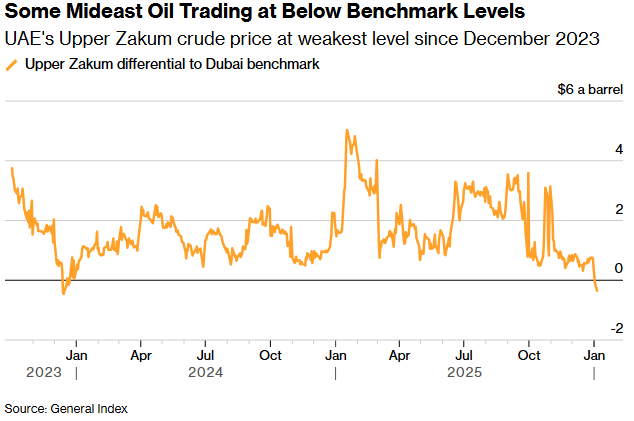
中东原油市场疲态尽显,亚洲买家“淡看”委内瑞拉变局
Jin Shi Shu Ju· 2026-01-06 06:10
Group 1 - The Middle East oil market is showing signs of further weakness, raising concerns about a potential global supply surplus that could drive oil prices lower [1] - The price differential between Dubai benchmark crude and Brent crude futures has widened to its largest level since August, indicating ample supply [1] - The forward curve of Dubai swaps has returned to a "contango" structure, where near-term contract prices are lower than future contract prices, a typical bearish signal [1] Group 2 - Saudi Aramco has significantly lowered its selling prices to major Asian customers for the third consecutive month, pushing the price differential for its flagship Arab Light crude to a five-year low [2] - The current market conditions have alleviated concerns about U.S. intervention in Venezuela potentially disrupting oil flows from the South American country [2] - There is a notable lack of urgency among Asian buyers to purchase alternative Middle Eastern grades such as Iraq's Basrah crude [2] Group 3 - Approximately 8 million barrels of crude oil scheduled for shipment in February remain unsold, which is unusual as such supplies are typically sold by the end of December [3] - This backlog in sales indicates that it is the fourth consecutive month that Arabian Gulf crude has struggled to find buyers [3] - Historically, the region has been able to sell most of its oil offerings [3]
大越期货纯碱早报-20251218
Da Yue Qi Huo· 2025-12-18 01:44
Report Summary 1. Investment Rating No investment rating for the industry is provided in the report. 2. Core View The fundamentals of soda ash are weak, with high supply, declining terminal demand, and high inventory levels. The industry's supply - demand mismatch has not been effectively improved. In the short term, soda ash is expected to move in a volatile manner [2][5]. 3. Summary by Directory 3.1 Daily View - Fundamentals: Alkali plant production is at a high level, with the second - phase of Yuangxing expected to be put into operation before the end of the year, leading to an expected abundant supply. Downstream float glass and photovoltaic daily melting volumes are on a downward trend, and soda ash plant inventories are at a historically high level [2]. - Basis: The spot price of heavy soda ash in Hebei Shahe is 1,135 yuan/ton, and the closing price of SA2605 is 1,170 yuan/ton, with a basis of - 35 yuan, indicating that the futures price is higher than the spot price [2]. - Inventory: The national soda ash plant inventory is 149.43 million tons, a 2.88% decrease from the previous week, and the inventory is above the 5 - year average [2]. - Disk: The price is running below the 20 - day moving average, and the 20 - day moving average is downward [2]. - Main Position: The main position is net short, and short positions are increasing [2]. - Expectation: Soda ash is expected to move in a volatile manner in the short term due to weak fundamentals [2]. 3.2 Influencing Factors - Bullish Factors: Equipment problems have led to enterprise production cuts for maintenance, resulting in a slow recovery of soda ash supply [3]. - Bearish Factors: Since 2023, soda ash production capacity has expanded significantly, and there are still large production plans this year. The industry's production is at a historically high level. The downstream photovoltaic glass of heavy soda ash has cut production, reducing the demand for soda ash [4]. 3.3 Main Logic The supply of soda ash is at a high level, terminal demand is declining, inventory is at a high level in the same period, and the industry's supply - demand mismatch has not been effectively improved [5]. 3.4 Soda Ash Futures Market | Day Session | Main Contract Closing Price | Heavy Soda Ash: Shahe Low - end Price | Main Basis | | --- | --- | --- | --- | | Previous Value | 1,170 yuan/ton | 1,140 yuan/ton | - 30 yuan/ton | | Current Value | 1,170 yuan/ton | 1,135 yuan/ton | - 35 yuan/ton | | Change Rate | 0.00% | - 0.44% | 16.67% | [6] 3.5 Soda Ash Spot Market The low - end price of heavy soda ash in the Hebei Shahe market is 1,135 yuan/ton, a decrease of 5 yuan/ton from the previous day [12]. 3.6 Supply in the Fundamentals - Production Profit: The profit of heavy soda ash using the North China ammonia - soda process is - 147.60 yuan/ton, and the profit of the East China co - production process is - 129 yuan/ton, both at historically low levels [15]. - Operating Rate, Production Capacity, and Output: The weekly operating rate of the soda ash industry is 84.35%. The weekly production of soda ash is 73.54 million tons, including 39.78 million tons of heavy soda ash, with production at a historically high level [18][21]. - Production Capacity Changes: From 2023 to 2025, there have been and are still plans for significant increases in soda ash production capacity. In 2023, the total new production capacity was 6.4 billion tons; in 2024, it was 1.8 billion tons; and the planned new production capacity in 2025 is 7.5 billion tons, with 1 billion tons actually put into production [22]. 3.7 Demand in the Fundamentals - Production - Sales Ratio: The weekly production - sales ratio of soda ash is 106.02% [25]. - Downstream Demand: The national daily melting volume of float glass is 157,200 tons, with an operating rate of 74.85% [28]. 3.8 Inventory in the Fundamentals The national soda ash plant inventory is 149.43 million tons, a 2.88% decrease from the previous week, and the inventory is above the 5 - year average [34]. 3.9 Supply - Demand Balance Sheet The report provides the annual supply - demand balance sheet of soda ash from 2017 to 2024E, including data on effective production capacity, output, operating rate, imports, exports, net imports, apparent supply, total demand, supply - demand difference, and various growth rates [35].
乙二醇利空兑现,关注估值低位反弹可能性
Tong Hui Qi Huo· 2025-12-17 06:36
Price Trend Judgment - The price of ethylene glycol futures has been rising recently, but there is pressure on the fundamentals, and the price is likely to fluctuate. The reasons are as follows: on the cost side, the profits of coal-based and natural gas-based production have deteriorated, indicating a possible increase in costs; the profits of ethylene-based production have improved, possibly due to a decrease in ethylene costs. On the demand side, the loads of polyester factories and Jiangsu and Zhejiang looms are stable, with no significant changes in demand. In terms of inventory, the port inventory has increased, indicating an oversupply pressure [39][41][45]. Ethylene Glycol Futures Market Data Change Analysis - **Main Contract and Basis**: The price of the main contract rose by 49 yuan to 3,700 yuan/ton, and the spot price rose by 40 yuan to 3,670 yuan/ton. The basis widened from -21 yuan to -30 yuan (the futures premium increased) [36][24][25]. - **Position and Trading Volume**: The trading volume increased significantly by 42.01% to 229,814 lots, and the position decreased significantly by 15.82% to 170,475 lots, indicating active trading, but the decrease in position may mean that some positions were closed [36][29]. Industrial Chain Supply, Demand, and Inventory Change Analysis - **Supply Side**: The overall operating rate remained stable at 61.13%, with the oil-based operating rate at 71.18% and the coal-based at 49.34%, both showing no changes. In terms of profits, the profits of ethylene-based production improved (e.g., SD oxidation method improved by 97 yuan), but the profits of coal-based and natural gas-based production deteriorated. This may affect future supply, but the current operating rate is stable [37][26][30]. - **Demand Side**: The load of polyester factories was 89.42%, and the load of Jiangsu and Zhejiang looms was 63.43%, both showing no changes. The demand was stable [38][40]. - **Inventory Side**: The inventory at the main ports in East China increased by 25,000 tons to 844,000 tons, a 3.05% increase, and the inventory in Zhangjiagang slightly decreased by 2,000 tons to 318,000 tons. The inventory pressure increased [39][40].