
建筑和采矿设备

Search documents
卡特彼勒(CAT.US)成“二线AI概念股”领头羊!市值首破 3000 亿美元大关
智通财经网· 2026-01-13 23:25
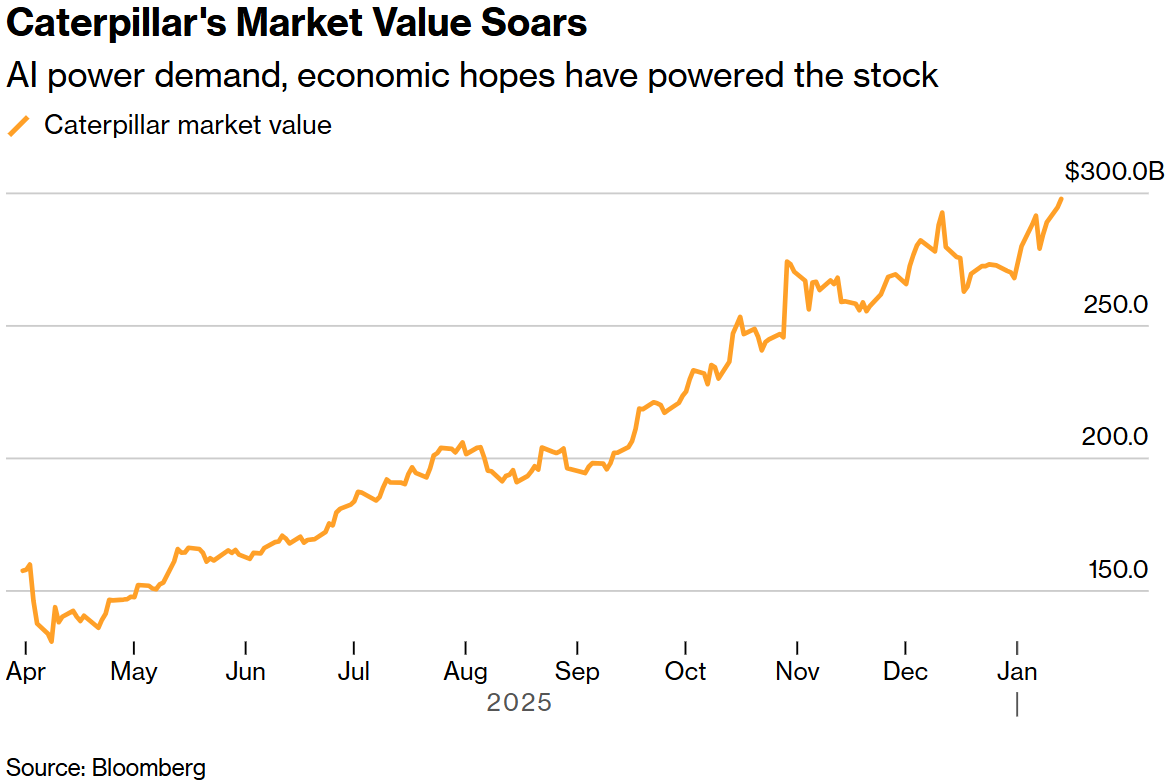
Group 1 - Caterpillar's stock price has continued to rise, driven by strong AI prospects, with its market capitalization briefly surpassing $300 billion [1] - The stock price increased by 2.4% to a high of $644.59 before closing up 1.1%, resulting in a market cap of approximately $298 billion [1] - Caterpillar's stock has risen 11% this year, following a 58% increase last year, making it one of the best-performing stocks in the S&P 500 industrial index [1] Group 2 - The demand for power generation equipment, driven by data center needs, has created a record backlog of orders for Caterpillar [1] - Analysts highlight that the power generation segment is the fastest-growing part of the company, with above-average transparency and significant capacity increases to meet demand [1] - Economic optimism has benefited Caterpillar's stock, as investors shift towards economically sensitive stocks following stronger-than-expected U.S. economic growth [4]


Caterpillar Unusual Options Activity - Caterpillar (NYSE:CAT)
Benzinga· 2026-01-07 15:02
Group 1: Market Sentiment and Options Activity - Whales have adopted a bearish stance on Caterpillar, with 61% of trades being bearish and only 38% bullish [1] - The total amount for put trades is $157,421, while call trades amount to $821,915 [1] - Major market movers are focusing on a price band between $480.0 and $620.0 for Caterpillar over the last three months [2] Group 2: Volume and Open Interest Analysis - Analyzing volume and open interest provides insights into liquidity and interest for Caterpillar's options [3] - The evolution of volume and open interest for calls and puts within the strike price range of $480.0 to $620.0 has been tracked over the last 30 days [3] Group 3: Options Overview - A summary of significant options trades shows a mix of bearish and bullish sentiments, with notable trades including a bearish call at a strike price of $560.00 and a bullish call at $610.00 [6] - The largest trade recorded was a bearish call with a total trade value of $437.2K at a strike price of $560.00 [6] Group 4: Company Overview - Caterpillar is the leading manufacturer of construction and mining equipment, with a market share approaching 20% across many products [7] - The company operates a global network of over 150 dealers and approximately 2,800 facilities, reaching about 190 countries [7] Group 5: Analyst Ratings and Market Status - Recent analyst ratings for Caterpillar show an average target price of $571.67, with Citigroup maintaining a Buy rating targeting $690 [9] - Current trading volume is 167,125, with the stock price at $619.2, reflecting a decrease of -0.63% [10] - Analysts from Bernstein and Morgan Stanley have set price targets of $630 and $395, respectively, with Bernstein maintaining a Market Perform rating [12]

Caterpillar Inc. (NYSE:CAT) Insider Purchase and Financial Overview
Financial Modeling Prep· 2025-11-07 02:13
Core Insights - Caterpillar Inc. is a leading manufacturer in the construction and mining equipment sector, competing with companies like Komatsu and John Deere [1] Financial Metrics - The company's price-to-earnings (P/E) ratio is 28.83, indicating investor willingness to pay for earnings [3] - Caterpillar has a price-to-sales ratio of 4.13, reflecting market valuation of its revenue [3] - The enterprise value to sales ratio stands at 4.51, while the enterprise value to operating cash flow ratio is 25.28, suggesting market valuation of sales and cash flow from operations [4] - The earnings yield for Caterpillar is 3.47%, providing insight into shareholder return on investment [4] - The debt-to-equity ratio is 1.56, indicating financial leverage, and the current ratio is 1.38, suggesting the ability to cover short-term liabilities [5] Insider Transactions - Director MacLennan David purchased 300 shares at $568.86 each, increasing his total holdings to 7,947 shares, which may signal confidence in the company's future prospects [2][6] Shareholder Impact - CAT Strategic Metals Corporation's Rights Offering, expiring on November 21, 2025, allows shareholders to subscribe for units at $0.0075 each, potentially impacting shareholder value [5][6]
Caterpillar Inc. (NYSE:CAT) Sees Positive Outlook from Analysts
Financial Modeling Prep· 2025-11-06 05:13
Core Viewpoint - Caterpillar Inc. has received an upgrade from HSBC, reflecting increased confidence in its market position and growth prospects, supported by positive stock performance and investor interest [2][5]. Company Overview - Caterpillar Inc. is a leading manufacturer in the construction and mining equipment sector, as well as diesel and natural gas engines, industrial gas turbines, and diesel-electric locomotives, operating globally across various industries [1]. Stock Performance - The stock price of Caterpillar is currently at $569.15, having increased by 3.94%, or $21.57, following the upgrade from HSBC [2][5]. - The stock's trading range today is between $550.36 and $574.01, indicating active investor interest [3]. Market Capitalization and Trading Volume - Caterpillar's market capitalization is approximately $266.63 billion, highlighting its significant presence in the industry [4][5]. - The trading volume on the NYSE is 2,696,506 shares, reflecting strong investor engagement [4][5]. Historical Stock Volatility - Over the past year, Caterpillar's stock has reached a high of $596.21 and a low of $267.30, demonstrating its volatility and potential for growth [4].
Buy Or Sell Caterpillar Stock?
Forbes· 2025-11-03 17:10
Core Viewpoint - Caterpillar (CAT) has shown strong performance in the industrial sector, driven by optimism around infrastructure spending and a resilient U.S. economy, but concerns arise regarding its stock valuation and operational performance, suggesting a potential sell-off [2][4]. Performance Metrics - CAT stock has surged 10% over the last week, currently trading at $577.26, but a price target of $404 is considered achievable due to weak operational performance and financial health [2][5]. - The company has experienced a revenue decline of 4.9% over the past 12 months, dropping from $66 billion to $63 billion, with quarterly revenues also falling by 0.7% to $17 billion compared to the same quarter last year [5][9]. Valuation and Financial Health - CAT's market capitalization stands at $271 billion, with a debt of $41 billion, resulting in a debt-to-equity ratio of 15.0% [9]. - The company has an operating income of $12 billion, reflecting an operating margin of 18.2%, and a net income of approximately $9.4 billion, indicating a net margin of around 14.9% [9]. Downturn Resilience - CAT has shown moderate resilience during economic downturns, experiencing a slightly worse impact than the S&P 500 index during several crises, including the 2020 COVID-19 pandemic and the 2008 financial crisis [6][10].

Caterpillar Inc. (NYSE: CAT) Sees Optimistic Price Target from Truist Financial
Financial Modeling Prep· 2025-10-30 22:15
Core Viewpoint - Caterpillar Inc. demonstrates strong financial performance with a positive outlook for future growth, despite slight fluctuations in stock price. Financial Performance - Caterpillar's third-quarter sales and revenues increased by 10% year over year to $17.64 billion, surpassing the expected $16.77 billion [2] - Adjusted earnings per share were $4.95, exceeding the $4.52 estimate but slightly below the previous year's $5.17 [3] - GAAP profit per share was $4.88, compared to $5.06 a year ago [3] Stock Performance - Truist Financial set a new price target for Caterpillar at $729, indicating a potential 24.51% increase from the current trading price of $585.49 [2] - Despite the positive earnings report, Caterpillar shares experienced a slight decline of 0.1%, trading at $585.02 [4] - The stock has fluctuated between a low of $575.77 and a high of $593.77 on the day of reporting [4] Market Position - Caterpillar's market capitalization stands at approximately $274.45 billion, with a trading volume of 1,527,198 shares on the NYSE [5] - Over the past year, CAT has reached a high of $596.21 and a low of $267.30 [5] Future Outlook - Caterpillar expects its 2025 full-year sales and revenues to be modestly higher than those in 2024, with full-year services revenues remaining approximately flat [5]

Caterpillar (CAT): A Must-Buy Dividend Stock Built for Long-Term Investors
Yahoo Finance· 2025-10-17 01:25
Core Insights - Caterpillar Inc. (NYSE:CAT) is recognized as a leading dividend stock suitable for long-term investors [2][4] - The company has diversified its business beyond heavy machinery into brand licensing and financial services [3] - Despite challenges from tariffs, Caterpillar's stock has seen a significant increase, reflecting strong investor confidence [4] Business Overview - Caterpillar Inc. is a global leader in heavy machinery, producing construction and mining equipment, diesel and natural gas engines, industrial turbines, and diesel-electric locomotives [2] - The company operates through a comprehensive dealer network that spans every continent [2] Financial Performance - Caterpillar has maintained a 31-year streak of dividend growth, making it attractive for income-focused investors [5] - On October 6, the company declared a quarterly dividend of $1.51 per share, consistent with previous dividends, resulting in a dividend yield of 1.21% as of October 9 [5] Market Challenges - Tariffs have presented challenges for the company, with projected costs reaching $1.8 billion by 2025 [4] - A recent federal appeals court ruling has introduced uncertainty regarding the future of many Trump-era tariffs [4]
涉及至少720种产品,日企叫苦:“关税比想象中高”
Huan Qiu Shi Bao· 2025-09-28 22:45
Group 1 - Japanese companies are facing significant impacts from the U.S. government's steel and aluminum tariffs, which now include at least 720 products categorized as "derivative goods" [1] - The complex tariff structure imposes a 50% steel and aluminum tariff on the portion of products that use these materials, while a "countervailing duty" of 15% applies to Japan [1] - The expansion of the tariff list to include "derivative goods" has raised concerns among foreign companies and industry organizations, as it appears to be aimed at protecting U.S. domestic manufacturing [1] Group 2 - The Japan Construction Equipment Manufacturers Association has requested the Japanese government to negotiate with Washington to exclude construction machinery from the steel and aluminum tariffs [2] - Exports of construction and mining equipment from Japan to the U.S. were valued at over 800 billion yen in FY2024, but saw a 26% year-on-year decline in August [2] - The inclusion of cutlery products in the "derivative goods" category has negatively impacted manufacturers in Niigata Prefecture, with one company expressing concerns about potential price increases leading to reduced consumer demand [2] Group 3 - A recent agreement between Japan and the U.S. established a 15% tariff rate on Japanese exports, making it easier for companies to strategize around additional costs, but the steel and aluminum tariffs have complicated this [2] - The Japanese Minister of Economy, Trade and Industry has stated efforts will be made to assess the impact of the expanded tariffs and coordinate with relevant industries [2] - The U.S. Department of Commerce has initiated an investigation to determine if specific tariffs or import restrictions should be applied to machine tools, industrial robots, and medical devices, causing the Japanese machine tool industry to remain cautious [2]