
钢铝关税

Search documents
纳瓦罗称有关美国拟下调钢铝关税的报道“毫无事实依据”
Xin Lang Cai Jing· 2026-02-13 15:42
Core Viewpoint - The report indicates that there are no factual bases for claims regarding the government's plans to lower steel and aluminum tariffs, as stated by White House trade advisor Peter Navarro [1][1]. Group 1 - Navarro emphasizes that steel and aluminum are considered "sacred" to the current administration [1]. - The Trump administration adheres to a policy of "no exemptions, no exceptions" regarding tariffs on steel and aluminum [1].
美欧数字关税战升级 黄金上4236下4183
Jin Tou Wang· 2025-12-03 06:17
Group 1 - The current spot gold price is trading around $4,228, with a latest quote of $4,215.24 per ounce, reflecting a 0.23% increase, and has seen a high of $4,228.57 and a low of $4,201.67 during the session [1] - The gold market is expected to exhibit a range-bound trading pattern following a "V-shaped" reversal observed in the previous trading day, where prices had been declining [3] - Recent comments from Trump disrupted the downward trend in gold prices, leading to a recovery, although the overall market direction remains unclear, indicating a lack of strong momentum for either upward or downward movement [3] Group 2 - The U.S. has imposed a 50% tariff on over 400 types of steel and aluminum from the EU, amidst ongoing trade tensions, particularly concerning digital regulations affecting U.S. companies [2] - The EU has enacted strict regulations under the Digital Services Act and Digital Markets Act, resulting in significant fines for companies like Google, and is evaluating potential penalties for Amazon and Microsoft [2] - The U.S. is leveraging its position by linking digital regulations to tariff negotiations, creating a challenging situation for the EU, which faces political backlash if it concedes to U.S. demands [2]
【环球财经】美欧数字监管冲突升级 欧战略自主空间遭挤压
Xin Hua She· 2025-12-03 03:58
Core Viewpoint - Recent tensions have arisen between the US and EU regarding digital regulation, with the US accusing the EU of unfair practices against American tech companies and using tariffs as leverage to demand concessions from the EU [1][2]. Group 1: US-EU Trade Relations - The US imposed a 50% tariff on over 400 steel and aluminum products from the EU in August, while criticizing the EU's increasing digital regulations on American tech firms [2]. - The EU has taken enforcement actions against American tech companies, including a €2.95 billion antitrust fine against Google and ongoing investigations into Amazon and Microsoft regarding their cloud services [2][4]. - US Secretary of Commerce has linked digital regulation to steel and aluminum tariffs, suggesting that the EU must adjust its tech regulations for the US to consider lowering tariffs [3][4]. Group 2: Digital Sovereignty vs. Economic Interests - The US aims to maintain its dominance in the global digital industry by pressuring the EU to relax its digital regulations, which the EU views as a matter of sovereignty [4][5]. - The EU insists on its right to legislate digital regulations independently, with officials stating that these regulations are non-negotiable and part of their sovereign rights [4][5]. - The EU's strategic autonomy is being challenged as the US uses tariffs as leverage, creating a dilemma for the EU between maintaining digital sovereignty and protecting its economic interests [5][6]. Group 3: Future Implications - The linkage of tariffs and digital regulation may complicate future trade negotiations, as the US adopts a "cross-issue" negotiation strategy that could embed digital regulation conditions in any trade discussions [5][6]. - The EU's need for tariff reductions may lead to political backlash if concessions are made on digital regulations, while a firm stance could result in greater trade impacts and deepen transatlantic rifts [6].
27国通告美国,联手断中方后路,话音刚落,特朗普先向中国献礼
Sou Hu Cai Jing· 2025-11-26 13:49
Core Viewpoint - The EU is attempting to leverage its relationship with the US to negotiate tariff reductions, particularly concerning steel and aluminum, while simultaneously trying to use China as a bargaining chip. However, the US is not receptive to this strategy and is instead focusing on EU digital regulations as a key negotiation point [1][3][5]. Group 1: EU's Strategy and Challenges - The EU is under pressure due to the potential expansion of US steel and aluminum tariffs, which could affect over 400 products with a 50% tariff rate, threatening the viability of European steel companies [3][5]. - In an effort to negotiate tariff relief, the EU is promoting a narrative of a "common enemy" in China, suggesting that if the US eases tariffs, the EU will support US efforts against China [3][5]. - The EU's reliance on China for critical resources, such as rare earth elements and components for electric vehicles, has created a sense of urgency to negotiate with the US while also managing its relationship with China [5][16]. Group 2: US's Position and Digital Regulations - US Commerce Secretary Gina Raimondo has shifted the focus of negotiations to the EU's digital regulations, suggesting that if the EU can find a balanced regulatory framework, it could attract $1 trillion in investment, which is more appealing to the US than the EU's anti-China stance [7][9]. - The US is not interested in a united front against China but rather in easing regulations that affect American tech giants, indicating a prioritization of economic interests over geopolitical alliances [9][18]. - The EU's digital regulatory framework is seen as a point of contention, as it represents a significant area of legislative power for the EU, which the US is attempting to leverage in negotiations [9][20]. Group 3: Implications for EU-China Relations - The EU's attempt to align with the US against China has backfired, as the US has simultaneously offered concessions to China, such as reducing tariffs on fentanyl-related products and suspending export controls on rare earths [11][14]. - This dual approach by the US highlights a disparity in how the EU and US view their relationships with China, with the US prioritizing its own economic needs over its alliance with the EU [14][22]. - The EU's strategy of using China as a bargaining chip has left it in a precarious position, as it risks alienating a key trading partner while failing to secure the desired concessions from the US [16][20].

欧盟对美国说“不”:欧洲数字监管不容谈判 不换钢铝关税减免
Di Yi Cai Jing· 2025-11-25 05:02
Core Viewpoint - The EU has firmly rejected the US proposal to link the reduction of steel and aluminum tariffs to the relaxation of technology regulations, emphasizing the importance of its digital regulatory framework for market fairness and consumer protection [1][6]. Group 1: US-EU Trade Relations - The US Secretary of Commerce, Gina Raimondo, indicated that a favorable steel and aluminum agreement would require the EU to ease its technology regulations [1]. - The EU is concerned that over 400 products are affected by the 50% steel and aluminum tariffs, which could undermine the trade agreement reached in July [2]. - The EU Trade Commissioner stated that the EU has made progress in fulfilling its commitment to purchase $250 billion worth of energy products from the US over the next three years [5]. Group 2: Digital Regulation - The EU's Digital Services Act and Digital Markets Act are central to its technology regulation, aimed at ensuring accountability and preventing anti-competitive behavior among major tech companies [3][2]. - The EU maintains that its digital regulations are not negotiable and are designed to protect consumer rights and promote fair competition [1][6]. - The EU has imposed significant fines on major tech companies, including a €2.95 billion fine on Google, indicating its strict enforcement of digital regulations [6]. Group 3: EU's Stance on Negotiations - The EU insists on its legislative sovereignty and will not use its technology regulations as bargaining chips in trade negotiations [1][7]. - An EU official emphasized that steel tariffs and digital technology regulations are completely unrelated issues [7]. - The EU's strict regulatory approach is seen as a means to protect its market and promote local industry development, given its lag behind the US in digital technology [7].
涉及至少720种产品,日企叫苦:“关税比想象中高”
Huan Qiu Shi Bao· 2025-09-28 22:45
Group 1 - Japanese companies are facing significant impacts from the U.S. government's steel and aluminum tariffs, which now include at least 720 products categorized as "derivative goods" [1] - The complex tariff structure imposes a 50% steel and aluminum tariff on the portion of products that use these materials, while a "countervailing duty" of 15% applies to Japan [1] - The expansion of the tariff list to include "derivative goods" has raised concerns among foreign companies and industry organizations, as it appears to be aimed at protecting U.S. domestic manufacturing [1] Group 2 - The Japan Construction Equipment Manufacturers Association has requested the Japanese government to negotiate with Washington to exclude construction machinery from the steel and aluminum tariffs [2] - Exports of construction and mining equipment from Japan to the U.S. were valued at over 800 billion yen in FY2024, but saw a 26% year-on-year decline in August [2] - The inclusion of cutlery products in the "derivative goods" category has negatively impacted manufacturers in Niigata Prefecture, with one company expressing concerns about potential price increases leading to reduced consumer demand [2] Group 3 - A recent agreement between Japan and the U.S. established a 15% tariff rate on Japanese exports, making it easier for companies to strategize around additional costs, but the steel and aluminum tariffs have complicated this [2] - The Japanese Minister of Economy, Trade and Industry has stated efforts will be made to assess the impact of the expanded tariffs and coordinate with relevant industries [2] - The U.S. Department of Commerce has initiated an investigation to determine if specific tariffs or import restrictions should be applied to machine tools, industrial robots, and medical devices, causing the Japanese machine tool industry to remain cautious [2]
又来?特朗普政府拟将更多钢铝制品衍生品纳入关税范围
Di Yi Cai Jing· 2025-09-16 00:58
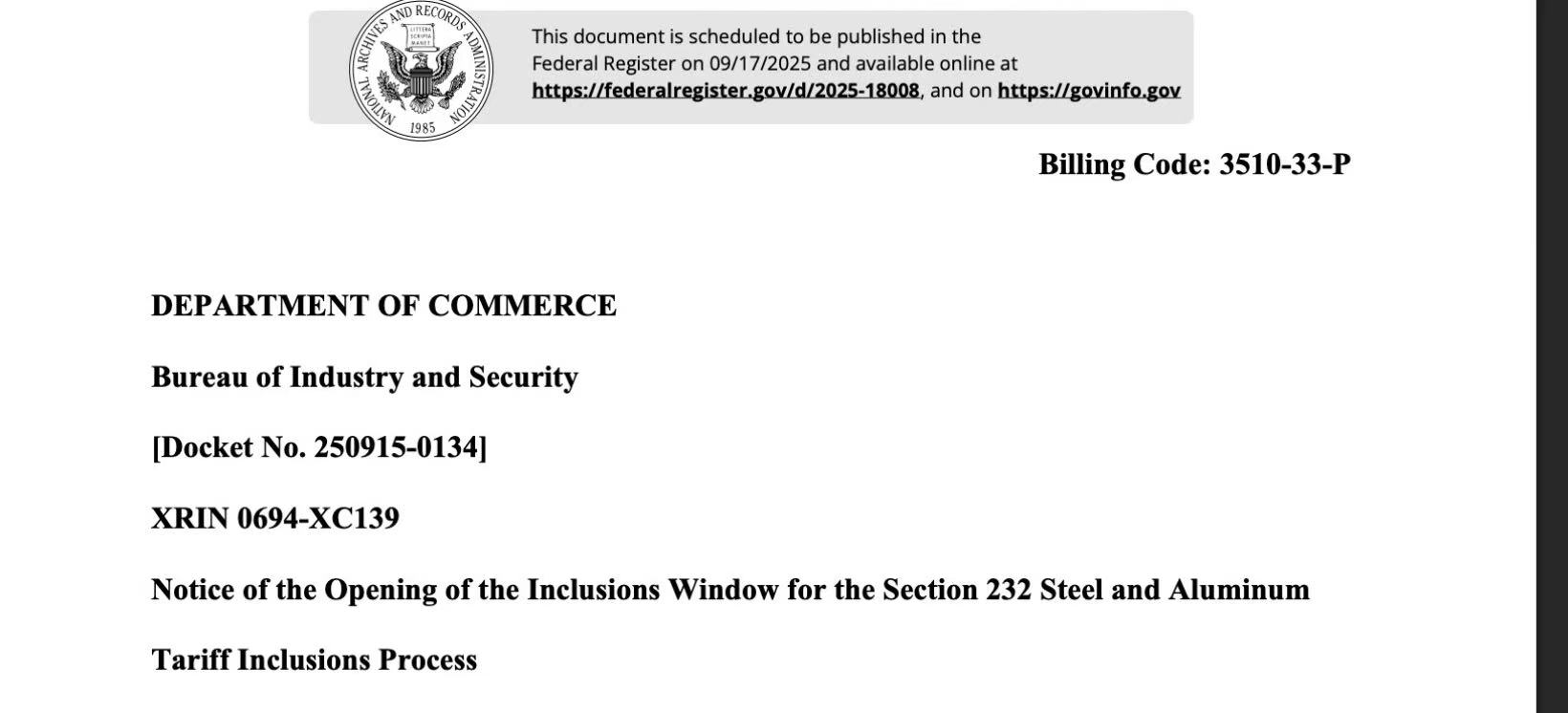
Core Points - The U.S. Department of Commerce has announced the opening of an application window for additional steel and aluminum derivative products to be included under tariffs authorized by President Trump, starting from September 15, 2025, and closing on September 29, 2025 [1][2] - This initiative follows previous announcements and actions taken by the Trump administration to adjust tariffs on aluminum and steel imports, including the establishment of a process to include more derivative products under Section 232 of the Trade Expansion Act of 1962 [3][5] Summary by Sections Application Process - The application window for including more derivative products under tariffs will be open for two weeks, with submissions required to be sent to the Defense Industrial Base Programs inbox [3] - Approved applications will be published for public comment under the document number BIS-2025-0023 [3] Tariff Adjustments - In February 2025, the Trump administration announced adjustments to aluminum and steel imports, imposing specific tariff rates on certain derivative products [3] - The tariffs on steel and aluminum were increased to 25% in March 2025, with further increases to 50% announced in June 2025, expanding the scope of products subject to these tariffs [5][6] Impact on Trade - The recent expansions in tariff coverage have affected a wide range of products, including consumer goods packaging, industrial products, and heavy machinery [6] - Approximately 673 steel derivative products and 188 aluminum derivative products have been included, representing about 3.5% of all U.S. Harmonized Tariff Schedule (HTSUS) codes [6] Regulatory Environment - The U.S. Customs and Border Protection updated the list of exempt products under Section 232, with new tariffs taking effect without prior notice to importers [6] - The scope of the tariffs can be modified at the discretion of the President, allowing for broad inclusion of various products under the existing tariff framework [7]
美国钢铝关税扩围,钢价有所承压
Minsheng Securities· 2025-08-24 08:55
Investment Rating - The report maintains a "Buy" recommendation for several steel companies, including Hualing Steel, Baosteel, Nanjing Steel, and others in the special steel and pipe sectors [5]. Core Insights - The expansion of U.S. steel and aluminum tariffs has put pressure on steel prices, leading to a notable contraction in steel mill profits [5]. - The report highlights that the long-term focus will remain on capacity management, with a combination of market-oriented and administrative measures expected to optimize crude steel supply [5]. - The report indicates that the seasonal decline in steel demand, coupled with a vacuum in supply-side policies, has resulted in a significant narrowing of steel mill profits [5]. Price Trends - As of August 22, 2025, steel prices have decreased, with Shanghai's 20mm HRB400 rebar priced at 3,270 CNY/ton, down 30 CNY/ton from the previous week [3][11]. - The prices for various steel products have shown a downward trend, with hot-rolled and cold-rolled steel also experiencing price reductions [3][11]. Production and Inventory - As of August 22, 2025, the production of five major steel products increased to 8.78 million tons, with total inventory rising by 264,300 tons to 10.1621 million tons [4]. - The apparent consumption of rebar was estimated at 1.948 million tons, reflecting a week-on-week increase of 48,600 tons [4]. Profitability - The report notes a decline in steel profitability, with margins for rebar, hot-rolled, and cold-rolled steel decreasing by 58 CNY/ton, 50 CNY/ton, and 42 CNY/ton respectively [3][5]. Recommendations - The report recommends specific companies for investment, including Hualing Steel, Baosteel, Nanjing Steel in the general steel sector, and Xianglou New Materials, CITIC Special Steel in the special steel sector [5].


大越期货沪铝早报-20250822
Da Yue Qi Huo· 2025-08-22 02:06
Report Summary 1) Report Industry Investment Rating No information provided. 2) Core View of the Report - The fundamentals of the aluminum industry are neutral due to carbon - neutral policies controlling capacity expansion, weak downstream demand, and a soft real - estate market, along with volatile short - term macro sentiment. The basis shows a neutral state with a spot price of 20690 and a basis of 100, indicating a premium over the futures. The inventory on the Shanghai Futures Exchange increased by 7093 tons to 120653 tons, also neutral. The closing price is above the 20 - day moving average which is moving downwards, a neutral signal. The main positions are net long but the long positions are decreasing, showing a slightly bullish tendency. In the long run, carbon - neutral policies will drive the transformation of the aluminum industry and benefit aluminum prices, but the US expanding steel and aluminum tariffs creates a situation where bullish and bearish factors are intertwined, leading to an oscillating aluminum price [2]. 3) Summary by Relevant Catalogs a. Daily View - Fundamentals: Carbon - neutral policies control capacity expansion, downstream demand is not strong, the real - estate market remains weak, and short - term macro sentiment is volatile; neutral [2]. - Basis: Spot price is 20690, basis is 100, premium over futures; neutral [2]. - Inventory: Shanghai Futures Exchange aluminum inventory increased by 7093 tons to 120653 tons; neutral [2]. - Disk: Closing price is above the 20 - day moving average which is moving downwards; neutral [2]. - Main Positions: Main net long positions, long positions decreasing; slightly bullish [2]. - Expectation: Carbon - neutral policies will drive the transformation of the aluminum industry and benefit aluminum prices in the long run, but the US expanding steel and aluminum tariffs creates a situation where bullish and bearish factors are intertwined, and the aluminum price will oscillate [2]. b. Recent Bullish and Bearish Analysis - Bullish Factors: Carbon - neutral policies control capacity expansion; geopolitical disturbances between Russia and Ukraine affect Russian aluminum supply; interest rate cuts [3]. - Bearish Factors: The global economy is not optimistic, and high aluminum prices will suppress downstream consumption; the export tax rebate for aluminum products is cancelled [3]. - Logic: There is a game between interest rate cuts and weak demand [3]. c. Daily Summary - Spot Prices: Shanghai's yesterday's spot price was 70770, down 375; Nanchu's was 70690, down 450; today's Yangtze River's was 70870, down 400 [4]. - Inventory: Shanghai Futures Exchange warehouse receipts increased by 699 to 70798 tons; LME inventory decreased by 425 to 74750 tons; Shanghai Futures Exchange inventory (weekly) increased by 29728 to 136300 tons [4]. d. Supply - Demand Balance | Time | Production (10,000 tons) | Net Imports (10,000 tons) | Apparent Consumption (10,000 tons) | Actual Consumption (10,000 tons) | Supply - Demand Balance (10,000 tons) | | ---- | ---- | ---- | ---- | ---- | ---- | | 2018 | 3609 | 7.03 | 3615.03 | 3662.63 | - 47.61 | | 2019 | 3542.48 | - 0.64 | 3541.84 | 3610.44 | - 68.61 | | 2020 | 3712.44 | 105.78 | 3818.22 | 3816.92 | 1.3 | | 2021 | 3849.2 | 150.33 | 3994.63 | 4008.83 | - 14.2 | | 2022 | 4007.33 | 46.55 | 4053.88 | 4083.86 | - 29.98 | | 2023 | 4151.3 | 139.24 | 4290.51 | 4294.81 | - 4.31 | | 2024 | 4312.27 | 196.16 | 4502.5 | 4487.5 | 15 | [22]
重庆钢铁股价持平 美国加征钢铝关税影响有限
Jin Rong Jie· 2025-08-21 12:10
Group 1 - The stock price of Chongqing Steel is reported at 1.51 yuan as of August 21, 2025, remaining stable compared to the previous trading day, with a trading volume of 1.5953 million hands and a transaction amount of 241 million yuan [1] - Chongqing Steel operates in the steel industry, primarily engaged in the production and sales of steel products, which are widely used in construction and machinery manufacturing [1] - The recent announcement by the U.S. to impose a 50% tariff on 407 categories of steel and aluminum derivatives is expected to have a limited direct impact on Chinese steel companies, as only 0.7% of China's steel exports went to the U.S. in the first half of 2025 [1] Group 2 - Chongqing Steel indicated in its semi-annual report forecast that losses have decreased in the first half of the year [1] - On August 21, 2025, the net inflow of main funds into Chongqing Steel was 23.7737 million yuan, accounting for 0.19% of the circulating market value, with a cumulative net inflow of 48.1723 million yuan over the past five trading days, representing 0.38% of the circulating market value [1]
