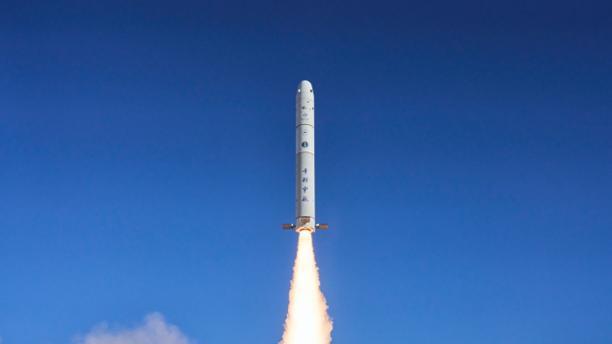
微重力激光增材制造返回式科学实验载荷

Search documents
多个首次!我国科技再迎密集突破
Yang Shi Xin Wen Ke Hu Duan· 2026-01-24 08:18
Group 1: Breakthroughs in Technology - China's first successful automatic formation trial of heavy-duty trains marks a significant advancement in railway freight, achieving a 50% increase in comprehensive capacity through wireless communication technology [1] - The successful launch of 19 low-orbit satellites for satellite internet represents a milestone in digital process integration, enhancing efficiency through automated testing and intelligent assembly [1] - The first realization of space metal 3D printing signifies a major leap in space manufacturing technology, transitioning from ground validation to space engineering verification [3] Group 2: Energy Sector Developments - The full-capacity operation of the Zhejiang Anji power plant, the largest and most efficient gas power plant in China, supports winter electricity demand in East China with a total installed capacity of 1686 megawatts and an efficiency of 64.15% [4] - The Anji power plant is expected to generate up to 7 billion kilowatt-hours annually, sufficient to meet the electricity needs of 6 million residents for a year [4] Group 3: Scientific Research Advancements - Chinese scientists have presented the dynamic process of gold nanoparticle formation at the nanoscale, challenging traditional views on gold sources and providing new insights for green gold extraction processes [2]
我国首次在太空微重力条件下制造出完整金属构件
Yang Shi Xin Wen· 2026-01-22 12:39
Core Viewpoint - The Chinese Academy of Sciences' Institute of Mechanics has successfully conducted the first space laser melting metal additive manufacturing experiment in microgravity, marking a significant advancement in space technology [1] Group 1: Technology Breakthroughs - The experiment utilized a microgravity laser additive manufacturing payload aboard the "Lihong-1" remote rocket, achieving key technological breakthroughs in metal additive manufacturing under microgravity conditions [1] - The system demonstrated closed-loop control throughout the entire process, ensuring high reliability in the collaboration between the payload and the rocket [1] Group 2: Experimental Outcomes - The payload successfully returned to Earth via a parachute system, allowing for the recovery of metal components manufactured in space, along with comprehensive data and performance parameters [1] - The experiment has established a foundational theoretical framework and a process database for space metal manufacturing through various experimental systems, including microgravity drop towers and suborbital rockets [1] Group 3: Industry Implications - Space metal additive manufacturing is viewed as a critical enabling technology for future space missions, facilitating rapid in-orbit manufacturing and autonomous repair of spacecraft components [1] - This technology significantly reduces reliance on ground supplies, enhancing the flexibility and sustainability of deep space exploration, long-term operations of space stations, and lunar base construction [1]
力鸿一号遥一飞行器亚轨道飞行试验任务取得圆满成功
Huan Qiu Wang Zi Xun· 2026-01-12 11:29
Core Viewpoint - The successful test flight of the PH-1 spacecraft marks a significant advancement in space manufacturing technology, transitioning from concept validation to engineering validation, laying a solid technical foundation for future developments in space manufacturing, experiments, medicine, and tourism [1]. Group 1: Test Flight Achievements - The PH-1 spacecraft completed its first flight test, reaching an altitude of approximately 120 kilometers and crossing the Kármán line into space, successfully demonstrating the return and recovery of its payload capsule [1]. - The flight verified high-reliability parachute aerodynamic deceleration technology and precise landing control technology for the sub-stage of the spacecraft, achieving a landing accuracy of within 100 meters [2][3]. Group 2: Technological Innovations - The parachute recovery system utilized during the landing process involved advanced trajectory prediction and reliability modeling techniques, which will support the development of reusable flight vehicles like the PH-2 [3][4]. - The precise landing control technology is crucial for the vertical return and reuse of rocket sub-stages, employing real-time trajectory optimization algorithms to address complex landing conditions [4]. Group 3: Scientific Experiments and Applications - The flight carried a microgravity laser additive manufacturing payload, which aims to validate the feasibility of laser melting wire metal additive manufacturing in microgravity, providing essential data for future space manufacturing technologies [6]. - The mission also included the space radiation mutation of rose seeds, which will contribute to the development of new rose varieties with improved traits, thus paving the way for advancements in space agriculture [7]. Group 4: Future Developments - The collaboration between the China Aerospace Science and Technology Corporation and the Chinese Academy of Sciences aims to develop a reconfigurable flexible on-orbit manufacturing platform, enhancing the capabilities for long-duration missions and multiple reuses [6][7]. - The upgraded payload capsule is expected to support missions with a minimum operational duration of one year and at least ten reuse cycles, facilitating a wide range of scientific experiments and manufacturing processes in space [6].