房利美MBS

Search documents
外汇商品 | 就业市场触发预警,利好美债前景——美国国债月报2025年第十二期
Sou Hu Cai Jing· 2025-11-27 00:30
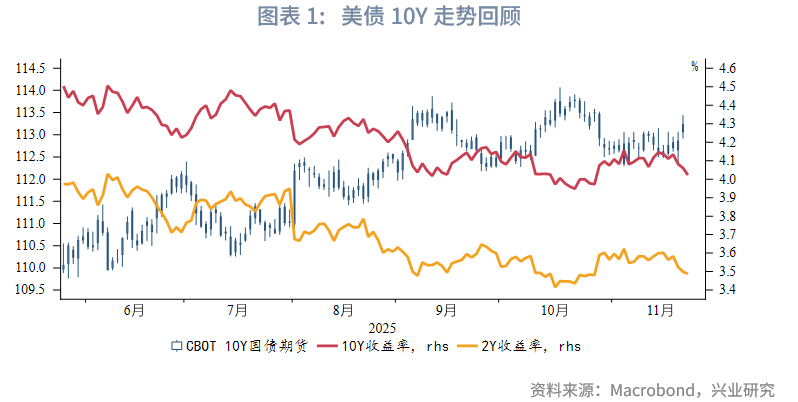
Group 1: Economic Indicators and Federal Reserve Actions - The unemployment rate and layoff numbers in the U.S. have triggered early warning signals, indicating potential further pressure on the job market as the inventory cycle approaches its bottom [1][5][7] - The Federal Reserve is likely to continue its rate-cutting cycle, with a high probability of a 25 basis point cut in December, although the market has already priced in this expectation [2][28] - The 10-year Treasury yield is expected to experience low volatility, with support levels at 3.9% and 3.8%, and resistance levels at 4.1% and 4.2% [2][28] Group 2: Employment Market Analysis - The unemployment rate exhibits strong cyclical and nonlinear characteristics, with sharp increases during economic downturns and gradual decreases during recoveries [5][6] - The Challenger job-cut report shows a significant increase in layoffs, particularly in government sectors, which raises concerns about the employment market's deterioration [6][7] - The cumulative month-on-month change in the unemployment rate reached 0.4% in October, signaling a potential economic slowdown [6][7] Group 3: MBS Market Monitoring - In November, agency MBS yields declined alongside Treasury yields, with Fannie Mae MBS experiencing a slightly larger decrease than Freddie Mac MBS [1][38] - The credit spread of agency MBS relative to Treasuries remains stable near historical median levels, indicating a neutral valuation [38] - The duration of agency MBS is stable at around 5.5 to 6 years, with no significant overvaluation or undervaluation detected [38]

外汇商品 | 美债收益率或难流畅下行——美国国债月报2025年第十一期
Sou Hu Cai Jing· 2025-10-29 00:50
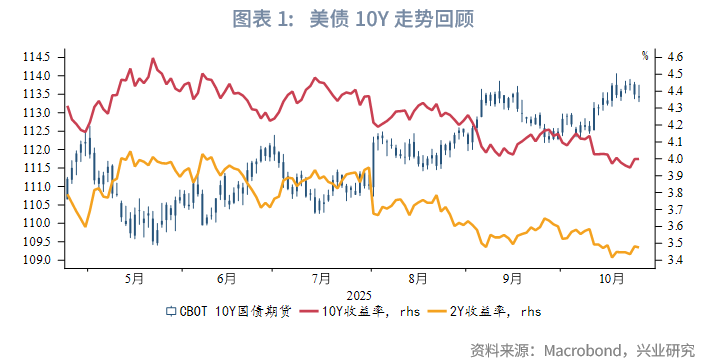
Core Viewpoint - The U.S. employment market shows signs of resilience despite the government shutdown, indicating a potential "soft landing" for the economy. Although September's non-farm payrolls were weak, improvements are expected in the coming months. The unemployment rate's upward pressure may ease as layoffs decrease [1][7][8]. Economic Outlook - The U.S. high-frequency economic indicators are entering an upward cycle, with employment data expected to show resilience. This limits the potential for significant declines in bond yields. The Consumer Price Index (CPI) likely peaked in September and is expected to enter a declining phase over the next few months, which will restrict interest rate rebounds. The 10-year yield is projected to oscillate within a weak range, with support at 3.9% and 3.8%, and resistance at 4.1% and 4.2% [1][33][34]. Market Review - The prolonged U.S. government shutdown led to the absence of employment data, while the CPI data release was delayed. Mid-month, tensions escalated in U.S.-China trade relations, and two regional banks faced crises, heightening risk aversion. However, by the end of the month, a framework agreement was reached in U.S.-China talks, and the regional bank issues did not escalate into systemic risks, leading to a recovery in market risk appetite [2]. Employment Data Insights - Five private sector indicators reflect the state of non-farm employment: ADP employment, NFIB small business hiring plans, Revelio Labs employment forecasts, Challenger job additions, and Job Indeed new postings. While ADP and NFIB indicate weak job growth for September, other indicators suggest a mild improvement. The Challenger layoffs data shows a significant decrease in layoffs, which may alleviate upward pressure on the unemployment rate [7][8]. Agency MBS Monitoring - In October, agency MBS yields declined alongside U.S. Treasury yields, with Fannie Mae MBS yields decreasing more than Ginnie Mae MBS. The credit spread relative to Treasuries narrowed to the historical 50th percentile. The duration of Fannie Mae MBS is currently overvalued [39][40].