机构MBS

Search documents
美联储“鸽派暂停”意味着什么?大摩:未来降息路径将更多由通胀驱动
Hua Er Jie Jian Wen· 2026-01-29 13:55
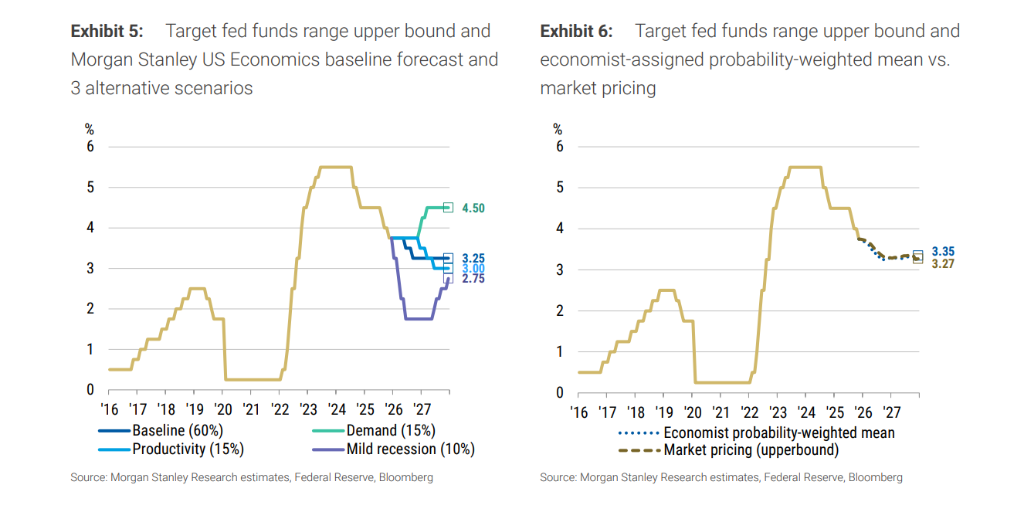
Core Viewpoint - The Federal Reserve implemented a "dovish pause" during the January FOMC meeting, signaling a shift in the future rate cut path, which will now depend more on inflation data rather than solely on labor market weakness [1][5] Economic Outlook - FOMC members showed greater consensus on the economic outlook, with Powell noting stronger economic performance compared to December, supported by resilient consumer spending, expanding business investment, fiscal support expectations, favorable financial conditions, and ongoing AI-related capital expenditures [5] - The only weak area identified was the housing market [5] Rate Cut Logic - The logic for future rate cuts has fundamentally changed, with a shift towards being "inflation-based" rather than "employment-based" as the risk of job losses diminishes [5][6] - Morgan Stanley expects the Fed to maintain patience until clearer signs of inflation deceleration appear, likely later in the year, before considering rate cuts [5][6] Market Strategy - Morgan Stanley's rate strategists recommend maintaining a neutral position on U.S. Treasury durations and curves, while continuing to favor 2-year UST SOFR swap spreads [8][9] - In the foreign exchange market, the firm predicts a weaker dollar, but notes that the Fed's policy is unlikely to be the main driver of dollar depreciation, with more focus shifting to international monetary policies and related intervention risks [9] MBS Strategy - For agency MBS, Morgan Stanley maintains a neutral stance, citing low volatility as favorable but noting that the option-adjusted spread (OAS) is near its narrowest levels in recent years, with ongoing uncertainty in housing policy [9]

外资行美债&汇率2026展望汇总
2025-12-31 16:02
Summary of Key Points from the Conference Call Records Industry Overview - The conference call records focus on the U.S. Treasury market and interest rate outlook for 2026, with insights from various financial institutions including Barclays, HSBC, Morgan Stanley, Deutsche Bank, and Bank of America Merrill Lynch. Core Insights and Arguments U.S. Treasury Market Outlook 1. **Yield Curve Dynamics**: - Barclays predicts a steepening of the yield curve, with 2-year yields expected to drop to 3.1% and 30-year yields remaining around 4.7%, resulting in a 2s30s spread of 160 basis points [6][10]. - HSBC anticipates a bear steepening of the yield curve, projecting a 10-year yield of 4.30% by the end of 2026 [15][19]. - Morgan Stanley suggests that the Fed's rate cuts may be less than market expectations, with a forecast of only 50 basis points of cuts [25][26]. 2. **Federal Reserve Policy**: - The new leadership at the Federal Reserve is expected to adopt a more dovish stance, potentially lowering rates below neutral levels [6][7]. - The Fed is projected to end quantitative tightening (QT) and begin purchasing T-bills to maintain adequate reserves, with an estimated purchase of $330 billion in T-bills in 2026 [10][31]. 3. **Fiscal Deficit and Inflation**: - The fiscal deficit is expected to remain around 6% of GDP, approximately $1.9 trillion, with inflation projected to stabilize around 2% [6][10][25]. - Concerns about inflation resurgence due to fiscal expansion and tariff impacts are highlighted, with core PCE inflation expected to remain above 2% [41][48]. Supply and Demand Dynamics 1. **Net Supply Projections**: - A significant reduction in net supply of U.S. Treasuries is anticipated, with a decrease of approximately $470 billion to $1.2 trillion in 2026 [6][58]. - Investment-grade corporate bonds are expected to see an increase in net supply, driven by mergers and acquisitions [58]. 2. **Market Demand**: - Bank demand for mid-term Treasuries is expected to rebound due to regulatory changes [9]. - Continuous inflows into bond funds are supporting demand, particularly for MBS, which are favored due to their attractive spreads [58][62]. Investment Recommendations 1. **Asset Recommendations**: - Barclays recommends going long on 2-year Treasuries to capitalize on anticipated rate cuts [10]. - HSBC suggests positioning in the belly of the curve (5-year Treasuries) for lower structural risk and positive carry [21]. - Deutsche Bank advises a cautious approach to long-dated Treasuries, predicting underperformance relative to swaps [39]. 2. **Strategic Themes**: - "Carry is king" is emphasized as a core investment strategy, focusing on high-yield bonds and leveraged loans due to their attractive coupon rates in a stable interest rate environment [41][47]. - The potential for a bear steepening of the yield curve is noted, with strategies to exploit this dynamic [21][47]. Other Important Insights - The reports highlight a complex economic landscape characterized by resilient growth, sticky inflation, and the dual risks of fiscal deterioration and inflation rebound [7][17]. - The impact of AI-driven capital expenditures and fiscal stimulus from legislation like the One Big Beautiful Bill Act (OBBBA) is noted as a potential growth driver [41][48]. - The need for caution regarding economic recession risks and policy uncertainties is emphasized, particularly in relation to tariffs and Fed independence [26][37]. This summary encapsulates the key points from the conference call records, providing a comprehensive overview of the U.S. Treasury market outlook and associated investment strategies for 2026.
美银市场或已不信鹰派降息?哈塞特,带来买谣言和卖事实交易机会
Sou Hu Cai Jing· 2025-12-14 10:22
Group 1 - The market widely anticipates a rate cut from the Federal Reserve in December, with Bank of America suggesting investors "buy the rumor" and increase holdings in long-term bonds, predicting the 10-year Treasury yield will drop below 4% in the coming months [2][5][12] - Adjustments in inflation and economic growth forecasts are expected, providing a rationale for the rate cut, with the dot plot potentially indicating two more rate cuts next year [5][7] - Federal Reserve Chair Powell faces challenges in conveying a "hawkish rate cut" signal, as upcoming economic data releases may complicate his messaging [8][10] Group 2 - The Federal Reserve is expected to announce a $45 billion monthly Treasury purchase plan starting in January, which is larger than market expectations and aims to bolster bank reserves [12][13] - This liquidity boost is seen as beneficial for the market, supporting arbitrage trading and keeping bond market volatility low, with expectations that MBS spreads could narrow [15] - Concerns arise regarding potential administrative interference in Federal Reserve decisions, particularly with rumors of Hassett potentially becoming the new chair, which could impact long-term interest rates [17][21] Group 3 - Bank of America recommends an overweight position in agency MBS, non-agency MBS, and CMBS, anticipating a decline in 30-year mortgage rates below 6% as the housing market picks up in spring [23][25] - CLOs are viewed as attractive investments due to stable pricing and decent yield opportunities, while high-yield bonds may underperform due to volatility in the AI sector and changing policy expectations [25][27] - The municipal bond issuance is projected to reach $640 billion next year, with recommendations to buy long-duration, high-rated bonds in the first half of the year for potential returns [27][29]

美银:市场或已不信“鹰派降息”,哈赛特带来“买谣言,卖事实”交易机会
美股IPO· 2025-12-09 07:15
Core Viewpoint - Bank of America anticipates a 25 basis point rate cut by the Federal Reserve this week, but Powell may struggle to present a "hawkish cut," leading the market to potentially bet more aggressively on further cuts in January [1][3]. Group 1: Federal Reserve Rate Cut Expectations - The market expects a 95% probability of a 25 basis point rate cut at the upcoming Federal Reserve meeting, with economic forecasts suggesting an upward revision for growth in 2025-2026, while unemployment rate predictions may also rise [3]. - The median dot plot may indicate two rate cuts next year, with the potential for a more dovish stance from the new Fed chair, Hassett, raising concerns about long-term interest rates [3][6]. Group 2: Liquidity Management and RMPs - Bank of America predicts the Federal Reserve will announce a Reserve Management Purchase (RMP) plan, starting in January with monthly purchases of $45 billion in Treasury securities, exceeding market expectations [4][11]. - This liquidity injection is expected to support arbitrage trading and maintain a low volatility environment, benefiting the front-end market [4][12]. Group 3: Market Reactions and Investment Strategies - The anticipated decline in the 10-year U.S. Treasury yield below 4% is likely to occur, driven by the "buy the rumor" strategy surrounding Hassett's nomination, which may also lower 30-year mortgage rates below 6% [7][9]. - Bank of America maintains an overweight recommendation on agency MBS, non-agency MBS, and CMBS, expecting the MOVE index to decline further, leading to a tightening of spreads [9]. Group 4: Credit and Securitized Asset Allocation - In the credit market, if the new Fed chair adopts a dovish stance, investment-grade corporate bond spreads may initially narrow due to duration chasing, while the yield curve between 10-year and 30-year bonds may flatten [13]. - CLOs are highlighted as resilient assets with good carry yield and price stability, while high-yield bonds face challenges due to volatility driven by AI and shifting Fed expectations [13].

美银:市场或已不信“鹰派降息”,哈赛特带来“买谣言,卖事实”交易机会
Hua Er Jie Jian Wen· 2025-12-09 06:27
Group 1 - The core viewpoint of the articles indicates that despite the Federal Reserve signaling a potential 25 basis point rate cut in December, the market remains skeptical about the credibility of this "hawkish cut" stance [1][3] - Market expectations suggest a 95% probability of a rate cut in the upcoming Federal Reserve meeting, with projections indicating an upward revision of economic growth forecasts for 2025-2026, alongside a potential increase in unemployment rate predictions [1][2] - The anticipated announcement of the Reserve Management Purchase (RMP) plan, involving monthly purchases of $45 billion in Treasury bills starting in January, is expected to exceed market expectations and support a low volatility environment [2][12] Group 2 - The report highlights that Powell may struggle to maintain a credible hawkish stance due to the release of significant economic data before the January meeting, which could lead to more aggressive market pricing for a rate cut [3][4] - The nomination of Hassett as the potential new Fed Chair is causing shifts in fixed income product return logic, with expectations that the 10-year Treasury yield could fall below 4%, benefiting the housing market as mortgage rates decline [4][6] - The credit market outlook suggests that if the new Fed Chair is perceived as extremely dovish, investment-grade corporate bond spreads may initially narrow, while CLOs are viewed as strong buy candidates due to their stable pricing and yield characteristics [8] Group 3 - The liquidity injection from the RMPs is expected to directly benefit the front-end market, with recommendations to go long on the January SOFR/Federal Funds rate spread, as historical data indicates that increased liquidity typically leads to a rapid decline in SOFR relative to FF [12] - The municipal bond market is projected to see a total issuance of $640 billion in 2026, with strategies suggesting buying and holding long-duration high-rated municipal bonds in the first half of 2026 [8]
外汇商品 | 就业市场触发预警,利好美债前景——美国国债月报2025年第十二期
Sou Hu Cai Jing· 2025-11-27 00:30
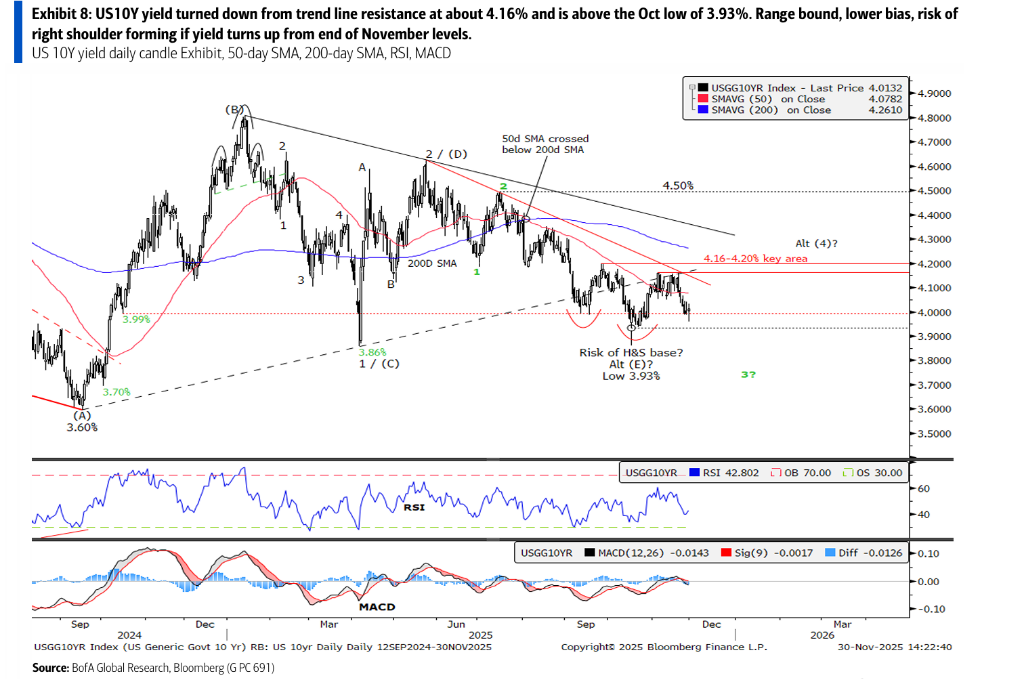
Group 1: Economic Indicators and Federal Reserve Actions - The unemployment rate and layoff numbers in the U.S. have triggered early warning signals, indicating potential further pressure on the job market as the inventory cycle approaches its bottom [1][5][7] - The Federal Reserve is likely to continue its rate-cutting cycle, with a high probability of a 25 basis point cut in December, although the market has already priced in this expectation [2][28] - The 10-year Treasury yield is expected to experience low volatility, with support levels at 3.9% and 3.8%, and resistance levels at 4.1% and 4.2% [2][28] Group 2: Employment Market Analysis - The unemployment rate exhibits strong cyclical and nonlinear characteristics, with sharp increases during economic downturns and gradual decreases during recoveries [5][6] - The Challenger job-cut report shows a significant increase in layoffs, particularly in government sectors, which raises concerns about the employment market's deterioration [6][7] - The cumulative month-on-month change in the unemployment rate reached 0.4% in October, signaling a potential economic slowdown [6][7] Group 3: MBS Market Monitoring - In November, agency MBS yields declined alongside Treasury yields, with Fannie Mae MBS experiencing a slightly larger decrease than Freddie Mac MBS [1][38] - The credit spread of agency MBS relative to Treasuries remains stable near historical median levels, indicating a neutral valuation [38] - The duration of agency MBS is stable at around 5.5 to 6 years, with no significant overvaluation or undervaluation detected [38]
外汇商品 | 美债收益率或难流畅下行——美国国债月报2025年第十一期
Sou Hu Cai Jing· 2025-10-29 00:50
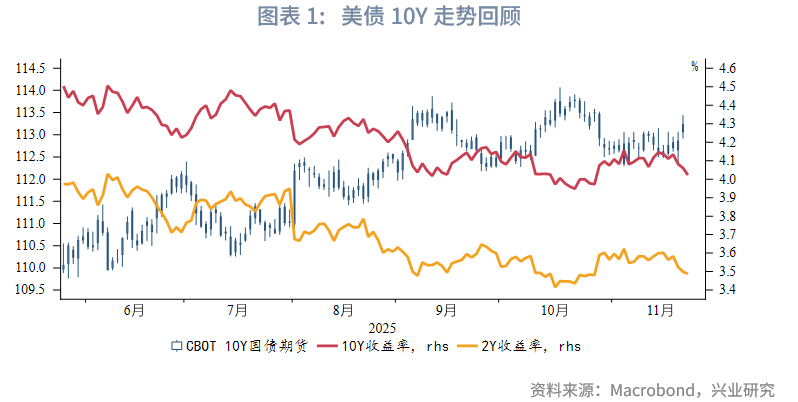
Core Viewpoint - The U.S. employment market shows signs of resilience despite the government shutdown, indicating a potential "soft landing" for the economy. Although September's non-farm payrolls were weak, improvements are expected in the coming months. The unemployment rate's upward pressure may ease as layoffs decrease [1][7][8]. Economic Outlook - The U.S. high-frequency economic indicators are entering an upward cycle, with employment data expected to show resilience. This limits the potential for significant declines in bond yields. The Consumer Price Index (CPI) likely peaked in September and is expected to enter a declining phase over the next few months, which will restrict interest rate rebounds. The 10-year yield is projected to oscillate within a weak range, with support at 3.9% and 3.8%, and resistance at 4.1% and 4.2% [1][33][34]. Market Review - The prolonged U.S. government shutdown led to the absence of employment data, while the CPI data release was delayed. Mid-month, tensions escalated in U.S.-China trade relations, and two regional banks faced crises, heightening risk aversion. However, by the end of the month, a framework agreement was reached in U.S.-China talks, and the regional bank issues did not escalate into systemic risks, leading to a recovery in market risk appetite [2]. Employment Data Insights - Five private sector indicators reflect the state of non-farm employment: ADP employment, NFIB small business hiring plans, Revelio Labs employment forecasts, Challenger job additions, and Job Indeed new postings. While ADP and NFIB indicate weak job growth for September, other indicators suggest a mild improvement. The Challenger layoffs data shows a significant decrease in layoffs, which may alleviate upward pressure on the unemployment rate [7][8]. Agency MBS Monitoring - In October, agency MBS yields declined alongside U.S. Treasury yields, with Fannie Mae MBS yields decreasing more than Ginnie Mae MBS. The credit spread relative to Treasuries narrowed to the historical 50th percentile. The duration of Fannie Mae MBS is currently overvalued [39][40].
政策迷雾下的投资指南:瑞银预判美联储9月降息 标普年底剑指6200点
智通财经网· 2025-07-07 07:03
Group 1 - The core focus of the market is shifting towards macroeconomic data, particularly the actual evolution of economic growth and inflation, despite recent policy uncertainties [1] - UBS expects a slowdown in US economic growth but does not foresee a recession, with consumer spending likely to moderate due to inflationary pressures [1] - The impact of tariffs on inflation data is anticipated to become evident in the coming months, with economic growth expected to weaken further by the end of the year [1] Group 2 - UBS predicts that the Federal Reserve will begin cutting interest rates in September, with a forecast of four consecutive 25 basis point cuts [1] - The assumption is that the effective tariff rate will stabilize at the current level of 15%, which is not expected to trigger an economic recession [1] Group 3 - As policy outlook becomes clearer, UBS suggests that market volatility will gradually return to normal, advising investors to prepare for opportunities in 2026 [2] - Investment strategies include continuing to allocate to gold for political risk hedging, investing in quality fixed-income products, and positioning for long-term equity investments [3] Group 4 - UBS has upgraded the financial sector to an "attractive" rating due to benefits from regulatory easing and capital returns post-stress tests [3] - The firm maintains an "attractive" rating for communication services, healthcare, utilities, and information technology, citing strong growth drivers and defensive attributes [3]

债券月报 | 美联储降息预期推迟,收益率曲线熊陡变牛陡?
彭博Bloomberg· 2025-06-05 06:09
Core Insights - The article discusses the anticipated delay of the Federal Reserve's interest rate cuts to Q4 2025, indicating a potential shift in the yield curve from a "bear steepening" to a "bull steepening" phase as market participants adjust their expectations for inflation and economic growth [3][10]. Group 1: Interest Rate Expectations - The market now expects the Federal Reserve to initiate rate cuts in Q4 2025, aligning with the company's assessment that rates could drop below 3% once the easing cycle begins [7]. - Current market pricing suggests a terminal rate of 3.35%, which is higher than the company's estimated reasonable rate of 2.75% [7]. - There is a 20% probability that the Federal Reserve will lower rates to below 2.25% by the end of 2026, based on risk-neutral distribution models [7]. Group 2: Yield Curve Dynamics - The yield curve is currently experiencing a "bear steepening" phase, with short-term rates stable while long-term rates rise due to supply pressures and concerns over fiscal sustainability [3][10]. - The 30-year U.S. Treasury yield is approaching a technical resistance level of 5%, which may provide temporary support for long-term rates, limiting further upward movement [3]. Group 3: Credit Market Insights - The credit spread of Chinese dollar-denominated bonds is influenced by U.S.-China trade tensions, with recent fluctuations reflecting market sensitivity to policy signals [11][12]. - The Peterson Institute reports that the average tariff on U.S. exports to China has risen to 126.5%, impacting the credit spread dynamics [12]. - Recent policy directions from China's central government aim to stimulate consumption and stabilize the real estate market, which may enhance risk appetite and affect credit spreads [14]. Group 4: Asset-Backed Securities - Major U.S. banks are showing caution in their demand for agency MBS, with a notable reduction in holdings as they navigate interest rate risks [19]. - The issuance of floating-rate and short-duration CMO securities has surged, indicating a defensive positioning by banks in a rate-sensitive environment [19]. - There is a growing preference for GNMA securities among banks due to their favorable capital treatment, despite expectations of regulatory changes [21].