
抗感染药品

Search documents
中央明确明年优化药品集中采购 可以从哪些方面入手?
Di Yi Cai Jing· 2025-12-12 03:14
Core Viewpoint - The Central Economic Work Conference held in Beijing on December 10-11 outlined key tasks for economic work in the coming year, including optimizing drug centralized procurement and deepening medical insurance payment reform [1]. Group 1: Drug Centralized Procurement - Since the launch of the "4+7" centralized procurement pilot by the National Healthcare Security Administration (NHSA) in November 2018, eleven batches of drug procurement have been conducted, successfully procuring 490 types of drugs [1]. - The goals of drug centralized procurement include reducing the economic burden on insured individuals, improving the efficiency of medical insurance fund usage, and encouraging companies to transition towards innovation [1]. - The eleventh batch of centralized procurement, which produced results on October 27, 2025, included 55 types of drugs covering common medications in various fields such as anti-infection, anti-allergy, anti-tumor, and blood sugar regulation [1]. Group 2: Optimization of Procurement Rules - The eleventh batch of procurement achieved its expected goals of "stabilizing clinical use, ensuring quality, countering excessive competition, and preventing collusion" by aligning selected products with medical institution needs, raising qualification thresholds for bidding companies, and guiding rational pricing [1]. - There is ongoing attention on how to further counter excessive competition in future drug procurements, with suggestions for establishing a minimum bidding price to provide more certainty for companies [2]. - Experts suggest that procurement rules could be further strengthened around the four dimensions of "stabilizing clinical use, ensuring quality, countering excessive competition, and preventing collusion," including potentially setting a "bottom price" for bids [2].
行业周报:集采+医保谈判稳步推进,关注相关投资机会-20251102
KAIYUAN SECURITIES· 2025-11-02 12:06
Investment Rating - The industry investment rating is "Positive" (maintained) [1] Core Views - The report emphasizes the ongoing progress of centralized procurement and medical insurance negotiations, highlighting investment opportunities in the pharmaceutical sector [5][6] - The report notes that the 2025 National Medical Insurance negotiations have commenced, with a focus on the commercialization potential of drugs included in the insurance list [6][19] - The pharmaceutical sector has shown resilience, with a 1.31% increase in October's fifth week, outperforming the CSI 300 index by 1.74 percentage points [7][22] Summary by Sections Section 1: Centralized Procurement and Medical Insurance Negotiations - The latest round of centralized procurement has been optimized, achieving a selection rate of 57% for the 11th batch, involving 55 products and 445 companies [5][15] - The 2025 medical insurance negotiations are expected to last 4-5 days, with 535 drug names passing the preliminary review for the basic medical insurance directory [6][19] Section 2: Market Performance - In the fifth week of October, the pharmaceutical sector rose by 1.31%, ranking 9th among 31 sub-industries [7][22] - The vaccine sector experienced the highest increase of 3.38%, while the medical consumables sector saw the largest decline of 1.98% [28] Section 3: Stock Recommendations - Monthly stock recommendations include companies such as Sanofi, Innovent Biologics, and WuXi Biologics [8] - Weekly stock recommendations feature companies like Kelun Pharmaceutical and Huadong Medicine [8]
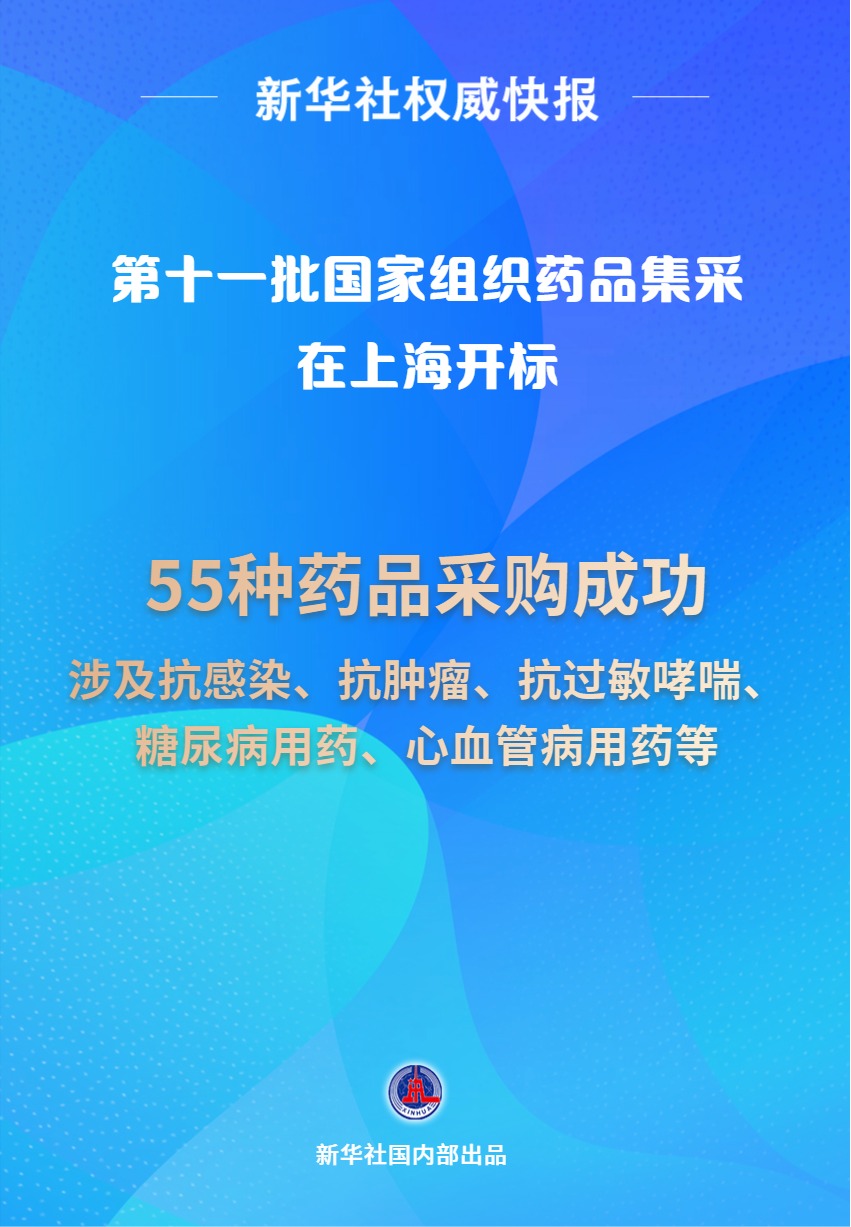
新华社权威快报|55种药品进集采 新一批国家组织药品集采开标
Xin Hua She· 2025-10-28 13:45
Core Points - The 11th batch of national organized drug procurement was opened for bidding in Shanghai on October 27, resulting in the successful procurement of 55 types of drugs [3] - A total of 272 companies with 453 products have obtained the proposed selection qualification, including essential medications for chronic and major diseases [3] - The procurement covers various categories such as anti-infection, anti-tumor, anti-allergic asthma, diabetes medications, and cardiovascular disease drugs [3] Summary by Category - **Procurement Details** - The 11th batch of national organized drug procurement was conducted in Shanghai, with 55 drugs successfully procured [3] - A total of 272 companies participated, with 453 products achieving proposed selection [3] - **Drug Categories** - The procurement includes drugs for chronic diseases and life-saving medications [3] - Specific categories covered are anti-infection, anti-tumor, anti-allergic asthma, diabetes, and cardiovascular disease medications [3] - **Historical Context** - Since the establishment of the National Medical Insurance Administration, 11 batches of national organized drug procurement have been conducted, totaling 490 types of drugs [3]

第十一批国家药品集采报量有看点
Xin Hua Wang· 2025-08-07 11:27
Core Insights - The eleventh batch of national drug procurement has initiated the reporting of demand from medical institutions, which is crucial for the effectiveness of the procurement process [1] Group 1: Changes in Reporting Rules - A new option for reporting demand by drug brand has been introduced, allowing medical institutions to report based on brand names rather than just generic names, addressing diverse medication needs [2] - A total of 55 drug varieties are involved in this procurement, covering treatment areas such as anti-infection, anti-tumor, anti-allergy, diabetes, and cardiovascular medications, with 480 companies having submitted relevant drug information [2] Group 2: Demand Reporting Flexibility - Medical institutions are generally required to report an annual demand of no less than 80% of the average usage from 2023 to 2024, but exceptions can be made for significant decreases in clinical demand or business adjustments [3] - Institutions may reduce reported quantities based on actual needs, provided they submit a written explanation [3] Group 3: Participation Encouragement - Private medical institutions and retail pharmacies are encouraged to participate in the procurement reporting, facilitating easier access for the public to selected drugs [4] Group 4: Procurement Policy Clarifications - The policy emphasizes that while selected drugs should be prioritized, it does not mandate exclusive use, allowing institutions to procure both selected and non-selected drugs [5] - Since 2018, ten batches of national drug procurement have cumulatively procured 435 types of drugs, improving the affordability and accessibility of medications for the public [5]