抗菌涂料

Search documents
周期起舞,涨价背后的逻辑与空间
2025-12-04 15:36
Summary of Key Points from Conference Call Records Industry Overview - The conference call discusses the **construction materials, steel, and non-ferrous metals industries**. The focus is on the cyclical nature of these sectors and the impact of government policies on supply and demand dynamics [1][2][4]. Core Insights and Arguments - **Anti-Competition Policies**: The "anti-involution" policy aims to curb vicious competition through government intervention and leading enterprises, promoting supply contraction. This has led to significant improvements in the steel industry after the elimination of substandard steel [1][2]. - **Current Industry Position**: Both the construction materials and steel industries are at the bottom of the cycle, with cement companies experiencing declining shipment volumes and some reporting losses. The steel sector shows slight improvement in profitability compared to last year, but remains weak due to high iron ore prices and cost pressures from coking coal [1][4]. - **Housing Policy Impact**: The new housing policy emphasizes quality design and materials, encouraging construction material companies to develop high-quality products to meet the growing demand for comfortable living environments in the existing housing market [1][4]. - **Non-Ferrous Metals Appeal**: The non-ferrous metals sector is attractive due to expectations of global economic recovery, supply chain tensions, and increased demand from the new energy industry. However, uncertainties from global economic and policy changes must be monitored [1][5]. - **Investment Drivers for Non-Ferrous Metals**: The rise in non-ferrous metals is driven by macro demand, supply-side vulnerabilities, and expectations of interest rate cuts. Fiscal expansions in Europe and the U.S., along with domestic manufacturing upgrades, are boosting metal demand [5][6]. Additional Important Content - **Supply-Side Vulnerabilities**: Despite high prices for copper and aluminum, new capacity and mining capital expenditures remain low. Existing mines face challenges such as geopolitical risks and natural disasters, limiting supply increases [6][8]. - **Investment Signals**: Key indicators for assessing investment opportunities in cyclical industries include PB (Price-to-Book) and ROE (Return on Equity). High PB and ROE suggest a peak in the industry cycle, while macroeconomic conditions and policy changes, such as interest rate adjustments by the Federal Reserve, significantly impact market liquidity and industry performance [9][10]. - **Future Outlook for 2026**: The cyclical sectors are expected to present structural investment opportunities, particularly in non-ferrous metals, as anticipated interest rate cuts may lead to increased liquidity. However, caution is advised as current valuations may not be low [17]. This summary encapsulates the critical insights from the conference call, highlighting the current state and future outlook of the construction materials, steel, and non-ferrous metals industries.
研判2025!中国抗菌涂料行业分类、发展历程、市场规模、重点企业及未来趋势分析:人们对健康和卫生的关注度不断提高,抗菌涂料市场规模将增长至153.68亿元[图]
Chan Ye Xin Xi Wang· 2025-07-05 01:08
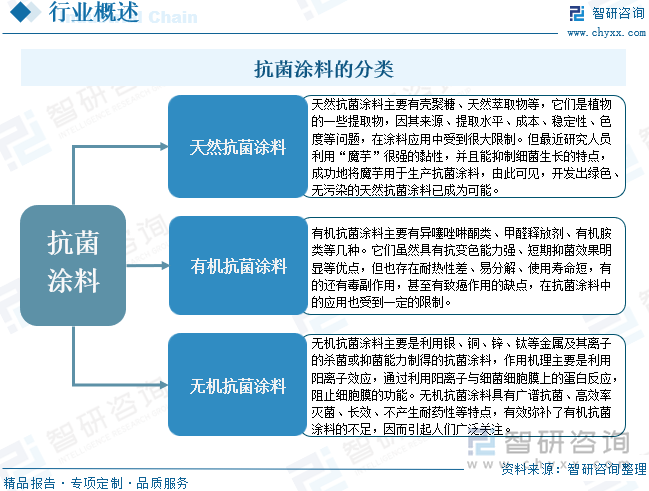
Core Insights - The antibacterial paint market in China is experiencing rapid growth due to increasing health awareness and demand for hygiene products, with the market size projected to reach approximately 10.98 billion yuan in 2024 and 15.368 billion yuan by 2027 [1][16] - The industry is benefiting from various national policies such as new infrastructure projects, urbanization, and rural revitalization, which are expected to drive demand for coatings [1][16] - Antibacterial coatings not only improve indoor air quality and reduce infection risks but also enhance the durability of painted surfaces, making them popular in medical institutions, homes, and public spaces [1][16] Antibacterial Coatings Industry Overview - Antibacterial coatings are designed to prevent the growth of bacteria, fungi, and algae, offering superior disinfection effects compared to regular paints [3][5] - The market is segmented into natural, organic, and inorganic antibacterial coatings, each with distinct properties and applications [3] Industry Development History - The antibacterial industry in China began in the 1980s and gained momentum in the late 1990s, with significant contributions from companies like Nippon Paint [8] - The establishment of standards for antibacterial coatings by the China Coatings Industry Association in 2020 has further propelled the industry's growth [8] Industry Chain - The upstream of the antibacterial coatings industry includes raw materials such as antibacterial agents, film-forming agents, and solvents, while the downstream applications span construction, food processing, healthcare, and more [10][12] Market Trends - The antibacterial agent market is projected to reach approximately 13.01 billion yuan in 2024, with a year-on-year growth of 6.71%, driven by expanding application scenarios and technological innovations [12] - The construction industry is a key application area for antibacterial coatings, with the total output value of the construction industry in China expected to grow from 21.39 trillion yuan in 2017 to 32.65 trillion yuan by 2024, reflecting a compound annual growth rate of 6.23% [13] Competitive Landscape - Leading international companies in the antibacterial coatings market include AkzoNobel, PPG Industries, Sherwin-Williams, and BASF, while domestic leaders include companies like Three Trees, Nippon Paint China, and Carpoly [18][20] - The competitive landscape is evolving, with a focus on technological innovation and the development of high-end applications in healthcare and home appliances [18] Future Development Trends - The industry is expected to focus on the development of composite antibacterial coatings that optimize the synergistic effects of different antibacterial agents [25] - The application of inorganic nano antibacterial materials is anticipated to deepen, with a focus on improving dispersion and stability in coatings [26][27] - Research into the mechanisms of antibacterial agents will support the development of targeted products, alongside the establishment of comprehensive testing methods and industry standards [28]