
携程平台服务

Search documents
他们为何急于注销携程?
Xin Lang Cai Jing· 2025-12-25 11:43
Core Viewpoint - The recent partnership between Ctrip and Cambodia has triggered a significant backlash from users, leading to a mass exodus from the platform due to concerns over data security and trust issues [4][6][12]. Group 1: User Reaction - Users have reportedly increased their uninstallation of the Ctrip app by 217% within 48 hours, with around 3 million users attempting to cancel their accounts [8][36]. - The rapid user response indicates a deep-seated fear regarding the potential misuse of personal data, particularly in light of recent news about scams in Cambodia [13][41]. Group 2: Trust Issues - The partnership with Cambodia has acted as a catalyst, exposing existing vulnerabilities related to data security and previous incidents of data mishandling by Ctrip [13][48]. - Users are not only concerned about data leaks but also about broader issues such as monopolistic practices and unfair pricing strategies, which have contributed to a growing distrust of the platform [20][48]. Group 3: Company Response - Ctrip has issued a formal statement asserting that the partnership is purely for advertising purposes and does not involve data sharing, while also emphasizing that advertising has been paused [6][34]. - Despite the company's assurances, the speed of user disengagement suggests that the trust has been significantly eroded, and the company may need to reassess its risk management and ethical practices [27][55].



携程受害者,开始反击
Xin Lang Cai Jing· 2025-12-15 10:13
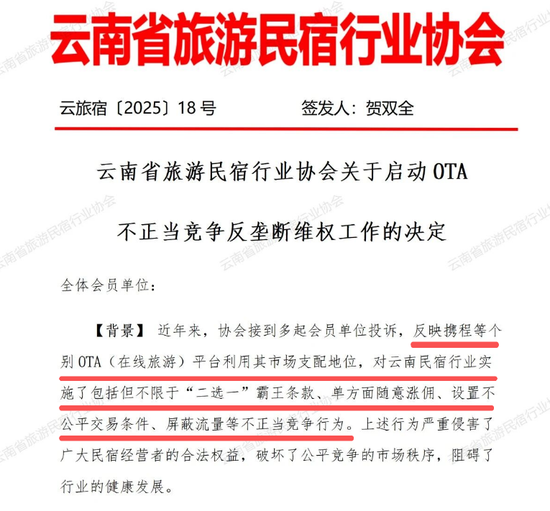
Core Viewpoint - The Yunnan Tourism Homestay Industry Association has initiated anti-monopoly actions against major online travel agencies (OTAs), specifically targeting Ctrip, marking a significant shift in industry dynamics [1][2][4]. Group 1: Anti-Monopoly Actions - The association has engaged legal advisors to collect evidence and prepare for collective complaints against Ctrip for alleged violations of the Anti-Monopoly Law [3][4]. - This is the first time since the Anti-Monopoly Law's enactment in 2008 that an industry association has publicly encouraged members to report large platform companies for potential violations [4][40]. - The focus of the association's actions includes issues like "choose one from two" practices, which have been a point of contention in previous discussions with regulatory bodies [6][8][42]. Group 2: Ctrip's Financial Performance - Ctrip reported a revenue of 18.3 billion yuan for Q3 2025, a 16% year-on-year increase, with a net profit of 19.9 billion yuan, showcasing strong operational profitability despite one-time investment gains [9][46]. - Ctrip's gross margin remains above 80%, significantly outperforming other internet giants like Tencent and Alibaba [10][46]. - The company's market share is projected to be around 56% in 2024, with its actual control in the OTA market exceeding 70% when including affiliated platforms [19][57]. Group 3: Industry Context - The hotel and travel sectors are facing significant financial challenges, with Beijing's accommodation industry reporting a 7.3% decline in revenue and a 92.9% drop in total profits in the first half of the year [12][48]. - Despite the struggles of traditional hospitality businesses, domestic tourism is thriving, with 4.998 billion trips taken by residents in the first three quarters of 2025, an 18% increase year-on-year [15][51]. - The disparity in financial performance between Ctrip and traditional hospitality businesses raises questions about the sustainability of the current business model in the OTA sector [32][67].
投诉企业没头绪?这些方法帮你精准维权
Xin Lang Cai Jing· 2025-10-15 04:42
Core Viewpoint - The article emphasizes the importance of consumer rights protection in China and outlines various channels available for consumers to file complaints regarding product quality, service issues, and misleading advertisements [1]. Group 1: National Complaint Platforms - The primary and most authoritative complaint channel is the "12315" platform, managed by the State Administration for Market Regulation, which handles general consumer disputes such as false advertising and product quality issues [2]. - Consumers can initiate complaints through three methods: calling 12315, visiting the "National 12315 Platform" website, or using the corresponding app and WeChat mini-program [2]. - The platform's advantages include its authority and broad coverage, with complaints being assigned to local market supervision bureaus for verification and mediation [2]. Group 2: Industry Regulatory Departments - Different industries have corresponding regulatory bodies, such as the China Banking and Insurance Regulatory Commission for financial issues and the Ministry of Industry and Information Technology for telecommunications [3]. - These industry-specific platforms offer stronger expertise and a better understanding of industry standards, making it easier to obtain clear responses for specialized issues [3]. - However, the need for consumers to identify the correct regulatory body can complicate the complaint process [3]. Group 3: E-commerce and Company Platforms - E-commerce platforms like Taobao and JD.com have internal complaint channels that allow for quick responses and short processing times [4]. - The self-handling by companies often prioritizes maintaining platform order, which can lead to dissatisfaction among consumers if they feel treated unfairly [4]. - In cases of inadequate responses, consumers may need to resort to more public channels to express their grievances [4]. Group 4: Third-party Complaint Platforms and Media Channels - Independent third-party complaint platforms, such as the "Black Cat Complaint" website operated by Sina, have emerged to provide transparent public channels for consumers [5]. - These platforms allow for public display of complaints, enabling companies to respond directly, which can expedite resolution and enhance accountability [5]. - Traditional media also play a significant role in amplifying consumer issues, particularly for companies that repeatedly fail to address complaints [5]. Group 5: Recommendations for Choosing Channels - Consumers are advised to retain all relevant evidence, such as invoices and communication records, to support their claims [6]. - It is important to clearly articulate the issue and desired resolution while remaining objective [6]. - Depending on the nature of the complaint, consumers should select the appropriate channel, starting with internal complaints and escalating as necessary [7].