文创年礼

Search documents
京城艺展“策马迎春”陪您过大年
Bei Jing Wan Bao· 2026-02-13 06:50
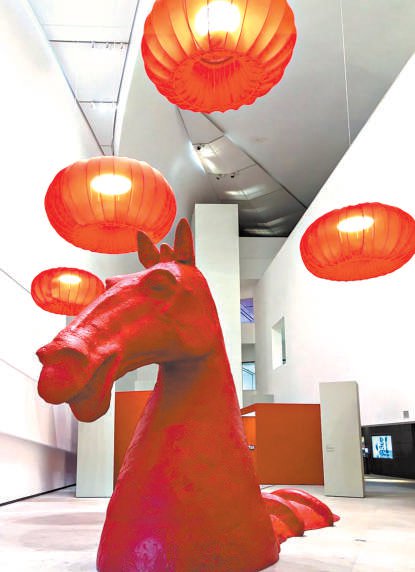
Core Viewpoint - The article highlights various art exhibitions and cultural activities in Beijing celebrating the Year of the Horse, showcasing significant artworks and installations that connect traditional and contemporary art [1][5][9]. Group 1: Art Exhibitions - Central Academy of Fine Arts Museum features a nearly 5-meter tall red horse head art installation by artist Lu Zhengyuan, symbolizing a connection between ancient and modern art [5][3]. - The museum's exhibition includes 221 works donated by artist Zhou Lingzhao, spanning from 1938 to 2008, and showcases a variety of artistic forms [5]. - The Beijing Painting Academy Museum presents a special exhibition titled "Dreaming with Horses," featuring the original work "Soaring Thousands of Miles" by Qi Baishi, alongside its popular derivative "Ma Biao Biao" [7]. Group 2: Cultural Activities - During the Spring Festival, the Central Academy of Fine Arts Museum offers a "Fu" character giveaway, allowing visitors to take home a piece of cultural significance [6]. - The Xu Beihong Memorial Museum is open from February 16 to February 23, featuring a themed exhibition on horses that showcases rare works from different historical periods [8]. - Tsinghua University Art Museum hosts an exhibition exploring the cultural significance of the Spring Festival, featuring over 150 items from its collection [8]. Group 3: Additional Exhibitions - The Jiade Art Center presents a selection of 80 masterpieces from Xu Beihong, Qi Baishi, and Zhang Daqian [9]. - The Three Hills and Five Gardens Cultural Art Center showcases a themed exhibition on horses, featuring 21 original works by Xu Beihong [9]. - The Chongqing Art Museum's "Chasing Light" exhibition focuses on the horse as a central theme, displaying works from 44 outstanding artists [9].

“年经济”折射消费韧性与活力
Xin Lang Cai Jing· 2026-02-06 21:01
Core Insights - The upcoming Spring Festival is expected to drive significant consumer spending, showcasing the unique cultural and economic attributes of the "Year Economy" in China [2][3] - The extended holiday period allows consumers to shift from urgent purchasing to quality selection, enhancing the potential for cultural and tourism-related consumption [3][4] - The transformation of consumption patterns during the Spring Festival reflects a blend of traditional values with modern lifestyles, indicating a dynamic market evolution [4][5] Group 1: Consumer Behavior - Consumers are increasingly prioritizing quality experiences over basic needs, with organic ingredients, cultural gifts, and smart home products becoming popular choices [2] - The integration of digital platforms in the shopping experience is blurring the lines between online and offline consumption, creating a complementary ecosystem for Spring Festival spending [3] Group 2: Economic Impact - The "Year Economy" serves as a lubricant for the consumption market, facilitating smoother internal demand and promoting balanced regional development [4] - The commercialization of traditional festivals must be approached with caution to avoid reducing the cultural significance of the "Year Economy" to mere entertainment and consumption [5]
【每周经济观察】“年经济”折射消费韧性与活力
Xin Lang Cai Jing· 2026-02-06 21:01
Core Viewpoint - The upcoming Spring Festival is expected to significantly boost consumer spending and economic growth, with an extended holiday period providing new momentum for traditional consumption patterns [2][3]. Group 1: Economic Impact - The Spring Festival is a vital cultural and economic event that drives social consumption and economic growth, with the extended holiday enhancing the "New Year economy" [2]. - The shift in consumer behavior from basic needs to quality experiences is evident, with organic food, cultural gifts, and smart home products becoming popular choices [2]. - The integration of cultural tourism and leisure activities is expected to enhance consumer potential during the holiday, allowing for more leisurely travel and deeper experiences [2]. Group 2: Changing Consumption Patterns - The digital age is transforming consumption patterns, with live streaming, social media, and local service apps blurring the lines between online and offline shopping [3]. - The evolution of the New Year shopping list and diverse travel options reflect a desire for a better quality of life, showcasing the advantages and potential of China's vast market [3]. - The Spring Festival migration represents a blend of wealth and consumer values, facilitating smoother domestic demand and regional development [3]. Group 3: Cultural and Commercial Balance - While the "New Year economy" thrives, there is a need for rationality to avoid excessive commercialization, ensuring that the essence of traditional celebrations is preserved [4]. - The commercialization of the festival should not overshadow its cultural significance, which is rooted in themes of reunion, family, and auspiciousness [4]. - Sustainable consumption that resonates with cultural traditions and emotional connections is essential for the resilience and vitality of the "New Year economy" [4].