
文心原生全模态大模型

Search documents
李彦宏人民日报撰文:内化AI能力加快形成新质生产力
Xin Lang Ke Ji· 2025-11-20 02:37
Core Viewpoint - The article emphasizes the importance of artificial intelligence (AI) in driving high-quality economic development and the need for industries to internalize AI capabilities to enhance productivity and innovation [1][5]. Group 1: AI Development and Infrastructure - China has made significant breakthroughs in AI infrastructure and large models, achieving a leading position globally, with its computing power ranking second in the world [1][5]. - Notable AI models such as DeepSeek and Wenxin have emerged, and Baidu has established the first self-developed P800 cluster in the country [1][5]. Group 2: AI Application and Industry Integration - AI technologies like digital humans, code agents, and autonomous driving have been successfully applied in various sectors, enhancing operational efficiency [2][6]. - The "14th Five-Year Plan" suggests promoting deep integration of technological and industrial innovation, focusing on areas with repetitive labor, labor shortages, and complex decision-making [2][6]. Group 3: Enhancing Productivity and Innovation - Internalizing AI capabilities within industries can lead to improved solutions in production scheduling, resource optimization, and decision-making processes [3]. - The integration of AI into traditional industries such as mining, chemicals, and light industry can strengthen the foundation of the real economy [2][3]. Group 4: Strategic Planning and Future Outlook - The article calls for strategic planning to make "AI empowerment" a common development consensus, emphasizing the need for innovation in technology, business models, and management practices [3][4]. - Baidu aims to continue investing in AI infrastructure and model development, contributing to the acceleration of intelligent transformation across various industries [4][6].


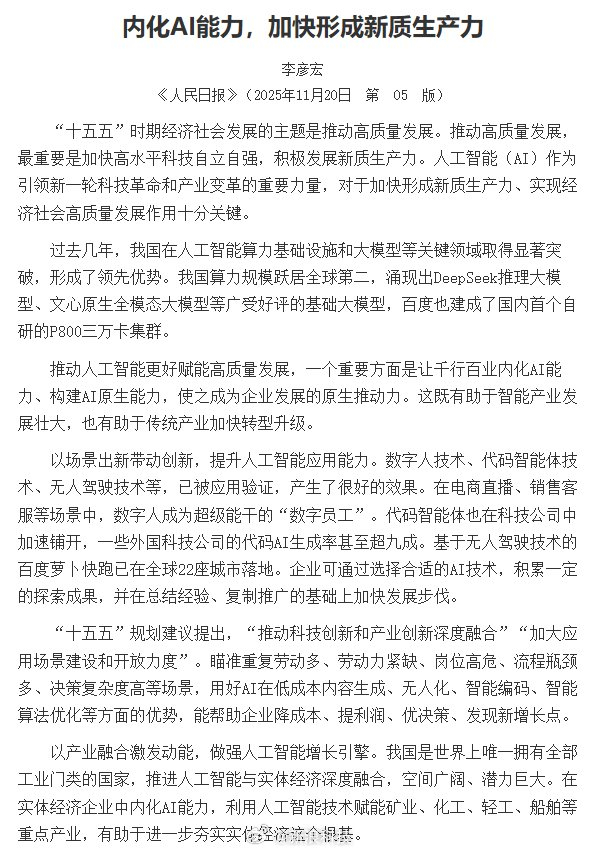
李彦宏人民日报撰文
Sou Hu Cai Jing· 2025-11-20 01:25
Core Viewpoint - The article emphasizes the importance of high-quality development driven by technological self-reliance and innovation, particularly through the integration of artificial intelligence (AI) into various industries [1][2][3] Group 1: AI Development and Infrastructure - China has made significant breakthroughs in AI infrastructure and large models, achieving a leading position globally, with its computing power ranking second in the world [1] - Notable AI models such as DeepSeek and Wenxin have been developed, alongside the establishment of the P800 self-researched cluster by Baidu [1] Group 2: Integration of AI in Industries - The integration of AI capabilities into various industries is crucial for enhancing productivity and driving transformation in traditional sectors [2] - AI technologies can optimize production scheduling, resource allocation, and decision-making processes, thereby improving the autonomy of industrial supply chains [2] Group 3: Strategic Planning and Innovation - The article highlights the need for strategic planning to make "AI empowerment" a common development consensus, focusing on both technological and managerial innovations [2] - Companies are encouraged to embed AI capabilities into every aspect of their operations to enhance efficiency and innovation [3] Group 4: Baidu's Role in AI Advancement - Baidu is positioned as a leader in the AI sector, committed to investing in advanced infrastructure and model technologies to support the integration of AI across various industries [3] - The company aims to accelerate the intelligent transformation of industries, contributing to China's high-quality economic development [3]
李彦宏人民日报撰文
财联社· 2025-11-19 23:29
Core Viewpoint - The article emphasizes the importance of artificial intelligence (AI) in driving high-quality economic development and the need for industries to internalize AI capabilities to enhance productivity and innovation [2][5]. Group 1: AI's Role in Economic Development - AI is identified as a key driver of a new round of technological revolution and industrial transformation, crucial for achieving high-quality economic development [2]. - China has made significant advancements in AI infrastructure and large models, ranking second globally in computing power and developing notable models like DeepSeek and Wenxin [2][3]. Group 2: Application of AI in Various Industries - AI technologies such as digital humans, code intelligence, and autonomous driving have been successfully applied in various sectors, enhancing operational efficiency [3]. - The article highlights the successful deployment of Baidu's autonomous driving technology in 22 cities globally, showcasing the practical applications of AI [3]. Group 3: Integration of AI in Traditional Industries - The integration of AI into traditional industries is seen as essential for enhancing productivity and driving transformation, particularly in sectors like mining, chemicals, and light industry [4]. - The article discusses the importance of optimizing production scheduling, resource allocation, and decision-making through AI solutions to improve the autonomy of industrial chains [4]. Group 4: Strategic Planning and Organizational Change - The need for strategic planning to make "AI empowerment" a common development consensus is emphasized, highlighting the importance of innovation in technology, business models, and management practices [4]. - Companies are encouraged to integrate AI capabilities across all operational aspects, from decision-making to supply chain management, to enhance efficiency and innovation [4]. Group 5: Baidu's Commitment to AI Development - Baidu is positioned as a leading player in the AI sector, committed to investing in advanced infrastructure and model technology to support the internalization of AI capabilities across various industries [5]. - The company aims to contribute to China's high-quality economic development by fostering an open industrial ecosystem and accelerating the intelligent transformation of industries [5].

内化AI能力,加快形成新质生产力
Ren Min Ri Bao· 2025-11-19 21:57
Group 1 - The core theme of the "14th Five-Year Plan" is to promote high-quality development, with a focus on accelerating high-level technological self-reliance and developing new productive forces, particularly through artificial intelligence (AI) [1] - China has made significant breakthroughs in AI infrastructure and large models, achieving a global second position in computing power and developing widely praised foundational models like DeepSeek and Wenxin [1] - The integration of AI capabilities across various industries is essential for driving high-quality development, helping both the smart industry to grow and traditional industries to upgrade [1] Group 2 - Innovative applications of AI technologies such as digital humans, code intelligence, and autonomous driving have shown positive results in various scenarios, enhancing operational efficiency [2] - The "14th Five-Year Plan" emphasizes the deep integration of technological and industrial innovation, advocating for the construction and opening of application scenarios to leverage AI's advantages in cost reduction and profit enhancement [2] - The potential for AI to empower key industries like mining, chemicals, light industry, and shipbuilding is vast, as China is the only country with a complete range of industrial categories [2] Group 3 - The improvement of the autonomous control level in the industrial chain relies on providing better solutions in areas like production scheduling and resource optimization, with algorithms like "Famu" focusing on finding global optimal solutions [3] - There is a pressing need to explore new organizational and management models that facilitate human-machine collaboration in the context of systemic and structural changes brought by AI [3] - Companies must integrate AI capabilities into every aspect of production, operation, and service to seize opportunities in the digital economy and AI development [3] Group 4 - Baidu, as one of the earliest and most comprehensive investors in AI in China, is committed to leading this transformation by enhancing intelligent infrastructure and developing cutting-edge model technologies [4] - The company aims to build a more open industrial ecosystem to help various industries internalize AI capabilities and accelerate their intelligent transformation, contributing to China's high-quality economic development [4]