时代天使冠军版

Search documents
时代天使(06699.HK)深度研究报告
Huachuang Securities· 2026-03-07 00:20
Investment Rating - The report gives a "Buy" rating for the company, with a target price of HKD 90.5, compared to the current price of HKD 69.60 [3][8]. Core Insights - The company is a leading provider of invisible orthodontics in China, having surpassed competitors in market share since 2021, and is experiencing robust growth in overseas markets, with a significant increase in case numbers and revenue [1][19]. - The domestic market for invisible orthodontics has substantial growth potential, with penetration rates expected to rise significantly in the coming years, particularly in the youth and grassroots markets [7][52]. - The company has established a strong competitive advantage through product innovation, a robust supply chain, and effective marketing strategies, which have facilitated its expansion into international markets [2][11]. Summary by Sections Section 1: Company Overview - The company has been a key player in the invisible orthodontics sector for over 20 years, achieving the top market position in China since 2021, with over 40% market share [28][19]. - The company has expanded internationally, acquiring a majority stake in a Brazilian orthodontic manufacturer, and has seen overseas case numbers surpass domestic ones by 2025H1 [16][19]. Section 2: Domestic Business Growth Potential - The domestic invisible orthodontics market is under pressure but has significant room for growth, with penetration rates expected to increase from 16% in 2024 to 25% by 2030 [46][52]. - The market is experiencing a consolidation trend, with leading companies benefiting from increased market concentration as smaller players exit due to competitive pressures [56][31]. Section 3: International Expansion Potential - The global market for invisible orthodontics is several times larger than the domestic market, providing substantial growth opportunities for the company [11][19]. - The company has improved its global market share from 4.5% in 2022 to an estimated 10.1% in 2025, with expectations to reach over 20% in the future [2][11]. - Revenue from overseas operations is projected to grow significantly, with estimates of USD 1.6 billion by 2033, driven by increased market penetration and operational efficiencies [11][12]. Section 4: Financial Projections and Valuation - The company is expected to generate total revenues of USD 337 million, USD 412 million, and USD 495 million for the years 2025, 2026, and 2027, respectively, with net profits projected at USD 27 million, USD 22 million, and USD 41 million [3][12]. - The report employs a price-to-sales (P/S) valuation method, estimating a P/S ratio of 4.8X for 2026, leading to a target market capitalization of HKD 154.5 billion [8][12].
时代天使(06699):国产隐形正畸龙头:本土崛起,出海破局
Huachuang Securities· 2026-03-06 15:23
Investment Rating - The report assigns a "Buy" rating to the company for the first time [8]. Core Insights - The company is a leading provider of invisible orthodontics in China, having surpassed competitors in domestic market share since 2021, and is experiencing rapid growth in overseas markets [1][28]. - The global invisible orthodontics market presents significant growth opportunities, with the company expected to increase its market share from 10% to over 20% in the coming years [2][11]. - The company’s revenue is projected to grow significantly, with total revenues expected to reach approximately $495 million by 2027, reflecting a compound annual growth rate (CAGR) of 20.4% [3][12]. Summary by Sections Section 1: Company Overview - The company has been a key player in the invisible orthodontics sector for over 20 years, achieving the top market position in China since 2021 [16][28]. - The company has expanded internationally, acquiring a majority stake in a Brazilian orthodontic manufacturer, which has contributed to its overseas case numbers exceeding domestic figures by 2025 [16][19]. Section 2: Domestic Business Growth Potential - The domestic market for invisible orthodontics has substantial growth potential, with penetration rates expected to rise from 16% in 2024 to 25% by 2030 [7][46]. - The market is experiencing consolidation, with leading companies benefiting from increased market concentration as smaller competitors exit due to pricing pressures [10][56]. Section 3: International Expansion Potential - The company’s global market share has increased from 4.5% in 2022 to 10.1% in 2025, with expectations to reach over 20% in the future [2][11]. - The company has established a comprehensive competitive advantage through product innovation, supply chain efficiency, and targeted marketing strategies [2][11]. Section 4: Financial Projections and Valuation - Revenue forecasts for 2025, 2026, and 2027 are $337 million, $412 million, and $495 million respectively, with net profits projected at $27 million, $22 million, and $41 million [3][12]. - The report utilizes a price-to-sales (P/S) valuation method, estimating a target market capitalization of HKD 154.5 billion and a target share price of HKD 90.5 [8][12].
2025 年隐形正畸品牌推荐:国产突围与进口标杆,分层市场精选指南
Tou Bao Yan Jiu Yuan· 2025-12-04 12:44
Investment Rating - The report indicates a positive investment outlook for the invisible orthodontics industry in China, projecting a compound annual growth rate (CAGR) of 13.9% from 2024 to 2030, with the market size expected to grow from 145 billion yuan in 2024 to 316 billion yuan by 2030 [8][9]. Core Insights - The invisible orthodontics market in China is characterized by a large patient population suffering from malocclusion, with a higher prevalence of complex cases compared to Western countries. The market is currently dominated by two major players, Angelalign and Invisalign, while local brands are emerging [5][6]. - The industry is experiencing rapid growth driven by technological advancements, increased consumer awareness, and a shift towards personalized treatment options. The competition is intensifying, but the overall market is expected to maintain a high growth trajectory [5][6][9]. Market Background - The invisible orthodontics industry in China has evolved over the past 20 years, transitioning from technology introduction to local innovation. Key milestones include the establishment of the first 3D printing production line for invisible aligners in 2007 and the introduction of regulatory frameworks to standardize the market [6][7]. - The demand for invisible orthodontics is significantly increasing due to rising aesthetic standards and the preference for less visible treatment options among consumers [5][8]. Market Status - The market size for invisible orthodontics in China is projected to reach 145 billion yuan in 2024, with a CAGR of 13.9% expected until 2030. The demand is driven by a high prevalence of malocclusion and the advantages of invisible aligners over traditional braces [8][9]. - The supply side is seeing advancements in materials technology, particularly in the development of heat-pressed film materials that enhance the performance of aligners [10]. Market Competition - The competitive landscape is marked by a "dual oligopoly" structure, with Angelalign and Invisalign leading the market. These companies leverage continuous technological innovation and extensive clinical data to build competitive advantages [16][17]. - The report identifies ten recommended brands in the market, highlighting their unique strengths and market positioning, such as Angelalign's extensive clinical database and Invisalign's patented technology [18][19][20]. Development Trends - The report outlines several key trends shaping the future of the invisible orthodontics industry, including enhanced control capabilities, increased predictability through AI and big data, reduced chairside time due to smart manufacturing, and expanded application flexibility through digital integration [31][32][33][34].

国际巨头起诉中国龙头,国产牙套动了谁的蛋糕?
Guan Cha Zhe Wang· 2025-08-25 08:41
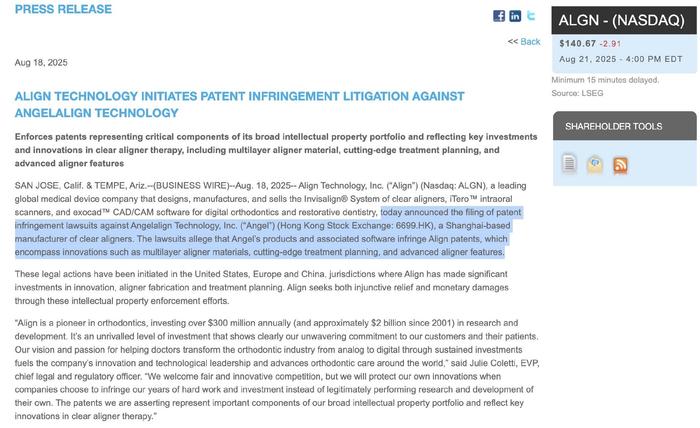
Core Viewpoint - Align Technology, the parent company of Invisalign, has initiated a series of patent infringement lawsuits against Angelalign in the US, Europe, and China, claiming infringement on core technologies related to multi-layer aligner materials, treatment planning, and aligner characteristics [1][3][15] Group 1: Legal Actions and Responses - Align Technology has filed lawsuits claiming Angelalign infringed on five US utility patents, including two material patents and three technology patents, which are crucial to Align's global intellectual property portfolio [3][15] - Angelalign has publicly denied the infringement allegations, stating they are "baseless" and has committed to actively defending against the lawsuits [1][2][5] - The legal actions reflect Align Technology's strategy to protect its intellectual property and reshape the competitive landscape to align with its research-driven development model [2][15] Group 2: Market Dynamics and Competitive Landscape - Angelalign has gained significant market share in China, reaching 41.9% in 2023, surpassing Align Technology by 10 percentage points [9][12] - Angelalign's revenue and net profit are projected to grow significantly, with a year-on-year increase of approximately 538.1% to 604.8% expected in the first half of 2025 [9][12] - Align Technology's performance in China has been declining, with revenue growth dropping from 90% in 2018 to less than 2% in 2020, indicating challenges in maintaining market presence [12][15] Group 3: Strategic Initiatives - Angelalign's strategy includes a tiered branding approach and partnerships to penetrate lower-tier cities, offering lower-priced products to attract price-sensitive consumers [13][15] - The company has expanded its international presence, with 39.1% of its cases now coming from outside China, and has established subsidiaries in key markets like the US and Europe [14][15] - Align Technology's reliance on high-margin structures is threatened by Angelalign's cost-effective and localized production strategies, which could disrupt traditional competitive advantages in the industry [15][16]