
隐形正畸

Search documents
时代天使20260310
2026-03-11 08:12
Summary of the Conference Call for Times Angel Company Overview - **Company Name**: Times Angel - **Established**: 2003, became a publicly listed company in 2021 - **Major Shareholder**: Songbai Orthodontics holds 51.05% of shares, indicating a concentrated ownership structure that supports efficient strategic decision-making [3][12] Industry Insights Domestic Market Performance - **Market Share**: Times Angel holds over 40% of the domestic market share, leading the industry since 2021 [4] - **Revenue Stability**: Despite pressures from local brands, domestic revenue remained stable, with an adjusted profit margin above 19% from 2023 to H1 2025 [4] - **Case Growth**: Domestic case numbers have shown double-digit growth in 2023 and H1 2025, although revenue growth has lagged behind due to price pressures [4] Overseas Business Development - **Growth Driver**: Overseas business has become the main growth engine, with overseas case numbers reaching 52% of total cases in H1 2025, marking a significant increase [2][5] - **Revenue Increase**: Overseas revenue surged to $80.5 million in 2024, with a projected significant profit recovery in 2025 [5] - **Loss Reduction**: Overseas losses narrowed to $5.4 million in H1 2025, indicating a nearing profitability point [2][5] Market Penetration and Growth Potential - **Market Penetration**: The domestic invisible orthodontics market penetration increased from 11% in 2020 to 14% in 2023, with expectations to reach 16% in 2024 and 25% by 2030 [6] - **Growth Drivers**: Key growth drivers include increasing demand from the youth market and expanding needs in lower-tier cities [6] Competitive Landscape - **Market Concentration**: The industry is consolidating, with leading companies like Times Angel and Align Technology capturing over 70% of the market share [6] - **Competitive Pressure**: Smaller manufacturers are exiting the market, creating opportunities for leading firms to capture additional market share [6][10] Global Market Dynamics - **Global Market Size**: The global invisible orthodontics market is projected to be over six times larger than the domestic market by 2024, with significant growth expected [7] - **Regional Distribution**: North America accounts for 39% of the global market, followed by Europe at 32% and Asia-Pacific at 20% [7] Core Competitive Advantages - **Product Range**: Times Angel offers a comprehensive product line catering to diverse market needs, supported by a strong R&D focus [8][9] - **Supply Chain Efficiency**: The company boasts a smart manufacturing system with an average global order delivery time of 8.5 days [9] - **Market Strategy**: Tailored marketing strategies for different regions, focusing on high-quality product promotion in Europe and North America [9] Future Outlook - **Market Share Projections**: Times Angel aims to capture over 20% of the global market share by 2033, with revenue projections reaching $1.6 billion [11][12] - **Revenue Forecast**: Expected revenues for 2025, 2026, and 2027 are $333 million, $412 million, and $495 million, respectively, with growth rates of 25%, 22%, and 20% [12] - **Valuation**: Using a price-to-sales (PS) ratio of 4.8 for 2026, the target market capitalization is estimated at HKD 154.5 billion, translating to a target share price of HKD 90.5 [12] Risks - **Market Expansion Risks**: Potential challenges in overseas market expansion and increased competition [12] - **Legal Risks**: Exposure to patent litigation and geopolitical risks [12]
【华创医药】时代天使(06699.HK)深度研究报告:国产隐形正畸龙头——本土崛起,出海破局
华创医药组公众平台· 2026-03-08 06:35
Core Viewpoint - The company is a leading provider of invisible orthodontic technology and products in China, having surpassed competitors in domestic market share since 2021, with robust performance despite industry pressures. The rapid growth of overseas business has significantly contributed to overall revenue, with overseas cases expected to reach approximately 140,700 in 2024, a year-on-year increase of 326% [3]. Group 1: Domestic Business Growth - The domestic invisible orthodontics market has substantial growth potential, with penetration rates nearing 16% in 2024, compared to 32% in the U.S. in 2020, indicating room for improvement, particularly in the youth/children and grassroots markets [4]. - Market concentration is increasing due to competitive pressures and policy changes, benefiting leading companies like this one as smaller players exit the market [4]. Group 2: International Expansion Potential - The global invisible orthodontics market is significantly larger than the domestic market, with case numbers being eight times higher. The company has opportunities to penetrate markets in the U.S., Europe, Asia-Pacific, and Latin America, where there is considerable room for growth [5]. - The company has established a comprehensive product system and is enhancing its competitive edge through continuous R&D and digital upgrades, leveraging a vast clinical database for complex case handling [5]. - The company’s global market share has increased from 4.5% in 2022 to 10.1% in 2025, with expectations to reach over 20% in the future as it enters a new phase of international expansion [6]. Group 3: Financial Projections - Revenue projections for the company from 2025 to 2027 are estimated at $337 million, $412 million, and $495 million, with net profits of $27 million, $22 million, and $41 million respectively. The company is currently in a growth phase for its overseas business and is valued using a PS method, with a target market value of HKD 15.45 billion and a target share price of HKD 90.5 [6].

时代天使(06699.HK)深度研究报告
Huachuang Securities· 2026-03-07 00:20
Investment Rating - The report gives a "Buy" rating for the company, with a target price of HKD 90.5, compared to the current price of HKD 69.60 [3][8]. Core Insights - The company is a leading provider of invisible orthodontics in China, having surpassed competitors in market share since 2021, and is experiencing robust growth in overseas markets, with a significant increase in case numbers and revenue [1][19]. - The domestic market for invisible orthodontics has substantial growth potential, with penetration rates expected to rise significantly in the coming years, particularly in the youth and grassroots markets [7][52]. - The company has established a strong competitive advantage through product innovation, a robust supply chain, and effective marketing strategies, which have facilitated its expansion into international markets [2][11]. Summary by Sections Section 1: Company Overview - The company has been a key player in the invisible orthodontics sector for over 20 years, achieving the top market position in China since 2021, with over 40% market share [28][19]. - The company has expanded internationally, acquiring a majority stake in a Brazilian orthodontic manufacturer, and has seen overseas case numbers surpass domestic ones by 2025H1 [16][19]. Section 2: Domestic Business Growth Potential - The domestic invisible orthodontics market is under pressure but has significant room for growth, with penetration rates expected to increase from 16% in 2024 to 25% by 2030 [46][52]. - The market is experiencing a consolidation trend, with leading companies benefiting from increased market concentration as smaller players exit due to competitive pressures [56][31]. Section 3: International Expansion Potential - The global market for invisible orthodontics is several times larger than the domestic market, providing substantial growth opportunities for the company [11][19]. - The company has improved its global market share from 4.5% in 2022 to an estimated 10.1% in 2025, with expectations to reach over 20% in the future [2][11]. - Revenue from overseas operations is projected to grow significantly, with estimates of USD 1.6 billion by 2033, driven by increased market penetration and operational efficiencies [11][12]. Section 4: Financial Projections and Valuation - The company is expected to generate total revenues of USD 337 million, USD 412 million, and USD 495 million for the years 2025, 2026, and 2027, respectively, with net profits projected at USD 27 million, USD 22 million, and USD 41 million [3][12]. - The report employs a price-to-sales (P/S) valuation method, estimating a P/S ratio of 4.8X for 2026, leading to a target market capitalization of HKD 154.5 billion [8][12].
时代天使(06699):国产隐形正畸龙头:本土崛起,出海破局
Huachuang Securities· 2026-03-06 15:23
Investment Rating - The report assigns a "Buy" rating to the company for the first time [8]. Core Insights - The company is a leading provider of invisible orthodontics in China, having surpassed competitors in domestic market share since 2021, and is experiencing rapid growth in overseas markets [1][28]. - The global invisible orthodontics market presents significant growth opportunities, with the company expected to increase its market share from 10% to over 20% in the coming years [2][11]. - The company’s revenue is projected to grow significantly, with total revenues expected to reach approximately $495 million by 2027, reflecting a compound annual growth rate (CAGR) of 20.4% [3][12]. Summary by Sections Section 1: Company Overview - The company has been a key player in the invisible orthodontics sector for over 20 years, achieving the top market position in China since 2021 [16][28]. - The company has expanded internationally, acquiring a majority stake in a Brazilian orthodontic manufacturer, which has contributed to its overseas case numbers exceeding domestic figures by 2025 [16][19]. Section 2: Domestic Business Growth Potential - The domestic market for invisible orthodontics has substantial growth potential, with penetration rates expected to rise from 16% in 2024 to 25% by 2030 [7][46]. - The market is experiencing consolidation, with leading companies benefiting from increased market concentration as smaller competitors exit due to pricing pressures [10][56]. Section 3: International Expansion Potential - The company’s global market share has increased from 4.5% in 2022 to 10.1% in 2025, with expectations to reach over 20% in the future [2][11]. - The company has established a comprehensive competitive advantage through product innovation, supply chain efficiency, and targeted marketing strategies [2][11]. Section 4: Financial Projections and Valuation - Revenue forecasts for 2025, 2026, and 2027 are $337 million, $412 million, and $495 million respectively, with net profits projected at $27 million, $22 million, and $41 million [3][12]. - The report utilizes a price-to-sales (P/S) valuation method, estimating a target market capitalization of HKD 154.5 billion and a target share price of HKD 90.5 [8][12].
时代天使(06699):时代天使发布正面盈利预告,利润超市场预期
Haitong Securities International· 2026-03-04 14:34
Investment Rating - The report assigns a positive outlook for Angelalign, indicating an outperform rating based on expected earnings growth [5][7]. Core Insights - The company anticipates achieving a net profit of USD 24-30 million in 2025, representing a year-on-year increase of 140-200% from approximately USD 10 million in the previous year [5][6]. - The profit performance is attributed to increased adoption of invisible orthodontic solutions in both domestic and international markets, scale benefits from prior investments, and a low profit base effect due to strategic investments in FY2024 [6][7]. - The company is viewed as transitioning from a leader in China's invisible orthodontics market to a significant player in the international market, with a board meeting scheduled for March 27 to discuss further developments [7]. Summary by Sections Earnings Forecast - The expected net profit for 2025 is projected to be between USD 24 million and USD 30 million, marking a substantial increase from the previous year's profit of approximately USD 10 million [5][6]. Performance Drivers - Key factors contributing to the anticipated profit growth include: 1) Increased adoption of the Group's products in both overseas and domestic markets [6]. 2) Realization of scale benefits from investments in localized sales and operations [6]. 3) Delayed commissioning of overseas factories leading to lower-than-expected capital expenditures and operating expenses [6]. 4) Limited financial impact from legal and intellectual property matters [6]. 5) A low base effect in FY2024 due to significant strategic investments [6]. Market Position - The report expresses optimism regarding the company's ability to validate its global operational capabilities and reduce losses overseas, positioning it as a key player in the international market for invisible orthodontics [7].
重启IPO:一家医疗器械公司20年长跑与资本化抉择
思宇MedTech· 2026-02-28 04:00
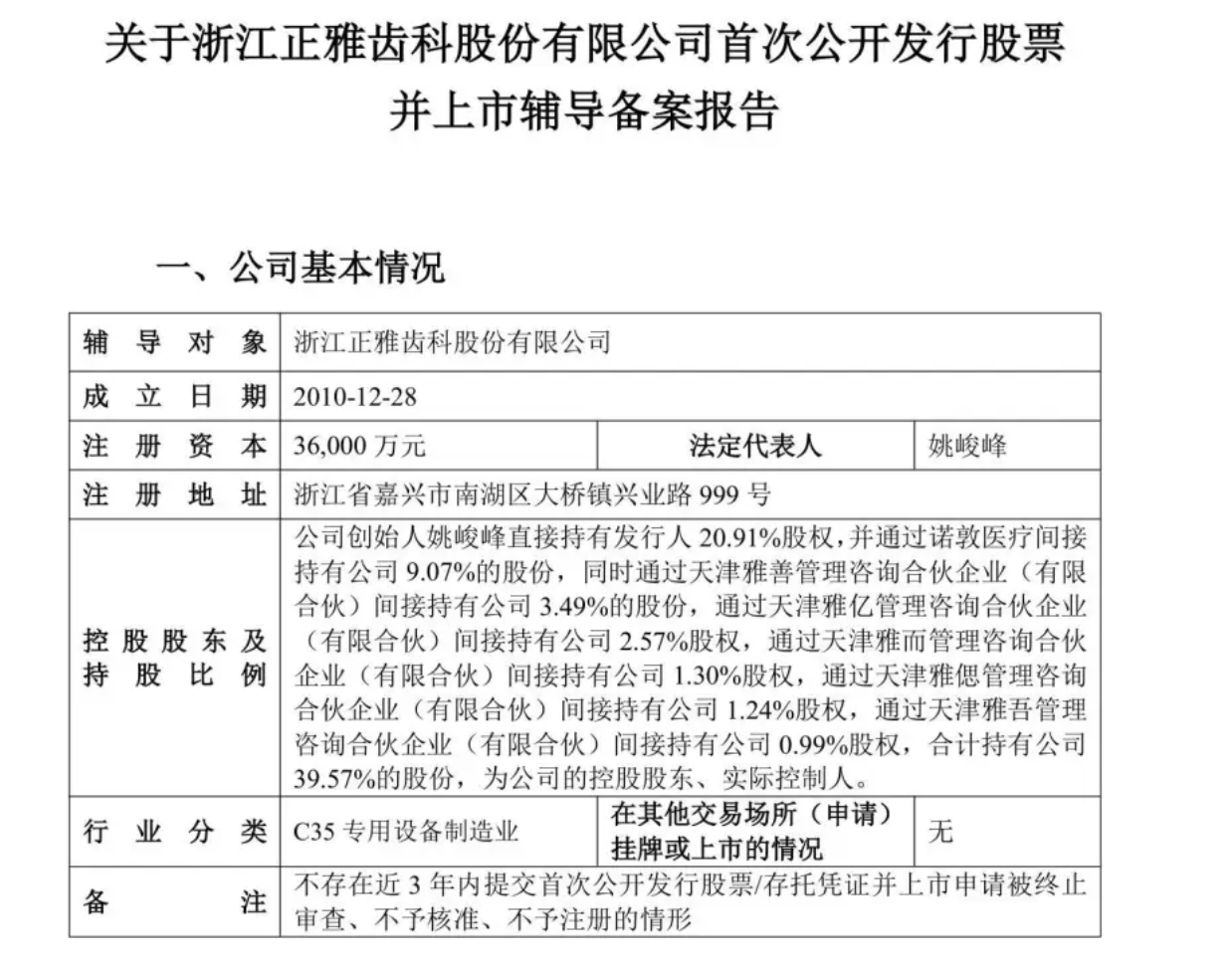
Core Viewpoint - Zhejiang Zhengya Dental Co., Ltd. is restarting its IPO process, reflecting not only the company's capital strategy adjustment but also providing a case worth observing in the medical device sector [2] Company Overview - Established on December 28, 2010, Zhengya Dental has a registered capital of 360,000 yuan and is headquartered in Jiaxing, Zhejiang Province [3] - The founder, Yao Junfeng, holds approximately 39.57% of the company's shares, indicating strong control over strategic decisions [7] Historical Context - Zhengya Dental's history dates back to October 2004, when it was registered as Zhengya Dental Technology (Shanghai) Co., Ltd., making it a company with over 20 years of experience in the dental medical device industry [5] - The company underwent nearly ten years of early technical accumulation before receiving angel round financing in 2013, which is atypical in the fast-paced startup environment [6] Manufacturing Capabilities - Zhengya Dental is the only domestic company that achieves full-process self-production of invisible orthodontic products, from polymer raw material extrusion to finished products [9] - The new production base in Jiaxing, set to be operational by October 2024, will cover 100,000 square meters and house over 180 industrial-grade 3D printing devices, with an expected annual output of over 10 million orthodontic devices by 2025 [9][10] Product Differentiation - The company has developed a comprehensive product system that addresses various orthodontic needs, including a unique "jaw position reconstruction technology" aimed at complex cases [12][13] - Zhengya has partnered with Disney and Marvel to create orthodontic products for children, targeting the growing early intervention market [14] Financing History - Zhengya Dental's financing history includes multiple rounds, starting from angel investment in 2013 to a significant D round in March 2022, raising 500 million yuan led by Taikang Investment [16] - The diverse investor base includes industry capital, top-tier PE/VC, insurance capital, and state-owned funds, indicating strong market confidence [16][17] IPO Advisory Changes - The company has switched its IPO sponsor from CICC to CITIC Securities, a move seen as more practical given the current IPO environment and CITIC's strong track record in the medical device sector [18] Industry Trends - Zhengya's IPO restart is part of a broader trend in the dental medical sector, with several companies accelerating their capital processes amid increasing competition [19] - The invisible orthodontics segment faces unique challenges due to regulatory requirements and market competition, which may complicate the IPO review process [20] Strategic Insights - Key strategic themes for Zhengya include "manufacturing depth," "globalization," and "timing," highlighting the importance of a self-controlled manufacturing system, international market expansion, and capitalizing on current market conditions [21][22]

国内排名第三的隐形正畸“黑马”再启IPO进程
Xin Lang Cai Jing· 2026-02-27 14:17
Company Overview - Zhejiang Zhengya Dental Co., Ltd. (Zhengya Dental) has completed the counseling filing for its initial public offering (IPO) on February 25, 2026, with CITIC Securities as the counseling broker [1] - The company was established on December 28, 2010, with a registered capital of 360 million yuan [2] - The founder, Yao Junfeng, directly holds 20.91% of the company's shares and has indirect holdings through various partnerships, totaling 39.57% [2][11] Business Model and Products - Zhengya Dental specializes in the research and development of digital invisible orthodontics, offering customized invisible aligners, with its main product line being the Smartee series [3] - The company has a production base in Jiaxing, Zhejiang, and an intelligent manufacturing base in Ziyang, Sichuan, capable of producing over 10 million invisible aligners annually [3] - Since 2021, Zhengya Dental has partnered with Disney and Marvel to produce and sell official licensed invisible aligners for children and teenagers [3] Market Position and Growth - Zhengya Dental's market share in the domestic invisible orthodontics market reached nearly 20% by 2021, making it the second-largest player after Align Technology and Angelalign [3] - The invisible orthodontics market in China has grown significantly, with retail sales increasing from $200 million in 2015 to $1.5 billion in 2020, and projected to reach $11.9 billion by 2030, reflecting a compound annual growth rate (CAGR) of approximately 23.1% [7] - The penetration rates for invisible orthodontics in China are significantly lower than in the U.S., indicating substantial growth potential [7] Industry Dynamics - The orthodontic market is divided into traditional and invisible segments, with the latter gaining traction since its introduction around 2010 [4] - The supply of orthodontic professionals in China is insufficient, which limits the promotion and accessibility of invisible orthodontic services [7] - Price reductions in orthodontic materials due to centralized procurement have compressed profit margins for companies in the sector [7] Financial Background - Zhengya Dental has undergone multiple rounds of financing, with the latest being a D-round in March 2022, raising 500 million yuan [9] - Prior to its IPO counseling, the company had completed several financing rounds, attracting investments from notable firms such as China Resources Capital and others [9]
浙江学霸卖“牙套”,要IPO
Sou Hu Cai Jing· 2026-02-27 12:30
Core Viewpoint - The dental industry, particularly the invisible orthodontics sector, is experiencing a paradox of high demand and intense competition, leading to a shift in business strategies among companies like Zhengya Dental, which is now pursuing an IPO amidst changing market dynamics [1][3][8]. Group 1: Company Overview - Zhengya Dental, the third-largest player in China's invisible orthodontics market, has resumed its IPO process after a previous attempt in May 2023 failed [1][2]. - The company has changed its underwriting team from China International Capital Corporation (CICC) to CITIC Securities, indicating a shift towards prioritizing the certainty of going public over high valuations [2][3]. - Zhengya holds data on 1.5 million patients, but faces challenges as the market becomes increasingly competitive and price-sensitive [3][6]. Group 2: Industry Dynamics - The invisible orthodontics market is transitioning from high-margin profitability to a focus on efficiency due to increased competition and regulatory changes, such as the introduction of price transparency by the National Healthcare Security Administration [3][7]. - The industry's previous high growth rates are slowing down, with price wars and a decline in doctors' bargaining power compressing profit margins [3][8]. - Despite current challenges, the long-term potential for growth remains, as the penetration rate of orthodontics in China is still low, and the population base is significant [6][8]. Group 3: Market Sentiment - The dental sector is viewed as a "golden signboard" in consumer healthcare, attracting significant investment despite current market pressures [4][5]. - Companies are adapting to a new reality where survival and cost management are prioritized over ambitious growth narratives [2][4]. - The emotional value associated with dental aesthetics continues to drive consumer spending, even as economic conditions lead to more cautious consumer behavior [6][8].
时代天使(06699):欧洲法院对于特定软件功能的初步裁定对用户影响甚微
智通财经网· 2026-02-24 01:52
Core Viewpoint - Angelalign Technology Co., Ltd. is facing a temporary injunction from the Unified Patent Court of Düsseldorf, requiring the company to suspend certain modules of its "live now" automatic update feature, which minimally impacts doctors and patients using its invisible orthodontic products [1] Group 1: Legal Developments - The temporary injunction applies only to certain European countries, excluding Spain, Switzerland, the UK, and Ireland [1] - The company plans to launch a new upgraded iPlan feature for affected European users, which will offer equal reliability and greater flexibility [1] - Angelalign asserts that the Live Now feature in its iOrtho treatment design software does not infringe on any valid patents held by Align Technology [1] Group 2: Company Position and Strategy - Angelalign has filed a patent opposition application with the European Patent Office, arguing that the patent in question lacks novelty and inventiveness compared to existing technology, seeking a permanent invalidation of the patent [1] - The company respects the court's ruling but intends to actively provide evidence to demonstrate the unreasonableness of the injunction [2] - Angelalign has a strong focus on innovation in the invisible orthodontics field, with several award-winning solutions and products, and aims to foster a fair and healthy competitive environment for the benefit of doctors and patients [2] Group 3: Market Performance and Growth - Angelalign has received high satisfaction ratings from doctors and has successfully transformed complex clinical concepts into practical solutions through its flexible manufacturing system [2] - The company has achieved strong global growth and aims to maintain this growth trend through continuous innovation [2]
2025 年隐形正畸品牌推荐:国产突围与进口标杆,分层市场精选指南
Tou Bao Yan Jiu Yuan· 2025-12-04 12:44
Investment Rating - The report indicates a positive investment outlook for the invisible orthodontics industry in China, projecting a compound annual growth rate (CAGR) of 13.9% from 2024 to 2030, with the market size expected to grow from 145 billion yuan in 2024 to 316 billion yuan by 2030 [8][9]. Core Insights - The invisible orthodontics market in China is characterized by a large patient population suffering from malocclusion, with a higher prevalence of complex cases compared to Western countries. The market is currently dominated by two major players, Angelalign and Invisalign, while local brands are emerging [5][6]. - The industry is experiencing rapid growth driven by technological advancements, increased consumer awareness, and a shift towards personalized treatment options. The competition is intensifying, but the overall market is expected to maintain a high growth trajectory [5][6][9]. Market Background - The invisible orthodontics industry in China has evolved over the past 20 years, transitioning from technology introduction to local innovation. Key milestones include the establishment of the first 3D printing production line for invisible aligners in 2007 and the introduction of regulatory frameworks to standardize the market [6][7]. - The demand for invisible orthodontics is significantly increasing due to rising aesthetic standards and the preference for less visible treatment options among consumers [5][8]. Market Status - The market size for invisible orthodontics in China is projected to reach 145 billion yuan in 2024, with a CAGR of 13.9% expected until 2030. The demand is driven by a high prevalence of malocclusion and the advantages of invisible aligners over traditional braces [8][9]. - The supply side is seeing advancements in materials technology, particularly in the development of heat-pressed film materials that enhance the performance of aligners [10]. Market Competition - The competitive landscape is marked by a "dual oligopoly" structure, with Angelalign and Invisalign leading the market. These companies leverage continuous technological innovation and extensive clinical data to build competitive advantages [16][17]. - The report identifies ten recommended brands in the market, highlighting their unique strengths and market positioning, such as Angelalign's extensive clinical database and Invisalign's patented technology [18][19][20]. Development Trends - The report outlines several key trends shaping the future of the invisible orthodontics industry, including enhanced control capabilities, increased predictability through AI and big data, reduced chairside time due to smart manufacturing, and expanded application flexibility through digital integration [31][32][33][34].
