易方达增强回报A

Search documents
易方达增强回报(A/B:110017/110018)公告分红
Mei Ri Jing Ji Xin Wen· 2026-02-27 02:43
Group 1 - The core point of the announcement is that E Fund Enhanced Return (A/B: 110017/110018) will distribute dividends, with a cash dividend of 0.15 yuan per 10 fund shares, effective from March 3, 2025 [1] - The dividend distribution is based on the earnings distribution benchmark date of February 24, 2025, and investors holding 10,000 shares will receive a total of 150 yuan [1] - This marks the third dividend distribution for the E Fund Enhanced Return (A/B: 110017/110018) in the 2025 fiscal year, with a maximum of 12 distributions allowed annually, and at least 60% of the annual distributable earnings must be allocated [1] Group 2 - E Fund Enhanced Return (A/B: 110017/110018) is classified as a first-level bond fund, with a minimum of 80% of its assets invested in fixed-income securities and a maximum of 20% in equity securities [1] - As of January 31, 2026, the net value growth rate of the main share class, E Fund Enhanced Return A, has reached 286.21% since its inception on March 19, 2008, with an annualized average growth rate of 7.85% and a maximum drawdown of only -6.93% [1] - Over the past 17 complete years, the net value growth rate of this fund ranks first among 20 similar funds [1]
长债暴跌!盘几只稳稳的“固收+”~
Sou Hu Cai Jing· 2025-12-06 09:22
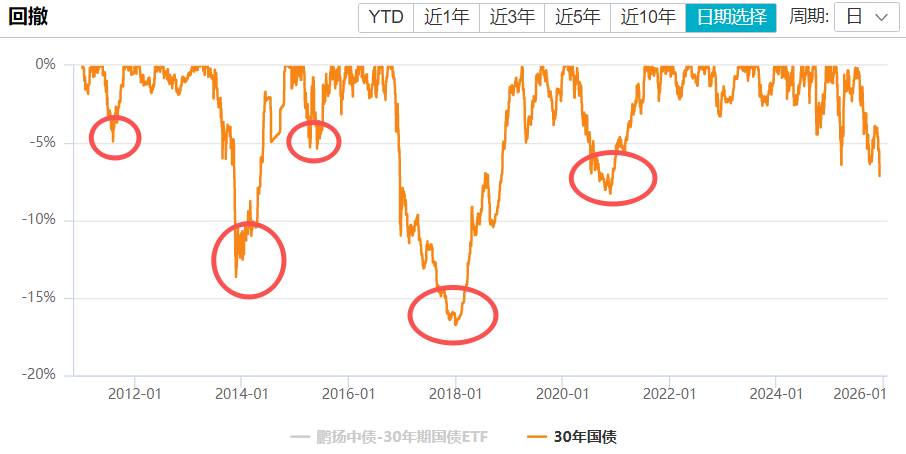
Group 1 - The 30-year Treasury ETF experienced a significant drop of 1.32% on Thursday, reaching a new low since the adjustment began, and has declined 5.86% year-to-date with a maximum drawdown of 8.2% [1][2] - Compared to previous market corrections, the current adjustment is less severe than the maximum drawdowns of 16.75% in 2017 and 13.64% in 2013, indicating a relatively milder market reaction [2] - The volatility of the 30-year Treasury ETF reflects the behavior of risk-seeking funds, which were actively buying during the downturn from July to September and continued to flow into the market during the October rebound [4] Group 2 - Starting from November 20, there has been a continuous outflow of funds, leading to a rapid decline in the bond market, which is perceived differently by large investors compared to previous downturns [5] - The decline in the bond market is attributed to several factors, including insufficient monetary policy easing as indicated by the central bank's net bond purchases of only 50 billion yuan in November, which fell short of market expectations [7] - Concerns over liquidity have increased due to the central bank's operations, including a net withdrawal of 1,756 billion yuan on the same day, alongside upcoming 1 trillion yuan reverse repos maturing in December [7] Group 3 - Market sentiment has been impacted by credit risk events, notably related to Vanke bonds, which have affected investor confidence [8] - The yield curve has been adjusting as expectations for economic recovery have shifted, leading to a gradual restoration of the yield spread between long-term and short-term bonds since July [8] - Institutional selling has been observed, with the 30-year Treasury ETF experiencing net redemptions, attributed to various factors such as fund redemptions and regulatory constraints on banks [10] Group 4 - For ordinary investors, traditional bond funds have shown a maximum drawdown of no more than 3% over the past decade, making them a more suitable option compared to the high volatility of the 30-year Treasury ETF [12] - The "fixed income plus" strategy, particularly low-volatility options, is gaining traction as both stock and bond markets face challenges, with many investors opting for professional fund managers to navigate these conditions [14] - The secondary bond fund index has increased by 13.19% since 2021, with a maximum drawdown of 6.93%, indicating a favorable performance for this investment category [14]

全市场仅1只:近十年收益超77%回撤小于-4%且是现任基金经理管的
Sou Hu Cai Jing· 2025-10-29 04:42
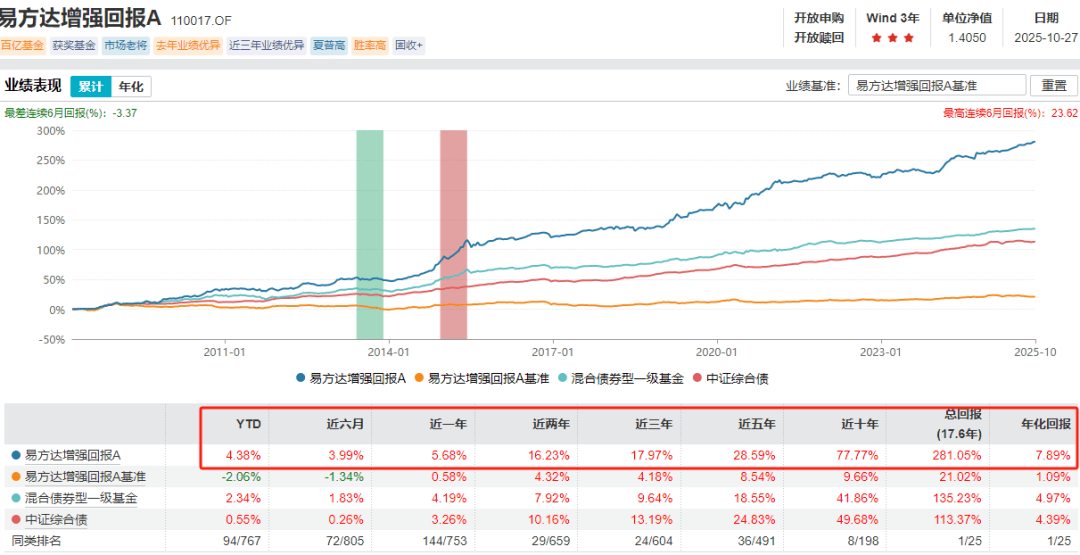
Core Viewpoint - The Shanghai Composite Index has reached the 4000-point mark for the first time in ten years, with expectations of future fluctuations around this level. Investors are encouraged to consider "fixed income+" products to seize market opportunities [1][7]. Group 1: Product Performance - E Fund Enhanced Return A (110017) has shown a nearly 77.77% increase over the past ten years, with a total return of 281.05% since inception and an annualized return of 7.89%, ranking first among its peers [1][3]. - The product has consistently outperformed its benchmark across various time frames, achieving an excess return of 260.03% since inception [3]. - The maximum drawdown for E Fund Enhanced Return A over the past ten years is -3.97%, indicating strong performance stability [3][5]. Group 2: Management Experience - The current fund manager, Wang Xiaocheng, has managed the product since August 5, 2011, with over 14 years of investment experience. Under his management, the total return has reached 182.56% with an annualized return of 7.58%, ranking 2nd out of 79 in its category [3][4]. - The fund has had three managers in total, with an average tenure of 8.64 years, showcasing a stable management team [4]. Group 3: Investment Strategy - The market outlook suggests a likely oscillating trend, and allocating a portion of funds to "fixed income+" products can act as a stabilizer for investment portfolios, smoothing out volatility [7]. - The investment strategy involves a systematic investment approach, starting with an initial purchase of 5000 yuan, allowing investors to monitor the product's performance [7].
金融产品每周见20250826:混合一级债基的配置价值提升:发展历程、策略分类、绩优产品-20250826
Shenwan Hongyuan Securities· 2025-08-26 13:13
Report Title - The Allocation Value of Hybrid First - Tier Bond Funds Increases: Development History, Strategy Classification, and High - Performing Products [2] Report Industry Investment Rating - Not provided in the content Core Viewpoints - The development of hybrid first - tier bond funds has gone through four stages: concept birth, new - share subscription strategy, convertible bond strategy, and "pure bond +" strategy. Currently, the allocation value of such funds has increased [4]. - In terms of overall risk - return characteristics, first - tier bond funds are between second - tier bond funds and pure bond funds, but there are significant internal differences [4]. - First - tier bond funds can be classified into pure bond and quasi - pure bond strategies, convertible bond增厚 strategies, and stock增厚 strategies according to asset allocation [4]. - Some high - performing first - tier bond funds, such as Western Securities LiDe HuiXiang, Tianhong Tianli, and E Fund Enhanced Return, showcase diverse risk - return characteristics through different allocations of risky assets [4]. Summary by Relevant Catalogs 1. Development History of Hybrid First - Tier Bond Funds - **Concept Birth (2002 - 2005)**: The earliest product conforming to the concept of first - tier bond funds was Huaxia Bond, established in 2002 [12]. - **New - share Subscription Strategy (2005 - 2012)**: First - tier bond funds could participate in offline new - share subscriptions without a stock bottom position, and new - share subscription became the mainstream strategy [12]. - **Convertible Bond Strategy (2012 - 2021)**: Policy changes led to first - tier bond funds losing the qualification for new - share subscriptions, and convertible bond investment gradually became the mainstream for enhancing returns [12]. - **"Pure Bond +" Strategy (2021 - present)**: Regulatory restrictions on convertible bond investment have emerged. As of the latest data, there are 415 first - tier bond funds in the market, with a total scale of approximately 868 billion yuan [4][16]. 2. Risk - Return Characteristics of Hybrid First - Tier Bond Funds - **Overall Characteristics**: First - tier bond funds generally have risk - return indicators between second - tier bond funds and pure bond funds, and their net - value trends are most similar to those of medium - and long - term pure bond funds [31]. - **Internal Differences**: There are significant internal differences among first - tier bond funds. Some are similar to short - term and medium - and long - term pure bond funds, while others have significantly higher risk - return characteristics. The volatility range is wide, with annualized volatility ranging from less than 1% to over 10% [36]. - **Low - Volatility Products**: There are 10 large - scale low - volatility first - tier bond funds, with an average annualized volatility of 0.78% in the past three years. Most of them adopt pure bond strategies [38][40]. - **Medium - Volatility Products**: Medium - volatility first - tier bond funds are defined as those with an average annualized volatility between the 30% - 70% quantile. The average annualized volatility of representative products in the past three years is 1.66%. Most of them moderately invest in convertible bonds to enhance returns [42][44]. - **High - Volatility Products**: High - volatility first - tier bond funds are those with an average annualized volatility in the highest 30% quantile. The average annualized volatility of representative products in the past three years is 4.29%. Most of them have a convertible bond position of over 20%, and some use stock investment as the main means to enhance returns [46][48]. 3. Strategy Classification of Hybrid First - Tier Bond Funds - **Pure Bond and Quasi - Pure Bond Strategies**: There are 166 products that do not invest in any risky assets, with a total scale of 31.023 billion yuan. Some products with a convertible bond investment ratio of less than 3% are also similar to pure bond funds. Credit - bond - based strategies are more common, and there are products of various duration types [56]. - **Almost Full - Position Convertible Bond Strategies**: There are 6 products with an average convertible bond position of over 80%, with a total scale of 4.797 billion yuan. They are similar to convertible bond funds but rarely hold stocks, and they focus on the elasticity of convertible bonds [62]. - **Moderate Convertible Bond增厚 Strategies**: Excluding full - position convertible bond first - tier bond funds, other convertible bond strategies are relatively low - risk. According to the convertible bond position, they can be further divided into four categories: high, medium, low, and extremely high positions. Medium - and low - position products are large in number and scale [64][66]. - **Stock增厚 Strategies**: Only 29 products invest in stocks, with a total scale of 10.986 billion yuan. Most products have a stock position of less than 5%. Only Huafu Enhanced Return and E Fund Enhanced Return have a stock position of over 10% [77]. 4. High - Performing Funds and Representative Product Analysis - **Evaluation Method**: Six indicators are used to evaluate the comprehensive investment ability of first - tier bond funds, including absolute return acquisition ability, risk control ability, etc., and some negative screening conditions are set [82][83]. - **Representative Products**: Western Securities LiDe HuiXiang adopts a pure bond + convertible bond strategy, achieving stable returns. The fund has achieved positive returns every year since its establishment and has a high annual winning rate compared to the medium - and long - term pure bond fund index. Its convertible bond position has been relatively stable since 2023, with an average proportion of 14.96%, and it prefers to allocate medium - and small - cap convertible bonds [86][95].
固收+规模两连涨破1.9万亿元!低波策略引爆市场
2 1 Shi Ji Jing Ji Bao Dao· 2025-08-06 05:37
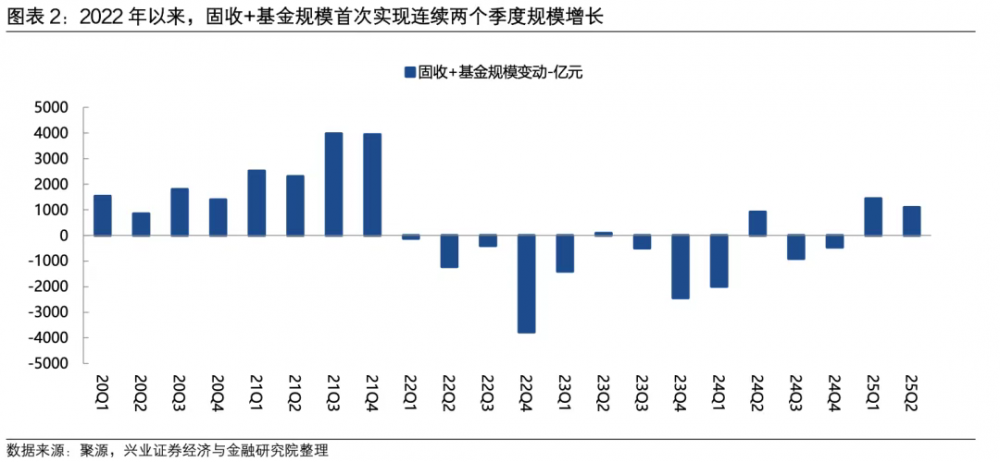
Core Viewpoint - The low-interest-rate environment has led to a significant increase in the popularity and growth of "fixed income plus" (固收+) funds, supported by regulatory guidance and market demand for stable investment options [1][24]. Group 1: Market Growth and Trends - As of June 30, 2025, the total market size of fixed income plus funds reached 1.93 trillion yuan, with a notable increase of 111.22 billion yuan in the second quarter of 2025, marking the first consecutive positive growth since 2022 [1][24]. - The growth rate for primary bond funds in Q2 2025 was approximately 25%, while secondary bond funds saw a 4% increase, and mixed bond funds experienced a 2% decrease [4][24]. - High-performing fixed income plus funds have attracted significant net subscriptions, with several funds exceeding 5 billion units in net purchases [3][24]. Group 2: Fund Performance and Characteristics - Many fixed income plus funds achieved positive returns in the first half of 2025, with 72 funds reporting returns over 6% [7][9]. - Three mixed bond funds reported annual returns exceeding 30%, while nearly 90 funds had returns between 10% and 30% [8][9]. - The performance of secondary bond funds was also strong, with over 50 funds achieving returns above 10% [9]. Group 3: Key Players and Strategies - Major fund companies like Yongying Fund, E Fund, and Invesco Great Wall have seen substantial growth in their fixed income plus fund offerings, with Yongying Fund's products ranking among the top in terms of scale increase [5][6][28]. - Yongying Fund employs a multi-strategy approach, integrating risk control and asset allocation to meet client needs, resulting in significant growth in their fixed income plus products [11][20]. - E Fund remains the largest player in the fixed income plus market, with a total scale exceeding 2 trillion yuan and a growth of over 172 billion yuan in the first half of 2025 [6][26]. Group 4: Regulatory Support and Future Outlook - The China Securities Regulatory Commission's action plan for promoting high-quality development of public funds has provided strong support for the growth of fixed income plus funds [1][24]. - The current market conditions, characterized by high volatility in the bond market and structural trends in the stock market, present an excellent opportunity to validate the effectiveness of fixed income plus strategies [7][24].
公募定增陷浮亏:爱博医疗成“重灾区” 工银、永赢、易方达浮亏合计近660万
Xin Lang Ji Jin· 2025-06-26 03:59
Group 1 - The article highlights that three public funds, namely ICBC Credit Suisse Fund, Yongying Fund, and E Fund, have reported paper losses from their locked shares in recent private placements, totaling approximately 6.6 million yuan [1][2] - Specifically, ICBC Credit Suisse Fund has a loss of about 296.07 thousand yuan, Yongying Fund has a loss of approximately 249.02 thousand yuan, and E Fund has a loss of around 114.76 thousand yuan [1][2] - The funds participated in one or more private placement projects, with the number of locked stocks being 1 for ICBC Credit Suisse and Yongying Funds, and 3 for E Fund [1][2] Group 2 - The data indicates that ICBC Credit Suisse Fund invested 24.477 million yuan in a private placement for Aibo Medical (688050.SH), with the lock-up period starting on May 12, 2025, and ending on November 13, 2025 [3] - Yongying Fund also participated in the same private placement for Aibo Medical, investing 20.587 million yuan, with identical lock-up dates [4] - E Fund engaged in two private placements, including Aibo Medical and Zhongtung High-tech (000657.SZ), investing 9.4871 million yuan in Aibo Medical, with the same lock-up period [5] Group 3 - The article notes that the primary source of the current public fund losses is linked to the private placement investments, which inherently carry risks due to the lock-up periods and market volatility [6] - It is mentioned that the attractiveness of private placements for companies is diminishing, as they may incur higher costs compared to other financing methods, such as debt financing, which does not dilute existing shareholders' equity [7] - Current market conditions, including low interest rates for bank loans and bond issuances, further reduce the incentive for companies to opt for private placements [7]

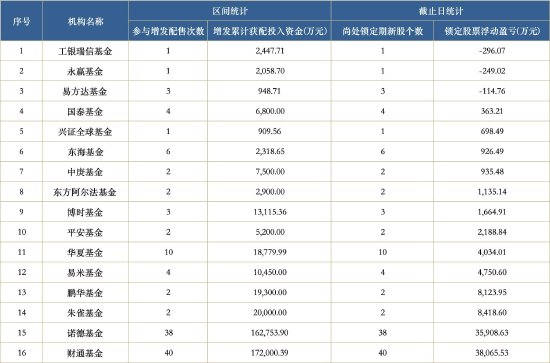
公募基金扎堆A股定增:23家公募机构合计获配109亿元,诺德基金、财通基金定增次数领跑
Xin Lang Ji Jin· 2025-06-25 10:30
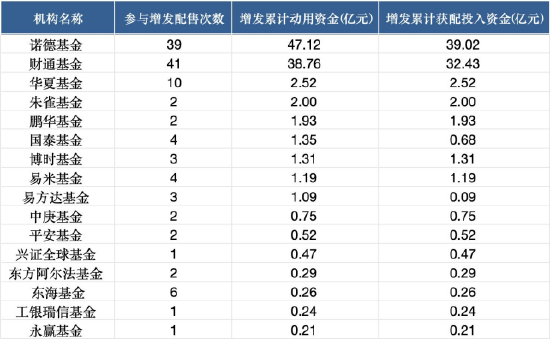
Group 1 - Public funds have shown increasing enthusiasm for investing in high-quality assets through A-share private placements, with a total investment amount reaching 10.917 billion yuan as of June 24 [1][4] - Notable public fund participants include Nord Fund, which engaged in 39 placements with a total investment of 4.712 billion yuan, and Caitong Fund, which participated in 41 placements with a total investment of 3.876 billion yuan [1][2] Group 2 - The attractiveness of private placement projects is highlighted by Haohua Technology, which attracted three public funds with a total investment of 1.628 billion yuan, and Guolian Minsheng, which drew four institutions with a total investment of 916 million yuan [4] - The trend in public fund private placements is shifting from "arbitrage" to "industry trend investment," with leading institutions actively investing in hard technology and resource restructuring [4] Group 3 - A total of 34 public fund private placement targets have achieved floating profits, with 14 of them having a floating profit rate exceeding 20%, and four targets exceeding 50% [5] - The non-ferrous metal industry is the most favored sector for public fund investments, with companies like Anning Co. and Zhongtung High-tech receiving a combined investment of 1.849 billion yuan [5] Group 4 - The recovery of the private placement market this year is attributed to supportive policies and improving market conditions, with public funds allowed to participate as strategic investors in private placements [5][6] - The private placement projects in key strategic areas such as semiconductors, AI computing power, and new energy are becoming capital hubs for industrial upgrades, indicating their potential for valuation elasticity and performance realization [6]