易方达稳健收益

Search documents
2026年公募基金投资策略:均衡配置,顺势而为
Western Securities· 2025-12-10 08:52
Core Conclusions - The public fund market in 2025 saw an increase in both scale and share, with significant changes in structure, as fixed income and active equity funds experienced net redemptions, while fixed income+ and index equity funds were net subscribed [1][3] - Global equity markets strengthened, with domestic stocks outperforming bonds, leading to overall gains in funds, particularly in active funds outperforming passive products, with notable performance in technology and cyclical theme funds [1][2] - For 2026, it is expected that equities will continue to have upward potential, with a recommendation to maintain a balanced allocation between growth and reversal strategies, while flexibly seizing short-term opportunities [1][4] Market Development: Total Growth and Structural Changes - The total scale of public funds surpassed 35 trillion yuan, with stock funds growing by over 1 trillion yuan, indicating a robust market expansion [13] - The number of public funds increased to 13,300, with significant growth in stock and REITs funds, while money market and alternative investment funds saw a decline [13][25] - Active equity funds grew by 21%, with a notable recovery in new fund launches, particularly in technology theme funds, which saw a growth rate exceeding 50% [1][2][29] Performance Analysis: Strong Equity and Weak Bonds - The performance of various asset classes showed that equities outperformed bonds, with gold reaching new highs and equity assets experiencing a broad rally [2][9] - Active funds outperformed passive funds, with specific themes such as TMT, cyclical, and advanced manufacturing showing strong results [9][2] - Fixed income+ funds demonstrated superior performance, particularly those with high allocations to fixed income and convertible bonds [9][20] Investment Strategies: Balanced Allocation and Trend Following - The report suggests a balanced allocation strategy for equity funds, emphasizing the importance of flexibility in capturing phase-specific market opportunities [4][3] - For fixed income funds, the emergence of the fixed income+ era is highlighted, with a focus on asset and strategy characteristics based on risk preferences [5][39] - The report advocates for a global multi-asset allocation approach, emphasizing the value of overseas and commodity funds, with recommendations to follow QDII quotas and focus on mutual recognition funds and southbound ETFs [6][32]
一只特别的二级债基,被机构猛买~
Sou Hu Cai Jing· 2025-11-07 15:41
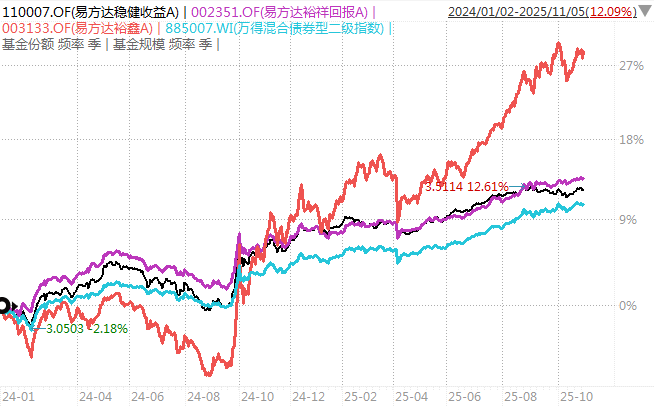
Core Insights - The article highlights a significant increase in the scale of secondary bond funds, with a growth of 374.7 billion units in Q3, representing a 56.9% increase. This trend indicates that many investors are entering the market through "fixed income+" products [1]. Group 1: Fund Growth Characteristics - Traditional large firms and emerging players are both experiencing growth. For instance, E Fund's secondary bond fund size increased from 98.8 billion to 128 billion, a rise of 29.2 billion. Meanwhile, new players like China Europe Fund and Yongying Fund also saw their secondary bond fund sizes grow by approximately 29 billion each in Q3 [2]. - There is a parallel growth in low-volatility and high-volatility "fixed income+" products. E Fund had three funds with growth exceeding 5 billion, including E Fund Stable Income and E Fund Yu Xiang Return, which saw increases of 9.9 billion and 5.9 billion respectively [3]. Group 2: Investment Strategy Insights - The article emphasizes the importance of selecting large firms for investment in secondary bond funds due to their superior risk control and professional talent pool. E Fund, for example, has a well-established team of experienced fund managers and has been a pioneer in multi-asset teams [4]. - A notable portion of the increased fund size is attributed to institutional investments, with over 90% of E Fund Yu Xin being held by institutions as of the second quarter [5]. Group 3: Investment Philosophy of Fund Managers - The investment philosophy of fund manager Hu Wenbo is characterized by two main principles: belief in mean reversion and the construction of a "anti-fragile" portfolio. This approach allows for potential gains to outweigh losses in volatile market conditions [6][13]. - Hu Wenbo's strategy includes increasing the allocation to convertible bonds, which rose from 8.4% to 14.82% in Q1 2024, and maintaining a high allocation of over 40% in subsequent quarters, contributing to the fund's strong performance [10][15]. Group 4: Performance Metrics - Under Hu Wenbo's guidance, E Fund Yu Xin achieved a return of 20.52% over the past year, ranking in the top 4% of its category, and a return of 17.44% year-to-date, also placing it in the top 4% [17].