
均值回复

Search documents
2026年4月1日利率债观察:做平30Y-10Y的机会已现
EBSCN· 2026-04-01 05:26
Group 1: Report's Industry Investment Rating - No information provided Group 2: Report's Core View - The opportunity to flatten the 30Y - 10Y spread has emerged, and currently, betting on the convergence of the 30Y - 10Y Treasury bond spread has a high probability of success. Similarly, the probability of success in betting on the convergence of the 30Y local government bond and 10Y Treasury bond spread is also high [1][2][3] Group 3: Summary Based on Related Catalogs 30Y - 10Y Treasury Bond Spread Analysis - The 10Y is the most - watched maturity on the Treasury yield curve. The spread between 30Y and 10Y Treasury bonds is used as an indicator to compare the investment cost - effectiveness of the two maturities. The higher the spread's historical quantile, the higher the investment cost - effectiveness of 30Y relative to 10Y [1][7] - In the medium - term, the 30Y - 10Y Treasury bond spread has a significant mean - reversion characteristic. From January 2010 to December 2022, the spread was generally in the range of 40 - 80bp, with a median of 57bp [1][7] - After December 2022, the spread trended downward, but has risen rapidly in the past six months. As of March 31, 2026, the spread is 53.5bp, at the 52% quantile since January 2010, at least at a historical neutral level [1][7] - The current spread is higher than the fitted value calculated from the 10Y Treasury yield. The spread and the 10Y Treasury yield are positively correlated, with a Pearson correlation coefficient of 0.44. An OLS model can be established: 30Y - 10Y Treasury bond spread = 10.23×10Y Treasury yield + 19.00. The actual spread has the motivation to revert to the fitted value [1][7] 30Y and 10Y Treasury Bond Yield Ratio Analysis - The ratio of 30Y and 10Y Treasury bond yields focuses on measuring the investment cost - effectiveness of the two assets from the perspectives of static yield and holding - period coupon income. It also has a mean - reversion characteristic [2][10] - Currently, the 30Y and 10Y Treasury bond yields are 2.35% and 1.82% respectively, and their ratio is 1.29, the highest since June 2020. The future decline of the ratio is only a matter of time, indicating that betting on the convergence of the 30Y - 10Y Treasury bond spread has a high probability of success [2][10] 30Y Local Government Bond and 10Y Treasury Bond Spread Analysis - The current spread between 30Y local government bonds and 10Y Treasury bonds is 79.3bp, at the 82% quantile since January 2021. The spread has basically returned to the level of March 2022 [3][12] - The current ratio of 30Y local government bond and 10Y Treasury bond yields is 1.39, the second - highest since January 2021. Betting on the convergence of the 30Y local government bond and 10Y Treasury bond spread has a high probability of success [3][12]
一只特别的二级债基,被机构猛买~
Sou Hu Cai Jing· 2025-11-07 15:41
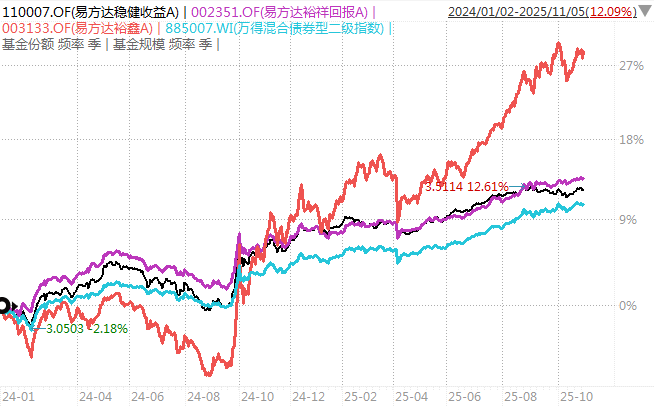
Core Insights - The article highlights a significant increase in the scale of secondary bond funds, with a growth of 374.7 billion units in Q3, representing a 56.9% increase. This trend indicates that many investors are entering the market through "fixed income+" products [1]. Group 1: Fund Growth Characteristics - Traditional large firms and emerging players are both experiencing growth. For instance, E Fund's secondary bond fund size increased from 98.8 billion to 128 billion, a rise of 29.2 billion. Meanwhile, new players like China Europe Fund and Yongying Fund also saw their secondary bond fund sizes grow by approximately 29 billion each in Q3 [2]. - There is a parallel growth in low-volatility and high-volatility "fixed income+" products. E Fund had three funds with growth exceeding 5 billion, including E Fund Stable Income and E Fund Yu Xiang Return, which saw increases of 9.9 billion and 5.9 billion respectively [3]. Group 2: Investment Strategy Insights - The article emphasizes the importance of selecting large firms for investment in secondary bond funds due to their superior risk control and professional talent pool. E Fund, for example, has a well-established team of experienced fund managers and has been a pioneer in multi-asset teams [4]. - A notable portion of the increased fund size is attributed to institutional investments, with over 90% of E Fund Yu Xin being held by institutions as of the second quarter [5]. Group 3: Investment Philosophy of Fund Managers - The investment philosophy of fund manager Hu Wenbo is characterized by two main principles: belief in mean reversion and the construction of a "anti-fragile" portfolio. This approach allows for potential gains to outweigh losses in volatile market conditions [6][13]. - Hu Wenbo's strategy includes increasing the allocation to convertible bonds, which rose from 8.4% to 14.82% in Q1 2024, and maintaining a high allocation of over 40% in subsequent quarters, contributing to the fund's strong performance [10][15]. Group 4: Performance Metrics - Under Hu Wenbo's guidance, E Fund Yu Xin achieved a return of 20.52% over the past year, ranking in the top 4% of its category, and a return of 17.44% year-to-date, also placing it in the top 4% [17].

基金能当嫁妆了...
表舅是养基大户· 2025-11-04 13:27
Market Overview - The market experienced a significant decline today, with major global indices, including US, Asia-Pacific, and Europe, all showing losses due to the rising US dollar index, which broke above 100 for the first time since August [6][7]. - The A-share market's trading volume fell below 2 trillion yuan again, indicating a decrease in market activity [11]. Dollar Index Impact - The dollar index has been on an upward trend since mid-September, influenced by hawkish signals from the Federal Reserve and rising US Treasury yields, which negatively affect risk assets [7][8]. - The biotech sector, particularly in Hong Kong, has seen substantial declines, with some stocks dropping nearly 20% since their peak [14]. Sector Performance - There is a notable divergence in sector performance, with some sectors like telecommunications, electronics, and non-ferrous metals surpassing their previous highs, while others like oil, coal, and food and beverage remain below their peak levels [16][17]. - Recently, traditionally "lagging" sectors such as oil and coal have shown better performance, contrasting with the persistent underperformance of the food and beverage sector [17]. Financing and Risk - A significant risk has emerged from the selling of stocks by leveraged funds, particularly in the technology sector, where many stocks have experienced substantial declines [20][22]. - The report highlights the dual nature of leveraged funds, acting as a market booster in bullish conditions but posing risks during market downturns [20]. Fund Management Insights - Insights from major asset management teams, such as E Fund's multi-asset team, indicate a shift towards growth-oriented assets like electronics, new energy, and pharmaceuticals, while reducing exposure to traditional sectors [25][26]. - The concept of "mean reversion" is emphasized, suggesting that asset prices tend to return to their long-term averages, which is crucial for investment strategies in convertible bonds [28][29].

2025年10月量化行业配置月报:微观结构再平衡:消费补涨-20251011
ZHESHANG SECURITIES· 2025-10-11 10:50
- The report introduces a **comprehensive allocation strategy model** that is updated monthly based on industry prosperity signals. The model allocates weights to industries with upward or stable prosperity signals, with stable industries receiving half the weight of upward industries. The strategy aims to optimize sector allocation by focusing on industries with low crowding levels and favorable prosperity trends. [4][33] - The **industry crowding monitoring indicator** is used to identify sectors with high crowding levels. As of October 9, 2025, five industries—non-ferrous metals, machinery equipment, electronics, communication, and comprehensive—triggered crowding signals, with their crowding indicators exceeding the 95% warning threshold. This suggests a cautious approach to these sectors. [3][30][31] - The report highlights the **industry divergence degree indicator**, calculated as the difference between the average growth rate and the median growth rate of the Shenwan first-level industry index. The 20-day moving average of this indicator reached the 93.7% percentile as of October 9, 2025, indicating historically high divergence. The report suggests that industry divergence tends to revert to the mean over time, implying potential for low-performing sectors to rebound. [1][11][13] - The **basic quantitative model for industry prosperity** is applied to assess the outlook for various sectors. For example, the automotive industry is expected to benefit from both domestic and international demand recovery, driven by macroeconomic improvements and global fiscal expansion. Similarly, the home appliance sector is projected to experience growth due to reduced production costs and increased export demand. The agriculture, forestry, animal husbandry, and fishery sector is highlighted for potential recovery due to the recent negative profitability in pig farming, which may accelerate capacity reduction and stimulate a turnaround. [17][18][22][24] - **Performance metrics of the comprehensive strategy model**: Over the last month (2025/9/7-2025/9/30), the strategy achieved a return of 0.1%, with excess returns of -4.6% and -4.3% relative to the industry equal-weight index and CSI 800, respectively. Over the last three months, the strategy returned 13.6%, compared to 26.3% for the equal-weight index and 19.3% for CSI 800. Over the last six months, the strategy returned 25.6%, compared to 40.1% for the equal-weight index and 32.1% for CSI 800. Year-to-date (2025/1/2-2025/9/30), the strategy returned 14.1%, compared to 29.5% for the equal-weight index and 20.9% for CSI 800. [4][33][36]
2025年9月量化行业配置月报:高切低,布局低位消费-20250910
ZHESHANG SECURITIES· 2025-09-10 13:07
Quantitative Models and Construction 1. Model Name: Timing Model for Nonferrous Metals - **Model Construction Idea**: This model uses macroeconomic scoring to time the allocation between the CSI SW Nonferrous Metals Index and the Wind All A Index, leveraging the dominant role of copper and other industrial metals in the nonferrous metals sector[19][20] - **Model Construction Process**: - The macroeconomic score for copper is calculated based on global economic and inflationary factors - Allocation Rule: - If the macro score > 0, allocate to the CSI SW Nonferrous Metals Index - Otherwise, allocate to the Wind All A Index - Backtesting Period: March 2009 to September 2025 - Formula: Not explicitly provided, but the scoring system is based on historical macroeconomic data[19][20] - **Model Evaluation**: The model demonstrates strong timing ability, capturing the upward trends in the nonferrous metals sector, except during 2012-2013 when the sector underperformed despite a bullish signal[20] 2. Model Name: Comprehensive Allocation Strategy - **Model Construction Idea**: This strategy dynamically allocates weights to industries based on their economic cycle signals (upward, flat, or downward) and crowding levels, with flat-cycle industries receiving half the weight of upward-cycle industries[35] - **Model Construction Process**: - Identify industries with upward or flat economic cycle signals - Exclude industries with high crowding levels - Assign weights: - Upward-cycle industries: Full weight - Flat-cycle industries: Half weight - Monthly updates based on the latest signals[35] - **Model Evaluation**: The strategy underperformed its benchmarks in the most recent month, suggesting potential limitations in capturing short-term market dynamics[35] --- Model Backtesting Results 1. Timing Model for Nonferrous Metals - **Excess Return**: 245% relative to the Wind All A Index during the backtesting period (March 2009 - September 2025)[20] 2. Comprehensive Allocation Strategy - **1-Month Return**: 4.6% - **Excess Return vs. Equal-Weighted Index**: -5.7% - **Excess Return vs. CSI 800**: -3.9%[35][39] --- Quantitative Factors and Construction 1. Factor Name: Macroeconomic Score for Copper - **Factor Construction Idea**: This factor evaluates the economic and inflationary environment to assess the attractiveness of copper as a leading indicator for the nonferrous metals sector[19][21] - **Factor Construction Process**: - Historical macroeconomic data is used to calculate a score for copper - The score ranges from negative to positive, reflecting unfavorable to favorable conditions[21] - Formula: Not explicitly provided, but the scoring system is derived from macroeconomic indicators[21] 2. Factor Name: Sector Crowding Indicator - **Factor Construction Idea**: This factor measures the crowding level in various sectors to identify potential risks of over-concentration[32][34] - **Factor Construction Process**: - Calculate the crowding level for each sector based on historical trading data - Identify sectors exceeding the 95% warning threshold[32][34] --- Factor Backtesting Results 1. Macroeconomic Score for Copper - **Latest Score**: 4, indicating a historically high level of attractiveness for the nonferrous metals sector[19][21] 2. Sector Crowding Indicator - **Sectors Above 95% Threshold**: Nonferrous Metals, Electronics, Communication, Machinery, Comprehensive, Beauty & Personal Care, Defense, and Pharmaceuticals[32][34]