
智慧食堂系统

Search documents
算好“经济账” 降本见实效
Jin Rong Shi Bao· 2026-01-27 03:37
Core Viewpoint - The China People's Bank Aba Prefecture Branch is actively implementing energy-saving measures and promoting green office practices, achieving significant reductions in energy and water consumption by 35% and 19% respectively compared to the same period in 2020, as part of its commitment to sustainability by 2025 [1][2][3][4] Group 1: Energy Efficiency Initiatives - The branch has established a public asset warehouse to manage and repurpose idle assets, resulting in cost savings of approximately 150,000 yuan through the refurbishment and reuse of over 140 office desks and chairs [2] - The implementation of a "smart cafeteria" system has led to a reduction in food waste, with the practice of "clean plate" becoming common [2] - The branch has achieved a reduction in A4 paper and toner usage by 12% and 8% respectively, alongside the removal of 19 inefficient landline phones [2] Group 2: Technological Advancements - The energy monitoring platform allows for real-time tracking of electricity and water usage, with automated alerts for anomalies, leading to a decrease in monthly electricity consumption from 7,100 kWh to 3,400 kWh [3] - The branch has integrated renewable energy sources, such as a distributed photovoltaic system and rainwater recycling, into its operations, significantly improving energy efficiency [3] Group 3: Cultural Shift Towards Sustainability - The branch has shifted its approach to energy conservation from a passive "must save" mentality to an active "want to save" culture, encouraging employee participation through interactive activities and digital reminders [4] - Various initiatives, such as energy-saving quizzes and recycling programs, have fostered a sense of engagement among employees, contributing to a broader commitment to sustainability [4]
北京市中小学2027年底全面实现食堂供餐
Xin Lang Cai Jing· 2026-01-18 17:25
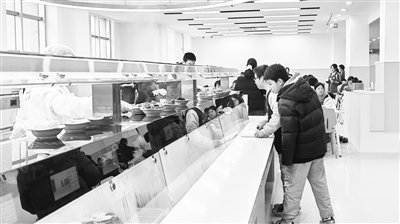
Core Insights - The Beijing municipal government aims to fully implement on-campus dining services in all primary and secondary schools by the end of 2027, promoting the application of smart canteens to enhance management through technology [3][6] - The initiative includes the establishment of a regional procurement platform for food supplies, which has already completed over 1,600 improvement projects across more than 1,300 school canteens since 2005 [3][6] Group 1: Smart Canteen Implementation - The smart canteen system at Pinggu Middle School has been operational for a month, serving an average of 1,500 people daily, with significant improvements in meal service efficiency, food waste reduction, and student satisfaction [3][4] - The kitchen utilizes robotic cooking and multifunctional ovens, standardizing meal preparation with over 200 recipes, which reduces human error and cooking time by approximately 30 minutes [4] Group 2: Student Experience and Nutritional Management - Students can choose meals using a self-service model, with electronic displays providing information on dish names, prices, nutritional content, and allergens, allowing parents to track their children's dining details via a mobile app [4] - The flexibility in meal portions, including unlimited rice refills, has effectively reduced food waste, while students report improved meal variety and affordability [4] Group 3: Supply Chain and Food Safety - Food procurement at Pinggu Middle School is managed through a certified platform, ensuring traceability and safety from farm to table, with a five-tier control system for food safety [5] - The supply chain includes cold chain logistics with real-time temperature monitoring, ensuring that fresh produce is delivered to schools on the same day [5] Group 4: Future Plans and Educational Integration - The Beijing Municipal Education Commission plans to transition all school canteens to self-operated models and expand the coverage of the procurement platform to ensure transparent sourcing of all food categories [6] - Schools are encouraged to develop curriculum that integrates food science and technology, enhancing students' practical skills and innovative thinking through project-based learning [4][6]

兴业银行济南分行绘就数链金融新图景
Zhong Guo Jin Rong Xin Xi Wang· 2026-01-16 12:20
Core Insights - The core viewpoint of the news is that Industrial Bank's Jinan Branch is leveraging "finance + technology" to enhance the digital financial service ecosystem in Linyi, focusing on regional and industry-specific value creation [1][2]. Group 1: Financial Technology Integration - The bank has developed a three-dimensional digital service system that includes a financial cloud platform, a smart park system, and an aggregated payment ecosystem to address pain points in enterprise operations, park management, and consumer services [1]. - The financial management platform launched by the bank connects multiple bank systems, enabling real-time visibility and intelligent scheduling of funds, thus transforming financial management from manual to digital [2]. Group 2: Digital Transformation in Logistics and Markets - The bank has tailored a park service platform and a smart market system to meet the digital transformation needs of Linyi's logistics parks and specialized markets, integrating financial services into park management [2]. - As of now, the platform has been implemented in three logistics parks and three specialized markets in Linyi, effectively addressing issues of management inefficiency and fragmented services [2]. Group 3: Scene-Based Services - A one-stop aggregated payment platform has been introduced to streamline payment processes for merchants, integrating major payment channels and providing real-time fund settlement [3]. - The smart canteen system has been launched to cater to large-scale employee dining needs, significantly improving dining efficiency and reducing management costs [3]. Group 4: Future Outlook - The successful implementation of the three-dimensional digital service system exemplifies the bank's commitment to the "good quality finance" concept and highlights the role of financial technology in empowering the real economy [3]. - The bank plans to continue deepening the integration of finance and technology, focusing on key industrial chains and specialized parks in Linyi to optimize digital products and expand application scenarios [3].

建行山东省分行以“心坎温度、未来远见、指尖效率”诠释金融为民
Zhong Guo Jin Rong Xin Xi Wang· 2026-01-14 10:53
Core Viewpoint - The article highlights the transformative impact of financial services provided by the Bank of China in Shandong Province, focusing on community development and innovative financial solutions to support local economies and environmental sustainability [1][3]. Group 1: Community Development Initiatives - The Bank of China in Shandong is actively involved in community projects, such as the establishment of a grain drying facility and storage for farmers in Li Fuyuan Tun Village, which has significantly improved local agricultural practices [2][3]. - In Yushui Village, the bank facilitated the construction of a production road with a donation of 250,000 yuan, enhancing access for farmers and improving their ability to transport goods [2][3]. Group 2: Environmental Sustainability Efforts - The bank provided a 2 million yuan loan to a marine aquaculture company, allowing them to use sea area rights as collateral for the construction of artificial reefs, which contribute to marine biodiversity [4][5]. - A technology company received support through various loan products, enabling them to create a comprehensive waste management system that addresses waste disposal challenges on the islands [5]. Group 3: Innovative Financial Solutions - The introduction of the "Shanxin Loan," which is a pure credit, no-collateral loan, allowed a biotech company to receive 10 million yuan quickly, addressing their urgent funding needs [6][7]. - The "Cloud Tax Loan" product enables small manufacturing enterprises to secure loans based on tax data, facilitating access to financing without traditional collateral requirements [7]. Group 4: Smart Services Implementation - The implementation of a smart cafeteria system in Qingzhou has improved efficiency in meal service, allowing users to access meals quickly through facial recognition or QR codes, enhancing the overall dining experience [7][8]. - The smart cafeteria system is being adopted in various settings, including schools and hospitals, demonstrating the bank's commitment to integrating technology into everyday services [8].

金融担当,写在泥土与浪潮之间,建行山东省分行以“心坎温度、未来远见、指尖效率”诠释金融为民
Xin Lang Cai Jing· 2026-01-14 08:28
Core Viewpoint - The article highlights the transformative impact of financial services provided by the Bank of China Shandong Branch on local communities, emphasizing the importance of innovation and community engagement in driving economic development [1][3]. Group 1: Community Engagement - The Bank of China Shandong Branch has deployed "first secretaries" in rural areas to address local needs, such as improving agricultural infrastructure and road access, thereby enhancing the quality of life for residents [2][3]. - In Li Fuyuan Tun Village, the efforts of the first secretary led to the establishment of a 7,200 square meter grain drying area and a 630 square meter grain storage facility, significantly benefiting local farmers [2]. - In Yushui Village, the bank facilitated a donation of 250,000 yuan for road construction, improving access for villagers and enhancing their ability to transport goods [2]. Group 2: Financial Innovation - The bank has introduced innovative financing solutions, such as using marine usage rights as collateral for a 2 million yuan loan to support ecological projects, demonstrating a commitment to sustainable development [4][5]. - The bank's "Tax Easy Loan" and "e-Government Pass" products have provided essential funding for environmental projects, enabling the establishment of a comprehensive waste management system on the islands [5]. - The "Good New Loan," which offers quick, unsecured financing, has been instrumental for high-growth tech companies, allowing them to access 10 million yuan in funding within minutes [7]. Group 3: Technological Integration - The implementation of smart cafeteria systems in various public service centers has improved operational efficiency, allowing for faster service and precise management of meal subsidies [8]. - The bank's technology-driven solutions, such as the "Cloud Tax Loan," have streamlined the loan approval process by utilizing tax and invoice data, thus enhancing access to financing for small and medium-sized enterprises [7].
深耕数字金融 服务政企民生
Nan Fang Du Shi Bao· 2025-11-27 23:14
Group 1 - The core viewpoint of the article highlights the innovative initiatives by China Construction Bank's Jiangmen branch in integrating digital financial services into various sectors, particularly focusing on the digital RMB and its applications in public services and education [2][3][4] - The Jiangmen branch has launched a "Smart Canteen System" that utilizes technology to enhance the efficiency of traditional canteen operations, providing a new approach for digital transformation in consumption scenarios [3][4] - The digital RMB fiscal distribution solution introduced by the bank aims to provide secure, efficient, and intelligent salary payment services for government departments, marking a significant step in the development of digital governance [2][4] Group 2 - The "Smart Canteen System" incorporates data analysis capabilities to create a fully digital management process, including online meal ordering, intelligent meal preparation, and facial recognition payment, thereby reducing food waste and improving service efficiency [4] - The system allows students to make payments through facial recognition without the need for physical cards or mobile phones, addressing common issues such as long queues and payment difficulties in traditional canteens [4] - The initiatives by the Jiangmen branch not only enhance the efficiency of fund circulation but also promote the digital transformation of management models, contributing to the digital development of the Guangdong-Hong Kong-Macao Greater Bay Area [4]
