智能汽车零部件

Search documents
鲁西南崛起智能汽车零部件高地
Qi Lu Wan Bao· 2026-01-18 16:48
Core Insights - The automotive consumption peak around New Year has led to a 40% month-on-month increase in orders for Sanxian Electronics (Heze) Co., Ltd, which operates a 120,000 square meter smart workshop with 40 production lines running at full capacity [1] - The company has invested 1 billion yuan in the project, which covers 100 acres, and aims to deliver 100,000 new energy vehicle wire harnesses in 2024 and 180,000 in 2025 [1] Group 1 - The company has established research and development centers in Beijing, Xi'an, and Shenzhen, with a team that includes members with experience from well-known automotive companies like BYD, Geely, and Volkswagen, positioning itself at the forefront of wire harness design and development in China [2] - The company currently employs over 1,600 people, with more than 90% being local residents, and projects a revenue of 300 million yuan in 2024, 500 million yuan in 2025, and 180 million yuan in the first quarter of 2026 [2] - The local government has played a crucial role in supporting the company by addressing labor shortages and establishing talent supply channels through school-enterprise cooperation [2] Group 2 - The new industrial park will house the group's headquarters and R&D center, aiming to achieve a full industrial chain layout for electronic and electrical components in new energy vehicle smart cockpits, thereby continuously empowering local economic development [2] - The rapid development of Sanxian Electronics reflects the optimization of the business environment and the promotion of industrial upgrades in Jiaocheng, contributing to high-quality regional economic growth [2]
解读华为2025半年报:研发创下新高,利润为什么减少了
第一财经· 2025-08-29 15:58
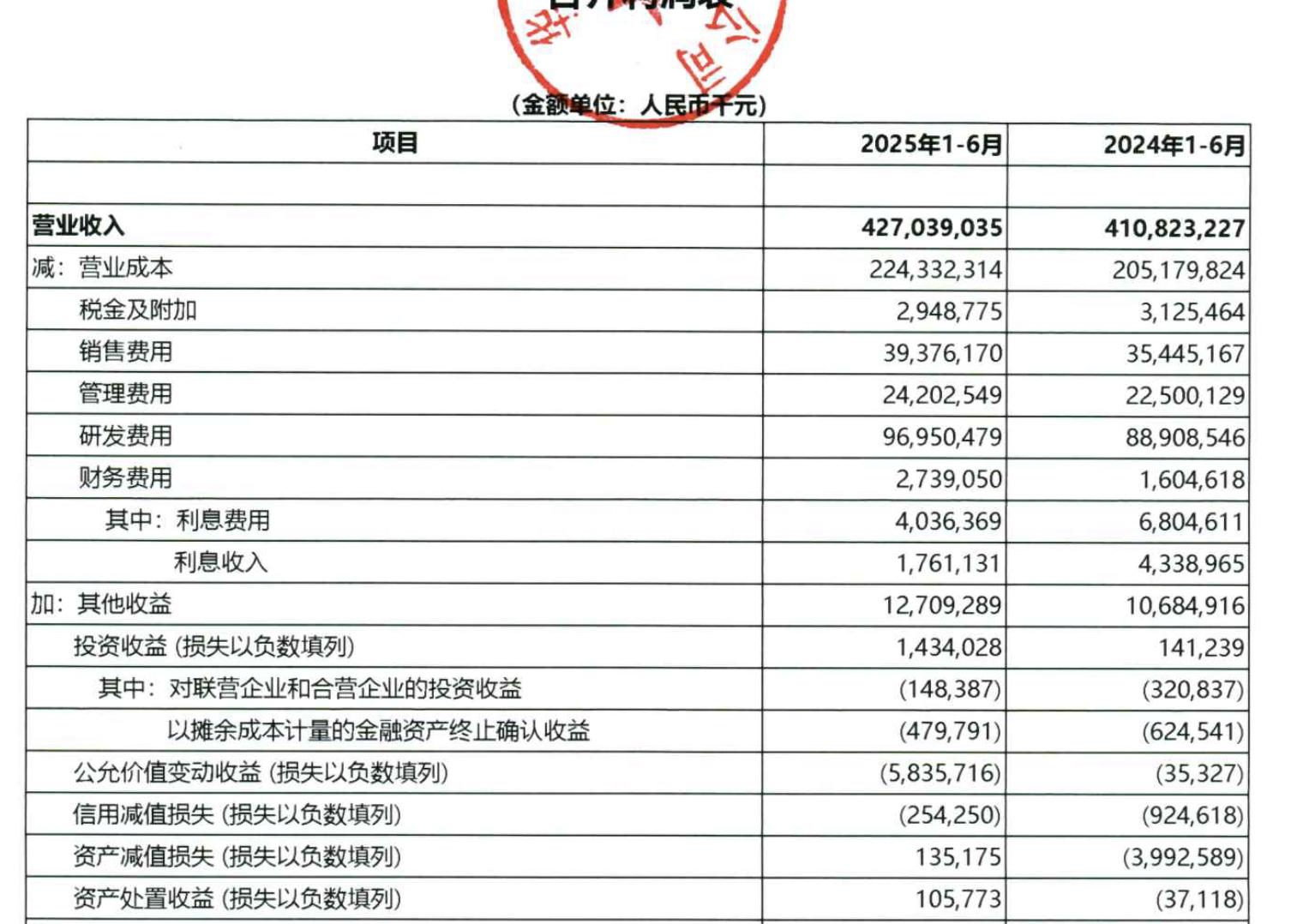
Core Viewpoint - Huawei's half-year report indicates a revenue increase of 3.95% year-on-year, reaching 427.04 billion yuan, while net profit decreased by 32% to 37.20 billion yuan, primarily due to rising costs and fluctuations in financial asset valuations [3][5][8]. Financial Performance - Huawei's revenue for the first half of 2025 was 427.04 billion yuan, compared to 410.82 billion yuan in the same period of 2024, marking a growth of 3.95% [7]. - The company's net profit for the first half of 2025 was 37.20 billion yuan, down from 55.10 billion yuan in 2024, reflecting a decline of 32% [5][7]. - Research and development (R&D) expenses reached 96.95 billion yuan, up 9.04% year-on-year, accounting for 22.7% of total revenue [3][7]. Cost Analysis - Operating costs for the first half of 2025 were 224.33 billion yuan, an increase of 9.33% from 205.18 billion yuan in 2024, indicating that cost growth outpaced revenue growth [8]. - Non-operating factors, such as a fair value change loss of 5.84 billion yuan, significantly impacted net profit [8]. Business Segments - Huawei's main business segments include ICT infrastructure, terminal business, cloud computing, digital energy, and intelligent automotive solutions, with the terminal and connectivity sectors being key revenue drivers [8][9]. - The automotive business saw significant growth, with a reported revenue increase of 4.7 times in 2024 and over 900,000 units delivered by August 2025 [9][10]. Market Position - Huawei regained the top position in China's smartphone market with a 18.1% market share in Q2 2025, selling 12.5 million units [10]. - The HarmonyOS ecosystem has over 12 million devices, with a goal to match the scale of Android and iOS ecosystems by the end of the year [10]. Strategic Focus - Huawei is focusing on artificial intelligence and computing technologies, with a recent organizational restructuring in its cloud division to enhance resource allocation towards AI and computing [11][12]. - The company aims to build a robust foundation in core technologies, emphasizing long-term growth over short-term gains [12].


解读华为2025半年报:研发创下新高,利润为什么减少了
Di Yi Cai Jing· 2025-08-29 15:14
Core Insights - Huawei aims to increase strategic investments in the next three years, countering economic trends and focusing on core technologies [1][9] - The company reported a revenue of 427.04 billion yuan for the first half of the year, a 3.95% increase year-on-year, while R&D expenses reached 96.95 billion yuan, up 9.04% [1][4] - Net profit decreased by 32% to 37.195 billion yuan, attributed to rising costs outpacing revenue growth and fluctuations in financial asset valuations [1][2] Financial Performance - Revenue for the first half of 2025 was 427.04 billion yuan, compared to 417.5 billion yuan in 2024 and 310.9 billion yuan in 2023, indicating a steady recovery in sales [2] - Net profit for the first half of 2025 was 37.195 billion yuan, down from 55.1 billion yuan in 2024, marking a 32% decline [2][5] - The increase in operating costs was 9.33%, reaching 224.33 billion yuan, which outpaced revenue growth [5] R&D and Strategic Focus - Huawei's R&D investment is projected to reach a historical high, with a focus on core technologies such as 5G-A, smart automotive components, and the HarmonyOS ecosystem [1][3] - The company is heavily investing in the Harmony ecosystem, with over 1,000 developers and significant annual R&D expenditures [3][7] - Huawei's cloud services are undergoing restructuring to focus on AI and computing capabilities, with plans to enhance the Ascend cloud and Pangu models [8][9] Business Segments - Huawei's main business segments include ICT infrastructure, terminal business, cloud computing, digital energy, and smart automotive solutions [6] - The automotive business saw significant growth, with over 900,000 vehicles delivered under the HarmonyOS brand by August 2025 [6] - Huawei regained the top position in the Chinese smartphone market with a 18.1% share, shipping 12.5 million units in Q2 2025 [7] Market Position and Challenges - Despite recent successes, Huawei faces challenges in the competitive Chinese electric vehicle market, where pricing pressures are increasing [6] - The company aims to expand the Harmony ecosystem internationally, as its global market share remains low at approximately 4% [7] - Huawei Cloud holds an 18% market share in China's cloud services, ranking second, indicating ongoing competitive pressures [8]