智能编程玩具

Search documents
AI玩具市场发展与用户洞察(2026)
艺恩· 2026-02-01 06:03
Investment Rating - The report indicates a strong growth potential for the AI toy market, with a projected global market size reaching $35.1 billion by 2030, reflecting a compound annual growth rate (CAGR) of over 50% [11][12]. Core Insights - The AI toy market is characterized by rapid growth and evolving consumer preferences, with significant contributions from traditional manufacturers, IP holders, and technology giants [16][20]. - The market is transitioning from an explosive growth phase to a more rational adjustment phase, as evidenced by the fluctuation in the number of new registered companies [13]. - The primary drivers of market growth are educational and emotional companionship toys, which leverage advanced AI technologies to enhance user interaction and learning experiences [28]. Market Overview: Scale, Structure, and Evolution Trends - AI toys are defined as products that integrate artificial intelligence technologies, enabling interactive, memory, and contextual awareness capabilities [8]. - The global AI toy market is expected to grow significantly, with China projected to reach $3.86 billion by 2030, marking a substantial increase [11][12]. - The market structure is dominated by traditional manufacturers, IP companies, and internet technology firms, each leveraging their unique strengths [16][18]. User Insights: Demand Segmentation and Scenario Analysis - The core demographic for AI toys includes women aged 18-34, with varying needs based on parental status and age [46]. - The demand for educational toys is particularly strong among Gen Z parents, who view these products as essential for child development [58]. - Emotional companionship toys are gaining traction, with significant social media engagement indicating a shift towards products that provide emotional support and interaction [74][75]. Product Categories and Market Potential - The educational learning category holds a substantial market share, with educational robots being the dominant product type [26]. - Emotional companionship toys are emerging as a key growth area, driven by advancements in AI technology that enhance user interaction [28]. - The market features a wide price range, with entry-level toys offering basic functionalities and high-end products providing advanced interactive capabilities [32][34]. Competitive Landscape - The leading brands in the AI toy market include Haivivi, which has seen remarkable growth, and traditional manufacturers that have successfully integrated AI into their product lines [22][23]. - The competitive dynamics are characterized by a mix of established players and new entrants, with a focus on innovation and technology integration [20][21].
“名场面”走进现实 “中国智造”让“科幻场景”加速落地
Ren Min Ri Bao· 2025-10-19 23:32
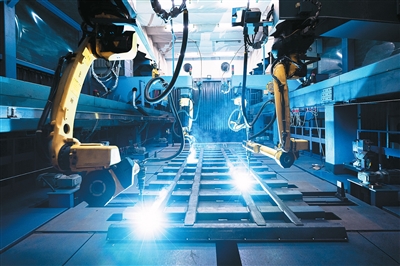
Core Insights - The article highlights China's transformation of science fiction concepts into reality, showcasing advancements in technology and manufacturing that are attracting global attention [1][2][3]. Group 1: Technological Advancements - China is increasingly recognized for its technological innovations, with examples including exoskeletons and advanced robotics being utilized in various sectors such as tourism and manufacturing [1][3]. - The country has become a leader in electric vehicles, batteries, solar panels, wind turbines, drones, and advanced robotics, demonstrating significant progress in these fields [2][3]. Group 2: Manufacturing Innovations - The concept of "dark factories" is emerging in China, where high levels of automation allow robots to perform tasks independently, often without human presence [2][4]. - By 2024, it is projected that approximately 2 million industrial robots will be operational in Chinese factories, indicating a strong trend towards automation and efficiency in manufacturing [4]. Group 3: Talent and Workforce - China boasts a substantial pool of engineering talent, with the number of engineers growing from approximately 5.2 million in 2000 to about 17.7 million in 2020, contributing to advancements in biotechnology, humanoid robotics, and AI [5]. - The country leads the world in the number of graduates in science, technology, engineering, and mathematics (STEM), with over 3.5 million graduates in 2020, providing a solid foundation for ongoing innovation [5]. Group 4: Global Perception and Tourism - There is a growing interest among international tourists in China's technological landscape, with many eager to experience innovations such as mobile payments, drone deliveries, and autonomous vehicles [6][7]. - The rise in "China tours" is reflected in increased social media posts showcasing the country's futuristic aspects, contributing to a positive global perception of China's technological capabilities [7][8].
“中国智造”让“科幻场景”加速落地(国际论道)
Ren Min Ri Bao Hai Wai Ban· 2025-10-19 22:11
Core Viewpoint - The article highlights China's rapid advancements in technology and manufacturing, showcasing how once fictional concepts from science fiction are becoming reality, particularly in robotics and automation [2][4][10]. Group 1: Technological Advancements - China is increasingly recognized for its technological innovations, with examples such as humanoid robots and exoskeletons becoming practical applications in various sectors [2][4]. - The country is leading in fields like electric vehicles, batteries, photovoltaic panels, wind turbines, drones, and advanced robotics [4][10]. - Chinese researchers have developed "super-material" clothing that can bend microwaves and visible light, showcasing significant progress in material science [5]. Group 2: Manufacturing Automation - The concept of "dark factories," where robots operate independently without human presence, is becoming common in China, demonstrating high levels of automation [4][6]. - By 2024, it is projected that approximately 2 million industrial robots will be operational in Chinese factories, indicating a strong trend towards automation [6]. - The integration of artificial intelligence in manufacturing is enhancing production efficiency and competitiveness in the global market [6]. Group 3: Talent and Workforce - China has a significant pool of engineering talent, with the number of engineers growing from about 5.2 million in 2000 to approximately 17.7 million in 2020 [7]. - The country produces over 3.5 million graduates in science, technology, engineering, and mathematics (STEM) annually, leading the world in this area [7]. Group 4: International Perception and Tourism - There is a growing interest among international tourists in China's technological landscape, with many eager to experience its modern advancements firsthand [9]. - Social media is filled with posts from foreign visitors highlighting China's futuristic elements, such as mobile payments and autonomous delivery services [8][9]. - China's global soft power ranking has improved significantly, reflecting its increasing influence and appeal as a hub of innovation [10].