
工程师红利

Search documents
公募出海策略曝光!瞄准技术赋能泛娱乐
证券时报· 2026-03-22 07:19
Core Viewpoint - The article highlights the growing interest of public funds in the "global comparative advantage" concept, particularly focusing on the pan-entertainment industry as a key area for investment due to its potential for accelerated revenue growth in overseas markets [1][3]. Group 1: Global Comparative Advantage - "Global comparative advantage" has become a highly recognized investment keyword among public funds, guiding stock selection and strategic direction [3]. - Prominent fund managers emphasize the importance of focusing on industries that leverage China's competitive strengths in technology, cost, and business models for overseas expansion [3]. - Several public funds have launched industry-specific funds named after "comparative advantage," targeting Chinese industries with global core competitiveness [3]. Group 2: Performance of Pan-Entertainment Companies - Companies like Pop Mart, Blokus, Xindong Company, Meitu, and Zhizi City Technology have shown strong growth in overseas markets, benefiting from mature cost control systems and AI technology [4]. - Blokus, heavily invested by Zhongyin Fund, saw its overseas revenue increase by 397% year-on-year by 2025, effectively offsetting a 19% revenue growth domestically [4]. - Xindong Company's overseas revenue share rose from 20% to nearly 50% as its stock price increased, highlighting the significance of overseas demand in driving performance [4]. Group 3: Investment Strategies and Future Outlook - Funds are increasingly investing in companies like Miniso, Zhizi City Technology, and Yuedu Group, which embody the "global comparative advantage" strategy [5]. - Miniso's overseas pan-entertainment business is expected to grow rapidly by 2025, while Zhizi City Technology anticipates a net profit exceeding 900 million yuan in 2025, with a year-on-year growth of no less than 87% [5]. - The high gross margins in the pan-entertainment sector are attracting more fund interest, as companies leverage China's engineering advantages and mature business models for international expansion [6][7]. Group 4: Market Trends and Valuation - The pan-entertainment sector is viewed as being at a valuation re-evaluation point, with recent market adjustments providing opportunities for investment [9]. - Non-tech sectors in the Hong Kong market have shown solid performance, with advertising, e-commerce, and gaming sectors experiencing steady revenue and profit growth [10]. - Companies in the pan-IP and pan-entertainment sectors are seeing increased overseas revenue shares, enhancing cash flow and growth certainty, which could lead to significant valuation increases [10].


2026年春季汽车行业投资策略:科技赋能下的换道再提速
Shenwan Hongyuan Securities· 2026-03-19 06:06
Core Conclusions - The automotive industry is expected to embrace technological advancements, with a limited impact from policy changes on demand, particularly in the mid-to-high-end segments, which are anticipated to see a significant recovery in demand [3] - The globalization of Chinese smart electric vehicles is underway, with overseas sales projected to approach 10 million units in five years, driven by engineering advantages [3] - Key players in the technology sector include Xiaopeng, NIO, and Li Auto, while established brands like BYD, Great Wall, and Geely are expected to lead the market [3] - The automotive parts sector represents a typical example of "high-end manufacturing" in China, with new applications in robotics, low-altitude economy, and AIDC becoming essential for growth [3] - The focus on robotics, low-altitude economy, and AIDC is expected to drive new industry directions, with significant developments anticipated by 2026 [3] - The trend of globalization remains a long-term growth path for excellent automotive parts companies, particularly in Europe, as domestic market saturation increases [3] - The automotive industry is undergoing dual transformations of electrification and AI integration, with AI expected to enhance driving, cabin, chassis, and power systems [3] Market Review - The automotive sector's performance has slightly lagged behind the CSI 300 index, with a cumulative increase of 0.5% from the end of 2025 to March 11, 2026 [11] - The automotive service, commercial freight, and parts sectors have shown notable growth, with increases of 6.21%, 3.84%, and 2.15% respectively [11] - The overall fund holding in the automotive sector increased to 3.29% in Q4 2025, with the parts sector contributing significantly to this growth [12] Vehicle Sector - The impact of policy changes on vehicle demand is limited, with a focus on technological advancements to drive growth [5] - The wholesale sales of passenger vehicles reached 30.06 million units in 2025, reflecting a year-on-year increase of 9.10%, while the first two months of 2026 saw a decline of 10.75% [18] - The penetration rate of new energy vehicles reached 51.50% in 2025, with a slight decrease to 45.25% in early 2026 [18] Parts Sector - The automotive parts sector is focusing on technological spillover and globalization, with strong horizontal expansion capabilities [3] - The sector is expected to benefit from shared resources and cost optimization through advanced manufacturing capabilities [3] AI Industry Trends - The automotive industry is entering the "Token era," where AI integration will redefine vehicle functionalities and consumer experiences [3] - The integration of AI in vehicles is expected to enhance user experience and operational efficiency, marking a significant shift in the industry [3]



从“工程师红利”到“科学家红利”,双重优势如何助力中国制造出海
第一财经· 2026-03-10 15:39
Core Viewpoint - China is transitioning from an "engineer dividend" to a "scientist dividend," indicating a shift towards advanced technology and innovation in various industries, particularly in biopharmaceuticals and shipbuilding [3]. Group 1: Biopharmaceuticals - The revenue from technology licensing in China's biopharmaceutical and gene pharmaceutical sectors reached $135 billion in the previous year, showcasing significant growth from a focus on raw materials and generic drugs [3]. - A major report on liver cancer prevention and treatment, led by Chinese scholars, was published in The Lancet, marking a historic achievement for Chinese research in global health [7]. Group 2: Shipbuilding Industry - Chinese shipbuilders, particularly Hudong-Zhonghua, have gained international orders due to superior technology and quality, with a strategic focus on high-value ship types like LNG carriers and ultra-large container ships [4]. - In 2025, China is projected to complete 53.69 million deadweight tons of shipbuilding, accounting for 56.1% of the global total, with new orders reaching 107.82 million deadweight tons, representing 69.0% of the global market [5]. - The market share of Chinese shipbuilders in the LNG sector has improved significantly, with the ratio of Chinese to Korean market share narrowing from 1:9 to 3:7 [4]. Group 3: Nuclear Energy - China has developed a fifth-generation nuclear energy system, termed "Chinese Hedianbao," which has been recognized internationally and is characterized by its small size, modularity, and long-term stable operation [7][8]. - The "nuclear treasure" technology is expected to play a crucial role in providing stable, low-carbon power for various applications, including remote areas and high-load computing centers, highlighting its potential in international markets [8].

消费组行业深度研究报告:服务消费迎来黄金十年
Huachuang Securities· 2026-03-06 12:08
Investment Rating - The report maintains a "Recommendation" rating for the consumer services sector, indicating a positive outlook for investment opportunities in this industry [4]. Core Insights - The report identifies that service consumption in China is entering a "golden decade," transitioning from basic survival needs to higher-level life experiences and values [2][15]. - It emphasizes the evolution of consumer demand, highlighting a shift from physical goods to service-oriented experiences, which are becoming the core of consumption growth [18][21]. - The analysis framework includes "demand progression," "supply upgrade," and "policy empowerment," suggesting a systematic approach to understanding the future of service consumption in China [7]. Summary by Sections 1. Service Consumption Enters a Golden Decade - Consumer demand is evolving from basic survival needs to life enjoyment and value, with significant improvements in living standards driving this change [15]. - The past two decades have seen saturation in basic physical consumption, leading to a focus on quality and service experiences [2][15]. 2. New Engines of Consumption - The report identifies two new engines driving consumption: the standardization and industrialization of service demands, and the shift from services supporting physical goods to services being the primary offering [5][21]. - The younger generations (Y and Z) are becoming the main consumer force, emphasizing emotional and experiential consumption [22][25]. 3. Supply-Side Dynamics - The report discusses the collaborative evolution of industry, technology, and talent, which is driving the upgrade of service consumption [5][18]. - The rise of AI and technology is expected to enhance service efficiency and consumer experience significantly [5][18]. 4. Policy Support - The report notes that both demand and supply sides are being supported by government policies aimed at boosting service consumption, with various initiatives being rolled out since 2025 [5][18]. 5. Investment Opportunities in Sub-Sectors - **Dining**: The report highlights the trend of chain restaurants focusing on supply chain integration and service experience as key competitive advantages, recommending companies like Gu Ming and Hai Di Lao [5][8]. - **Retail**: It discusses the transformation of retail formats to enhance shopping experiences, recommending companies like Yonghui Supermarket [5][8]. - **Cultural Tourism**: The shift from sightseeing to experiential tourism is noted, with recommendations for companies like Shoulv Hotel and Jinjiang Hotel [5][8]. - **Education**: AI is reshaping educational experiences, with a focus on vocational education, recommending companies like Fenbi and China Oriental Education [5][8]. - **IP Toys**: The transition from toys to emotional assets is highlighted, with recommendations for companies like Pop Mart and Chuangyuan [5][8]. - **Pet Healthcare**: The report notes the growth in demand for specialized pet healthcare services, recommending companies like Ruipai Pet Hospital [5][8]. - **Gaming**: Opportunities in overseas markets and new user demographics are emphasized, with recommendations for companies like Century Huatong and Perfect World [5][8]. - **Health and Wellness**: The report discusses the transformation of insurance models to include health services, recommending companies like China Ping An and China Life [5][8]. - **Physical Consumption**: The shift from selling products to selling lifestyles is noted, with recommendations for companies like Midea and Kweichow Moutai [5][8].
关于今天的政府工作报告,聊聊投资相关的十大趋势
表舅是养基大户· 2026-03-05 13:33
Group 1 - The core viewpoint of the article emphasizes the transformation of institutional advantages into strong development momentum in China, as highlighted in the government work report [2][3]. - The report outlines ten long-term trends that are crucial for understanding the future economic landscape [3]. Group 2 - Trend 1: Security is the premise of development, with military capabilities closely linked to manufacturing and AI. The report notes that China's manufacturing value added has maintained the global first position for 16 consecutive years [6][8][10]. - Trend 2: Food and energy security are essential for resilience, with non-fossil energy consumption reaching 21.7% and a focus on energy transition and diversification of energy import networks [14][15][18]. - Trend 3: The average life expectancy in China has increased to 79.25 years, indicating a need to address the challenges of an aging population and the opportunities in the "silver economy" [19][20]. - Trend 4: "Investing in people" is becoming a key fiscal paradigm, with increased funding for consumer demand and child-rearing subsidies [21][22]. - Trend 5: Technological self-reliance will be a long-term strategy, with a focus on upgrading industries and addressing core technology challenges [28][31]. - Trend 6: The integration of industry, research, and finance is crucial for new productive forces, with an emphasis on supporting technology-driven enterprises [33][37]. - Trend 7: The engineer dividend is a significant competitive advantage, with an increase in the average education level of the labor force to 11.3 years [38][41][43]. - Trend 8: New consumption scenarios will be created, with a focus on service consumption opportunities [45]. - Trend 9: The trend of "anti-involution" will penetrate corporate culture, encouraging companies to adopt supportive environments for employees [48][50]. - The report also mentions ongoing adjustments in the real estate market and the importance of quality housing for personal investment and living standards [52][53].


任泽平:2026将继续鼓励生育
Sou Hu Cai Jing· 2026-02-19 01:10
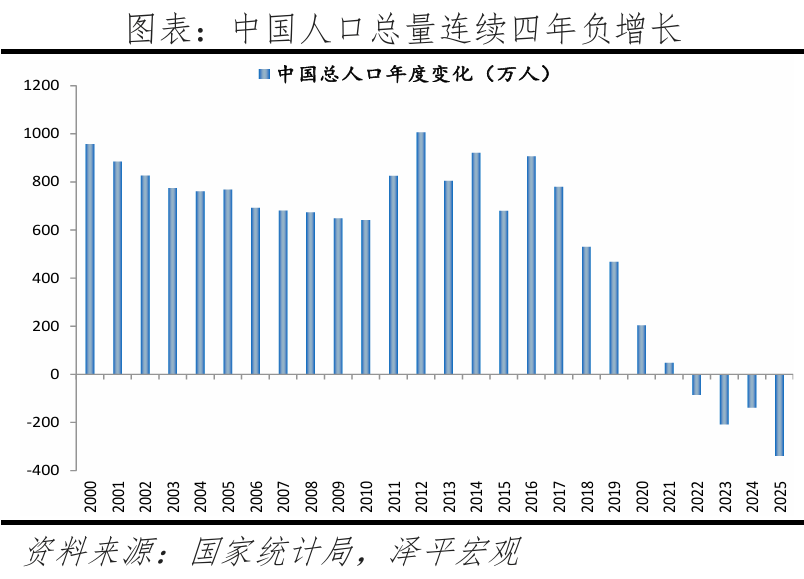
Summary of Key Points Core Viewpoint The article discusses the significant demographic changes in China as of 2025, highlighting the ongoing population decline, increasing aging population, and the need for effective policies to encourage childbirth and support families. Group 1: Population Trends - The total population of China is projected to be 1.40489 billion by the end of 2025, marking a decrease of 3.39 million from the previous year, continuing a trend of negative growth for four consecutive years [1][5]. - The birth rate has fallen to 5.63‰, with only 7.92 million births recorded in 2025, a decrease of 162,000 from the previous year [1][23]. - The death rate is 8.04‰, with 11.31 million deaths in 2025, contributing to a natural population decrease of -2.41‰ [1][5]. Group 2: Aging Population - The proportion of the population aged 65 and above is expected to rise to 15.9% in 2025, with projections indicating that this will exceed 20% by around 2030 [2][13]. - By 2050, the consumption of the elderly population is anticipated to account for approximately 21% of China's GDP [2][13]. Group 3: Labor Force Changes - The working-age population (ages 15-64) is expected to decline from 1 billion in 2010 to 950 million by 2025, representing a drop from 74.5% to 67.7% of the total population [2][18]. - This shift indicates a transition from a "demographic dividend" to a "talent dividend" and "engineer dividend" [18][19]. Group 4: Birth Rate and Family Structure - The number of marriages has slightly improved, with 6.763 million marriages registered in 2025, an increase of 657,000 from the previous year [2][27]. - The average household size has decreased to 2.5 people, reflecting a trend towards smaller families [2][27]. Group 5: Gender Ratio - The gender ratio in 2025 is reported at 104.2, indicating a slight improvement from the previous year, with 71.685 million males and 68.804 million females [2][32]. Group 6: Urbanization and Education - The urbanization rate is projected to reach 67.8% in 2025, with urban populations increasing significantly [2][35]. - The average years of education for the population aged 16-59 is expected to rise to 11.3 years by 2025, reflecting improvements in educational attainment [2][47]. Group 7: Policy Recommendations - There is a call for comprehensive policies to encourage childbirth, including financial incentives and support systems for families [2][53][55]. - The article emphasizes the importance of addressing the challenges posed by an aging population and declining birth rates through effective policy measures [2][56].
春晚的广告牌 印刻着中国经济的一次次跃迁
Nan Fang Du Shi Bao· 2026-02-17 15:27
Core Insights - The sponsorship history of the CCTV Spring Festival Gala reflects China's economic development and industrial upgrades over the past four decades, showcasing three major transitions: from basic needs to consumer electronics and automobiles, from virtual economy to hard technology, and from demographic dividend to engineer dividend [1][2]. Group 1: Historical Sponsorship Trends - In the 1980s, the main sponsors represented basic household needs, with brands like 康巴丝 leading the way, highlighting the public's desire for precision and the prosperity of light industry [1]. - The 1990s saw a shift towards quality consumption, with liquor brands and home appliance giants like 美的集团 becoming prominent sponsors, marking a transition from survival to quality-focused consumption [1]. Group 2: The Rise of Internet and Technology - The year 2015 marked a turning point with the emergence of internet giants like WeChat and Alipay, initiating a "red envelope war" that transformed user engagement and payment methods [2]. - As the internet traffic peaked, the focus shifted to hard technology, with a notable increase in sponsorship from the electric vehicle sector, indicating a fundamental shift in China's competitive edge from demographic to engineer dividends [2]. Group 3: Future Trends and Cultural Consumption - The upcoming 2026 Spring Festival Gala will feature new partnerships with brands like 名创优品 and 卡游, suggesting a potential shift towards "emotional value" and "cultural consumption" as new wealth drivers in a mature market [3]. - The evolution of sponsors serves as a "value anchor" migration, reflecting China's economic transitions from production capabilities to creative intelligence, providing a lens to observe the pulse of the times [3].
【研选行业】工程师红利+产业链优势,这个医疗细分领域龙头迎来“AI+出海”双催化,谁最可能复刻海外龙头千亿市值?(附重点公司)
Sou Hu Cai Jing· 2026-02-05 11:16
Group 1 - The demand for AR glasses and optical communication has surged over 40%, with a specific A-share company providing 78% of the global supply [1] - A leading company in a medical niche is experiencing a dual catalyst of "AI + going overseas," leveraging engineer advantages and industry chain benefits, raising questions about which company could replicate the overseas leader's trillion-yuan market value [1] - The first traditional Chinese medicine brain-computer interface equipment has been implemented, marking a breakthrough for future industries during the "14th Five-Year Plan" [1] Group 2 - Tencent is exploring the AI anime short drama market, with major players converging to ignite competition in a trillion-yuan industry [1]
外资巨头,深挖中国科技股
Shang Hai Zheng Quan Bao· 2026-01-25 05:34
Group 1 - The core viewpoint of the articles indicates that foreign public funds are optimistic about the Chinese stock market, particularly in the technology sector, which is expected to undergo a historical value reassessment by 2026, potentially generating excess returns [1][7][10] - Since 2025, the A-share market has shown resilience, with the Shanghai Composite Index stabilizing around 4100 points, and several foreign public fund products have reported significant performance, with net value increases exceeding 50% for multiple funds [3][8] - Foreign public funds have focused their investments on high-quality technology assets, with notable holdings in leading Chinese tech companies such as Tencent, Zhongji Xuchuang, and Han's Laser [3][4][5] Group 2 - Fund managers from various foreign public funds have expressed a commitment to maintaining a high equity position, focusing on growth-oriented investment opportunities in sectors like high-end manufacturing, electric vehicles, and AI technology [5][6] - The outlook for the A-share market in 2026 is positive, with fund managers highlighting the significant allocation value of Chinese stocks compared to RMB bonds, suggesting a continued overweight in equities [8][10] - There is a consensus among fund managers that high-quality technology assets are likely to continue yielding excess returns, with a focus on sectors benefiting from innovation and structural changes in the economy [9][10]






麦肯锡中国区主席倪以理:中国市场对跨国企业愈发重要
Zhong Guo Xin Wen Wang· 2026-01-21 07:51
Core Insights - The importance of the Chinese market for multinational companies is increasing, with McKinsey's China Chairman, Nir Eyal, emphasizing that "the next China is China" [1] - Despite geopolitical pressures, China's economic resilience has exceeded expectations, with significant contributions from AI and robotics sectors [1][2] Group 1: Economic Outlook - In 2024, there are concerns about China's economic growth due to geopolitical tensions, yet the actual performance is expected to surpass some predictions [1] - China's economy has shown strong resilience despite external shocks like tariffs, with advancements in AI and robotics boosting market confidence [1] Group 2: AI and Robotics - Chinese AI companies possess solid engineering capabilities, with future competitiveness likely to stem from "hardware-based AI" such as robotics [2] - The transition from labor dividends to engineer dividends, and potentially to robot dividends, indicates a shift in China's economic model [2] Group 3: Market Dynamics - China contributes approximately 30% to global economic growth and is one of the most competitive markets, demanding high standards in product quality, cost control, and innovation [2] - Success in the Chinese market can enhance a company's competitiveness in other global markets, making it an excellent training ground for multinational firms [2] Group 4: Strategic Partnerships - Many multinational companies are adapting to the changing market environment by partnering with local Chinese firms and divesting parts of their Chinese operations to strengthen their competitive edge [3] - Companies are encouraged to remain in China and deepen their engagement with the market to leverage its potential [3]