智能飞控系统

Search documents
广州可行性研究报告——低空经济投资项目
Sou Hu Cai Jing· 2025-11-12 08:11
Core Viewpoint - The low-altitude economy is being reshaped in China by the combined forces of policy, technology, and demand, transitioning from a new growth engine to a core component of the national comprehensive three-dimensional transportation network by 2025 [3][4]. Policy Environment - The low-altitude economy is included in the national "14th Five-Year Plan" and is a key focus of the Ministry of Industry and Information Technology's "20+8" industrial development plan, promoting key technologies like aviation-grade solid-state batteries and intelligent flight control systems [4]. - Over 30 cities, including Shenzhen, Hefei, and Guangzhou, have introduced special policies, with Shenzhen planning to establish 1,200 low-altitude takeoff and landing points by 2026 [4]. - The Civil Aviation Administration of China is piloting "dynamic electronic fence" technology to enhance airspace efficiency by 40% in Chengdu, while Shenzhen is implementing "sandbox regulation" for innovative companies [4]. Technology Environment - Breakthroughs in power systems include aviation-grade solid-state batteries with energy densities exceeding 400Wh/kg, extending eVTOL range from 50 km to 300 km [5]. - The integration of 5G-A networks and Beidou high-precision positioning enhances low-altitude aircraft's autonomous capabilities, with Shanghai achieving high-density scheduling of 300 aircraft per square kilometer [5]. - The cost of carbon fiber composite materials has decreased by 40%, significantly improving the economic efficiency of aircraft [5]. Market Environment - The consumer market for drones is growing, with Meituan's drone delivery service achieving over 3,000 daily deliveries in Shenzhen, reducing costs by 40% compared to traditional methods [6]. - Agricultural drones are utilizing multi-spectral imaging technology to reduce pesticide usage by 30%, while the area serviced by agricultural drones reached 1 billion mu, accounting for over 50% of the national arable land [6][7]. Regional Competition - The Guangdong-Hong Kong-Macao Greater Bay Area is leading in low-altitude economy development, supported by major companies like DJI and EHang [8]. - The central and western regions are catching up, with Sichuan housing over 200 low-altitude equipment manufacturers and establishing the first low-altitude economic industrial park [8]. Subject Competition - Traditional aviation manufacturers are accelerating eVTOL manufacturing through special funds, while tech companies like DJI hold a 70% market share in consumer drones [9]. - Startups like EHang are focusing on urban air mobility, achieving the world's first manned eVTOL certification [9]. Service Competition - Leading companies are building competitive barriers through a combination of technology, scenarios, and capital, with Meituan leveraging drone delivery data for value-added services [10]. Technical Trends - The eVTOL's range has surpassed 300 km, with hydrogen energy technology enabling long-duration operations in extreme conditions [11]. - The low-altitude intelligent network allows real-time monitoring and precise scheduling of aircraft [11]. Market Trends - Application scenarios are expanding from logistics and tourism to urban transportation and emergency management, with Shenzhen planning to establish 600 takeoff and landing points by 2026 [12]. - The low-altitude economy's output in Shenzhen reached 80 billion yuan in 2023, accounting for over 15% of the national total [12]. Ecological Trends - The integration of eVTOL, drones, and new energy vehicles is creating a collaborative industrial chain, enhancing energy efficiency [13]. - Chinese companies hold over 70% of the global drone market, with efforts underway to internationalize eVTOL certification standards [13]. Investment Recommendations - Investors are advised to focus on high-energy-density batteries and domestic flight control systems, as well as smart cluster control technologies [14]. - Short-term investments should target logistics and emergency rescue scenarios, while long-term strategies may include low-altitude tourism and precision agriculture [15].


高空看低空:一座小镇的“飞天梦”
Xin Hua She· 2025-09-07 08:21
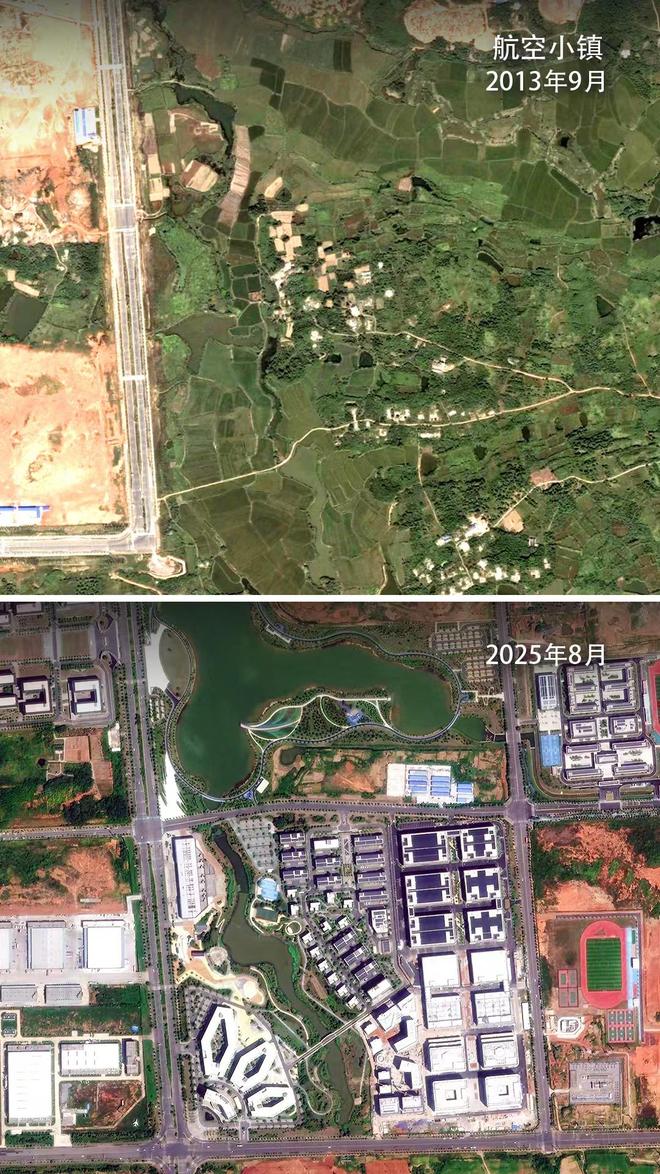
Core Viewpoint - The low-altitude economy is rapidly developing in Wuhu, Anhui Province, showcasing innovation in various aviation technologies and products, with a focus on integrating industry and urban development [1][4][7]. Group 1: Industry Development - The Wuhu Aviation Town has transformed into a new highland for industry-city integration, covering the entire industrial chain from manufacturing to operation of general aviation aircraft and drones [4]. - In 2024, the revenue of Wuhu's low-altitude economy industry reached 46.38 billion, marking a year-on-year growth of 15.95% [7]. - The aviation town has attracted over 200 enterprises across the industrial chain, fostering specialized and innovative companies [7]. Group 2: Technological Innovation - Companies in the aviation town have led or participated in 240 national and local industry standards and have overcome 30 critical technologies [7]. - The integration of advanced technologies such as 5G-A, AI, and big data is being utilized to establish a low-altitude intelligent system for safe and efficient operations [9]. Group 3: Market Expansion - The general aviation sector is experiencing a surge in demand, with the Civil Aviation Administration of China reporting a 149% year-on-year increase in flight hours for registered drones in the first half of 2025 [8]. - The general manager of a leading aircraft manufacturing company anticipates a revenue growth of over 40% for the year, driven by increasing overseas orders [8]. Group 4: Infrastructure and Ecosystem - The Wuhu Xuan Airport is developing into a specialized aviation cargo hub and international aircraft maintenance center, reflecting a trend towards a more industrialized airport [7]. - The local government emphasizes the importance of infrastructure development and application innovation to integrate low-altitude economy into various sectors [12].