期货交易咨询业务

Search documents
什么操作?瑞达期货“90后”女高管辞了副总当总助
Shen Zhen Shang Bao· 2025-11-18 13:29
Core Points - The resignation of Tian Yao, the Deputy General Manager of Ruida Futures, was announced on November 18, 2025, due to personal reasons, although she will continue to serve as the Assistant General Manager [1] - Ruida Futures primarily engages in futures brokerage, asset management, futures trading consulting, risk management, overseas financial services, and securities investment fund businesses [3] Financial Performance - For the first three quarters of 2025, Ruida Futures reported a revenue of 1.621 billion yuan, a year-on-year decline of 2.87% [3] - The net profit attributable to shareholders was 386 million yuan, reflecting a year-on-year increase of 42.15% [3] - The net profit excluding non-recurring gains and losses was 383 million yuan, showing a year-on-year growth of 45.29% [3] - The net cash flow from operating activities was -2.019 billion yuan, compared to 1.945 billion yuan in the same period last year [3]



行业热议期货交易咨询业务发展方向
Qi Huo Ri Bao Wang· 2025-10-22 01:40
Core Viewpoint - The China Futures Association is soliciting public opinions on the "Guidelines for Futures Companies to Publish Futures Research Reports (Draft for Comments)", which is expected to promote the development of futures trading consulting services centered on professional research [1] Group 1: Current State of Futures Trading Consulting Business - Futures trading consulting has been a relatively low-profile innovation for domestic futures companies, with its growth and scale lagging behind other innovative businesses in recent years [2] - The annual revenue from futures trading consulting has fluctuated between 100 million to 180 million yuan from 2018 to 2022, totaling only 717 million yuan over five years, accounting for approximately 0.065% of the total revenue of futures companies [3] - The main challenges hindering the rapid development of futures trading consulting include significant service homogeneity, a shortage of professional talent, and low client willingness to pay [3] Group 2: Regulatory and Structural Changes - The introduction of the "Guidelines" is seen as a pivotal moment for the futures trading consulting business, aiming to clarify compliance boundaries and foster a closed-loop management system [4][5] - The "Guidelines" will provide clear compliance bases for futures companies, allowing them to innovate service models within a regulated framework, thus reducing operational risks [5] Group 3: Future Directions and Opportunities - Futures companies are encouraged to focus on professional capabilities and compliance systems to enhance the sustainability and quality of futures trading consulting services [6] - The industry is expected to shift from a brokerage-focused model to one that emphasizes consulting and wealth management, with the "Guidelines" guiding the enhancement of research product professionalism and diversity [6] - There is a consensus that the futures trading consulting business will find broad development space centered on professional solutions, driven by the increasing sophistication of risk management needs from industrial clients [7]
中期协就《期货公司发布期货研究报告执业指引(征求意见稿)》公开征求意见 行业热议期货交易咨询业务发展方向
Qi Huo Ri Bao Wang· 2025-10-21 16:20
Core Viewpoint - The Futures Industry Association is seeking public feedback on the "Guidelines for Futures Companies to Publish Futures Research Reports (Draft for Comments)", which is expected to promote the development of futures trading consulting services centered on professional research [1][4]. Group 1: Current State of Futures Trading Consulting - Futures trading consulting has been a part of the industry since the early 1990s, initially providing basic market information and later becoming regulated in 1997 [2]. - Despite its long history, the revenue contribution from futures trading consulting remains low, fluctuating between 100 million to 180 million yuan annually from 2018 to 2022, totaling 717 million yuan over five years, which is only 0.065% of the total revenue of futures companies [3]. - The main challenges hindering the growth of futures trading consulting include significant service homogenization, a shortage of professional talent, and low client willingness to pay [3][6]. Group 2: Challenges and Pain Points - The industry faces three major pain points: the obvious homogenization of services, a lack of qualified professionals, and low client payment willingness [3][6]. - The mismatch between the services offered by futures companies and the diverse needs of clients, particularly in risk management, has led to a situation where consulting services are often seen as secondary to brokerage services [3][6]. - The high risk associated with futures and derivatives requires a high level of professionalism and compliance, which deters many companies from engaging in this business [3][6]. Group 3: Future Directions and Opportunities - The introduction of the guidelines is expected to clarify compliance boundaries and activate professional service capabilities, allowing futures companies to innovate within a regulated framework [5][6]. - The guidelines will help establish a clear distinction between public and private services, creating a conducive environment for charging for research services [5][6]. - Futures companies are encouraged to focus on professional capabilities and compliance systems, develop personalized services, and enhance the quality of consulting services to meet the evolving needs of the market [6][7]. Group 4: Talent Development and Integration - The cultivation of professionals who understand both futures and spot markets is crucial for the success of futures trading consulting [7]. - Companies are advised to adopt a model similar to foreign Commodity Trading Advisors (CTAs) to integrate consulting, asset management, and risk management services into a cohesive service loop [7]. - The future of futures trading consulting lies in closely aligning it with risk management and asset management to transform high-quality research into tangible products and profits [7].
期货公司迎来大洗牌!新规出台,评分逻辑大变,谁会被拉开差距?
Sou Hu Cai Jing· 2025-09-15 15:15
Core Viewpoint - The futures industry is undergoing a significant transformation with the introduction of a new classification evaluation regulation by the China Securities Regulatory Commission (CSRC), effective from 2025, aimed at scientifically measuring the comprehensive strength of futures companies [1] Group 1: Changes in Evaluation Criteria - The new regulation has restructured the scoring system, moving away from a one-size-fits-all approach to a more detailed and specific evaluation framework [3] - The "market competitiveness" category has been divided into three major categories and nine sub-items, including net profit, brokerage business net income, futures trading consulting income, market-making and derivative trading indicators, average margin of asset management products, and average net capital [3] - New items such as "market-making" and "derivative trading" have been added, indicating that companies excelling in these innovative areas will achieve higher scores in the classification evaluation [3] Group 2: Focus on Innovation and Service - The previous indicators for "cost management ability" and "return on equity" have been removed, reflecting a regulatory shift towards encouraging futures companies to innovate and grow rather than merely focusing on improving scores through cost-cutting [4] - The new scoring system has optimized the deduction mechanism, ensuring that only the most severe violation results in a score deduction, thus promoting fairness in evaluation [6] - A new scoring item has been introduced to penalize companies if their controlling shareholders or actual controllers violate regulations, aiming to extend compliance pressure to the leadership level [6] Group 3: Emphasis on Serving the Real Economy - The new regulation places greater emphasis on the ability to serve the real economy, with indicators such as "average daily positions of industrial clients" being added and adjustments made to the scoring of "average daily positions of institutional clients" [6] - The "insurance + futures" service model has been separated from the general "service to the real economy" scoring item, allowing for a more precise reflection of each company's capabilities in this specialized area [8] Group 4: Industry Trends and Future Competition - The futures industry is shifting from a model focused on quick profits to one emphasizing high-quality service and diversified income streams, as evidenced by the performance of leading firms in the first half of the year [8] - Companies like Ruida Futures have improved overall revenue through asset management, while Nanhua Futures has increased income through international business, contrasting with Yong'an Futures, which saw a 44.6% year-on-year decline in net profit due to reliance on traditional brokerage [8] - Future competition among futures companies will be redefined, focusing on who can better serve industrial clients and who has stronger derivative capabilities, rather than merely on client numbers or profit levels [10]

让“大而全”与“小而专”各美其美
Qi Huo Ri Bao· 2025-09-14 16:07
Core Viewpoint - The newly implemented "Futures Company Classification Evaluation Regulations" emphasizes both macro and micro perspectives, aiming to enhance industry quality and compliance while reducing burdens on futures companies [1][2]. Group 1: Key Changes in Regulations - The new regulations introduce a clear scoring basis, emphasizing legal compliance and changing the previous practice of deducting points without legal procedures [1][2]. - The regulations optimize the scoring system by including all business types of futures companies in the evaluation criteria, adding new performance indicators related to market competitiveness [1][2]. - The new rules encourage continuous compliance development by awarding additional points for companies maintaining high compliance and risk management scores over three evaluation periods [2]. Group 2: Industry Development Paths - The revised classification system balances the development paths of "scale" and "specialization," providing policy incentives for both large and specialized futures companies [2][3]. - Large futures companies with comprehensive licenses can gain significant advantages in scoring and innovation opportunities if they rank high across all business lines, while also facing increased management pressures [2][3]. - Smaller, specialized futures companies can achieve comparative advantages in classification results by maintaining high compliance and risk management, demonstrating that both "large and comprehensive" and "small and specialized" models can coexist and thrive in the industry [3].
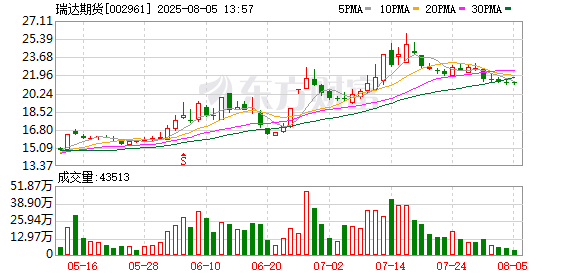
瑞达期货:公司今年暂无开展新的业务
Zheng Quan Ri Bao Wang· 2025-08-05 12:23
Group 1 - The company primarily engages in futures brokerage, asset management, and futures trading consulting services [1] - The company operates risk management, overseas financial services, and securities investment fund businesses through wholly-owned subsidiaries [1] - No new business initiatives are planned for this year [1]
瑞达期货:从事的主要业务为期货经纪业务、资产管理业务、期货交易咨询业务,今年暂无开展新的业务
Mei Ri Jing Ji Xin Wen· 2025-08-05 05:57
Core Viewpoint - The company, 瑞达期货 (002961.SZ), primarily engages in futures brokerage, asset management, futures trading consulting, and has no new business developments planned for this year [1]. Group 1 - The main business activities of the company include futures brokerage, asset management, and futures trading consulting [1]. - The company operates through wholly-owned subsidiaries that conduct risk management, overseas financial services, and securities investment fund businesses [1]. - There are no new business initiatives planned for the current year [1].