朱雀二号液氧甲烷火箭

Search documents
谁能成为“商业航天第一股”?
3 6 Ke· 2025-12-31 02:48
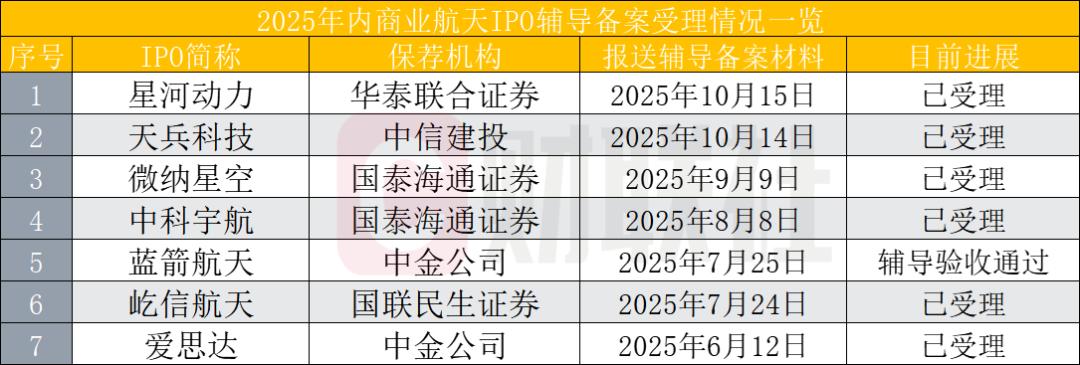
Core Viewpoint - The introduction of IPO guidelines for commercial space companies by the Shanghai Stock Exchange is expected to catalyze significant growth in the industry, marking the beginning of a golden era for commercial space ventures [1][10]. Group 1: Policy and Market Response - The new guidelines aim to support high-quality commercial rocket companies that have not yet achieved substantial revenue, facilitating their listing on the Sci-Tech Innovation Board [1][10]. - The emphasis on reusable rocket technology is seen as revolutionary, significantly reducing launch costs and increasing operational capacity, which is crucial for the commercialization of the space industry [1][10]. - The commercial space sector is viewed as a key focus for investment by institutions, with expectations of a strong market performance leading up to 2026 [1][3]. Group 2: IPO Activity and Industry Dynamics - As of now, seven commercial space companies have entered the IPO counseling process, with Blue Arrow Aerospace leading the charge as the fastest to complete its counseling [2][6]. - Major players in the global and domestic commercial space industry, including SpaceX and Blue Arrow Aerospace, are planning to advance their IPO processes by 2026, indicating a new dynamic of accelerated industry and capital interaction [2][9]. - The concentration of intermediary institutions is expected to increase, with top-tier brokers likely to dominate the IPO projects due to their industry expertise and experience [3][5]. Group 3: Institutional and Regulatory Insights - The new regulations require intermediaries to enhance their professional capabilities, ensuring thorough verification of the companies' qualifications and disclosures [3][5]. - The commercial space sector is characterized by high investment, risk, and long cycles, necessitating intermediaries to deepen their industry knowledge and collaborate effectively within their firms [5][11]. - The establishment of a dedicated regulatory body for commercial space, along with the application of the fifth set of listing standards, is anticipated to streamline financing and enhance the industry's capacity for commercialization [11][12]. Group 4: Future Outlook - The commercial space industry is expected to enter a phase of rapid growth, with significant technological advancements and increased demand for launch services and satellite networks anticipated in the coming years [10][11]. - The combination of policy support and capital investment is projected to drive the industry towards achieving high-frequency rocket launches and large-scale satellite production capabilities [11][12]. - The focus on medium to large reusable rockets is identified as a core development direction, with successful payload launches serving as a validation of commercial viability [11][12].

国家队出手,中国版“星链”提速
3 6 Ke· 2025-08-01 11:36
Group 1 - The core viewpoint of the articles highlights China's rapid advancement in low Earth orbit (LEO) satellite internet deployment, particularly through the GW constellation, which aims to establish a global satellite internet network [1][2][4] - The GW constellation is China's first giant satellite internet project, consisting of a mixed constellation of geostationary (GEO) and LEO satellites, with a total planned launch of 12,992 satellites [2][4] - The recent successful launches of multiple satellite batches within a short timeframe indicate a new record for China's LEO satellite constellation deployment, reflecting an accelerated pace in building satellite internet capabilities [1][4] Group 2 - The management restructuring at China Satellite Network Group (China Star Network) aims to enhance operational efficiency and strategic depth in satellite internet deployment, with new leadership expected to drive future network construction [5][6] - The reduction of launch costs is identified as a critical factor for the success of China's LEO satellite internet industry, with a focus on developing reusable rocket technologies to lower expenses [7] - The competitive landscape for LEO satellite internet is intensifying globally, with various countries and companies racing to secure orbital resources and establish satellite networks, emphasizing the strategic importance of space in the digital economy [8][10]
为中国航天提供“亦庄方案”——专访北京经济技术开发区机器人和智能制造产业局副局长马朝
Shang Hai Zheng Quan Bao· 2025-05-23 19:32
Core Viewpoint - Beijing Economic-Technological Development Area (Yizhuang) aims to become a world-class commercial aerospace innovation hub by 2030, targeting "thousand enterprises linked, thousand stars launched, and thousand billion revenue" [2][3] Group 1: Industry Development - Over 160 aerospace companies have gathered in Yizhuang, with commercial rocket enterprises accounting for 75% of the national total and internet satellite companies leading in density [2] - A specialized fund for commercial aerospace has been established, with over 60% of municipal-level aerospace funds directed towards Yizhuang enterprises in the past two years [3] - A 14,000 square meter common research base is being developed, with over 20 rocket and satellite companies expressing intent to settle [3] Group 2: Strategic Initiatives - Yizhuang focuses on three core tasks: expanding the industrial cluster, deepening scenario demonstrations, and constructing aerospace districts [2] - The establishment of a reusable rocket technology innovation center and a commercial aerospace alliance has been initiated, enhancing collaborative innovation [3] Group 3: Integration with Urban Development - The integration of aerospace technology with AI and big data is being promoted to create demonstration scenarios in autonomous driving and smart cities [4] - A "Belt and Road" commercial aerospace cooperation initiative will be launched to support enterprises in expanding overseas launch services and satellite operations [4] Group 4: Future Outlook - Yizhuang plans to accelerate key project construction, aiming to build landmark buildings and benchmark factories according to world-class aerospace port standards [4]