低轨卫星互联网

Search documents
未知机构:东吴计算机电科蓝天太空光伏绝对龙头深度绑定低轨卫星建设红利持续推荐-20260227
未知机构· 2026-02-27 02:15
Summary of Conference Call Notes Company Overview - The company is a core member of China Electronics Technology Group Corporation (CETC) and has over 50 years of experience in the aerospace power supply sector, establishing itself as the "national team" and absolute leader in the domestic space photovoltaic market [1] - The domestic aerospace power supply market coverage is expected to reach 50.5% in 2024, providing core power supply for over 700 spacecraft including Shenzhou, Beidou, Chang'e, and Tianwen [1] - The company has an 80% coverage rate for the national network constellation and a 100% exclusive supply for the Qianfan constellation [1] Core Technology and Products - The company possesses internationally leading triple-junction gallium arsenide solar cell technology, with on-orbit verification conversion efficiency reaching 32%-34.4%, and the latest thin-film gallium arsenide battery efficiency further improved to 33% [2] - The weight of the new battery is only 1/4 of traditional products, featuring strong radiation resistance, extreme temperature tolerance, and high reliability [2] - A complete product line of rigid, semi-rigid, and fully flexible solar cell arrays has been developed, with flexible solar wings having a thickness of only 40μm and a launch volume reduction of 70% [2] - The company is also developing four-junction/six-junction gallium arsenide and perovskite tandem battery technologies, aiming for efficiency breakthroughs of 35%-40% [2] Market Position and Growth Potential - The low Earth orbit satellite internet is included in the national new infrastructure plan, with over 20,000 satellites planned domestically, and the value of the power system per satellite estimated at 5-10 million yuan, leading to a potential market size in the trillion yuan range [2] - The company has strategically positioned itself in the industry, with a supply share of 82% in key projects such as Xingwang Generation, Qianfan Constellation, and Changguang Xingyun, with a potential market space exceeding 52.7 billion yuan from just these three constellations [2] - The commercial satellite business revenue has a compound growth rate exceeding 200%, with expected revenue contributions of approximately 15.9 billion yuan during the concentrated launch period of Qianfan Constellation and Xingwang Generation from 2025 to 2026 [2] Financial and Operational Insights - The company plans to raise 1.579 billion yuan through an IPO to invest in the industrialization project of aerospace power supplies, which will form an annual production capacity of thousands of satellite-grade units within 36 months [3] - The scale effect will continuously optimize the cost structure, significantly improving profitability, with strong growth certainty in a high-demand industry [3]
2025商业航天行业报告:大国重器
Sou Hu Cai Jing· 2026-02-11 05:51
Core Insights - The commercial space industry is becoming a new high ground for global technological competition and economic development, with a complete industrial ecosystem covering rockets, satellites, and application services rapidly taking shape in China [1][3]. Group 1: Strategic Importance of Commercial Space - The global commercial space market is maturing and entering a golden era, driven by low Earth orbit (LEO) satellite internet and characterized by technological integration and collaborative innovation across the entire industry chain [13][21]. - Commercial space has been elevated to a strategic emerging industry in China, with significant government support and inclusion in national development plans [21][26]. Group 2: Competition for Low Earth Orbit Resources - Low Earth orbit is the focal point of competition in commercial space, as it offers advantages such as low transmission latency and flexible launch capabilities, making it ideal for global satellite internet [28][32]. - The U.S. leads in LEO satellite constellations, particularly with SpaceX's Starlink, which has deployed over 10,000 satellites and aims for a total of 42,000 [35][36]. Group 3: Development of China's Commercial Space Ecosystem - China has begun to establish a complete industrial chain in commercial space, covering upstream manufacturing, midstream launch operations, and downstream application services, with a focus on cost reduction and efficiency [4][19]. - The development of reusable rocket technology is progressing, which is expected to significantly lower launch costs, a critical factor for scaling the industry [4][41]. Group 4: Infrastructure and Satellite Constellation Initiatives - Multiple commercial space launch sites in China are being completed and put into operation to meet the increasing demand for frequent launches, enhancing overall launch capabilities [5][19]. - China has announced three major satellite constellation plans, including the GW constellation, which aims to deploy nearly 13,000 satellites, marking a significant step in its competitive positioning [46][48].

亚信安全控股子公司亚信科技与格思航天签署合作备忘录
Di Yi Cai Jing· 2026-02-09 05:47
Group 1 - The core viewpoint of the article is the collaboration between AsiaInfo Technology (China) Co., Ltd. and Shanghai Geospace Aerospace Technology Co., Ltd. on low-orbit satellite internet technology [1] - The memorandum signed in Shanghai focuses on deep cooperation in areas such as "mobile direct connection to satellites" and "onboard sensing and computing intelligence" [1]

振芯科技推出高集成度宽带射频收发器GM4026N
Zhong Zheng Wang· 2026-02-07 07:13
Core Viewpoint - The introduction of the GM4026N, a highly integrated broadband RF transceiver, is a response to the evolving demands of 5G-Advanced and low Earth orbit satellite internet, emphasizing the importance of RF front-end chip performance and energy efficiency in communication systems [1][2]. Group 1: Product Features and Benefits - The GM4026N features high integration, large bandwidth, and ultra-low power consumption, enabling advancements in cellular network infrastructure and providing direct benefits across various scenarios [1]. - It supports macro stations and large-scale MIMO, meets the stringent requirements of small base stations, reduces development difficulty, and lowers operational costs for network operators [1]. - The chip opens new boundaries for 5G-A sensing integration, enhancing network capabilities with high-precision environmental sensing and positioning, thus creating new business scenarios [1]. Group 2: Applications in Satellite Communication - In the satellite communication sector, the GM4026N's ultra-wide frequency band and large bandwidth facilitate the miniaturization and cost reduction of terminal devices, providing essential hardware support for applications like direct satellite connections for mobile phones and mobile earth stations [2]. - Its excellent power consumption control is crucial for battery-dependent portable terminals [2]. Group 3: Applications in Low Altitude Economy - In the low altitude economy, the GM4026N addresses critical challenges faced by drones and eVTOLs, such as stringent power consumption, limited payload space, and the urgent need for high-bandwidth real-time data [2]. - The chip effectively reduces system power consumption and board area, saving valuable payload space and extending flight endurance [2]. - It supports reliable control links and high-definition real-time video transmission for dense drone swarms, meeting the demands for beyond-visual-line-of-sight operations and collaborative tasks [2]. - Additionally, the chip can be utilized to build miniaturized phased array radar sensing systems, enabling precise obstacle avoidance and intelligent flight path planning while effectively countering electromagnetic interference in complex low-altitude environments [2].

卫星连网初体验,手机畅游互联网(视频)
Zhong Guo Jing Ji Wang· 2026-02-06 23:26
Core Viewpoint - The rapid development of commercial space technology in China is making the dream of accessing satellite internet from remote locations, such as deserts and oceans, a reality [1] Company Insights - Galaxy Aerospace (Beijing) Network Technology Co., Ltd. is focused on building low Earth orbit satellite internet infrastructure [1] - The company provides a hands-on experience of "connecting mobile phones to satellite internet" [1] Industry Trends - The commercial space sector in China is accelerating, leading to advancements in satellite internet capabilities [1] - The potential for satellite internet to enhance connectivity in remote areas is becoming increasingly feasible [1]
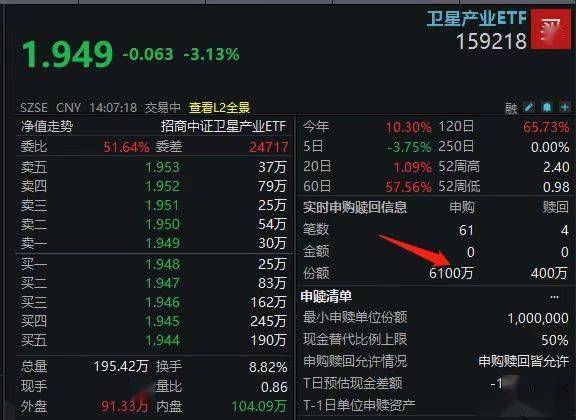
谁在抛,谁在买?暴跌3%的卫星产业ETF(159218)狂揽过亿,万亿"太空基建"逻辑生变?
Sou Hu Cai Jing· 2026-02-04 06:34
Core Viewpoint - The satellite industry ETF experienced a significant drop, but over 110 million yuan flowed into the ETF during the decline, indicating a "buy the dip" mentality among investors [1][4]. Group 1: Market Performance - As of February 4, the satellite industry ETF (159218) fell by 3.13%, with major component stocks like Xinwei Communication and Zhenlei Technology dropping over 9% [1]. - The ETF's net value showed a decline of 3.13%, with a 120-day increase of 10.30% and a 250-day decrease of 3.75% [2]. Group 2: Causes of the Decline - Internal factors include profit-taking by short-term investors, as the sector had seen a nearly 58% increase over the past three months, leading to a concentrated sell-off during market adjustments [2][3]. - External factors involve a sudden drop in risk appetite for global tech stocks, affecting sectors like AI and semiconductors, which amplified the volatility in the A-share satellite sector [3]. Group 3: Investor Sentiment and Strategic Insights - The lack of new catalysts and a divergence in market views on rapid short-term gains and valuations highlighted the need for a technical correction [4]. - The influx of over 110 million yuan into the ETF during the downturn reflects a strategic accumulation by long-term investors, viewing the drop as a "golden opportunity" [4]. - Three core values driving this sentiment include: 1. Strategic certainty: Low-orbit satellite internet has evolved from a tech concept to a national strategic infrastructure [4]. 2. Industry explosiveness: The year 2026 is pivotal for domestic commercial space, transitioning from storytelling to performance [4]. 3. Tool scarcity: As the first satellite-themed ETF in the market, it has become a primary tool for capital allocation in the space economy [4].
太空基建不断加速-持续看好商业航天与卫星产业链
2026-01-29 02:43
Summary of Key Points from Conference Call Industry Overview - The conference call focuses on the commercial aerospace and satellite industry, highlighting rapid advancements and investment opportunities in this sector [1][2]. Core Insights and Arguments - **Rocket Reusability**: Breakthroughs in rocket reusability technology are expected by 2026, which will lower launch costs and enhance competitiveness in commercial aerospace [1][2]. - **Low Earth Orbit (LEO) Satellite Internet**: The development of LEO satellite internet is accelerating, with Starlink achieving near 5G speeds and increasing its user base from 2 million in 2022 to approximately 8-9 million currently [2][4]. - **Global Expansion of LEO Networks**: Companies like Blue Origin and OneWeb are expanding their LEO satellite networks, with OneWeb planning to deploy over 400 satellites [2][3]. - **China's Strategic Moves**: China has applied for frequency resources for 203,000 LEO and medium Earth orbit satellites, indicating a strategic push to secure limited resources in the satellite industry [3][4]. - **Technological Integration**: The integration of commercial aerospace with AI and other emerging technologies is expected to enhance data processing capabilities and improve applications in various sectors [5][6]. Investment Opportunities - **Space Infrastructure**: Investment opportunities include space computing, solar power, 3D printing, and satellite internet, particularly in the context of 6G technology [8][9]. - **LEO Satellites**: There is a significant demand for upgrading TR components and antenna sizes to improve signal quality and bandwidth [9][10]. - **Platform and Service Companies**: Companies providing production testing solutions and satellite asset management services are poised for growth as the industry expands [10][11]. Additional Important Insights - **Technological Innovations**: Key innovations include larger antenna arrays for better connectivity, advanced TR components to counteract Doppler frequency shifts, and upgrades in baseband payloads to meet higher bandwidth demands [12][13][14]. - **Market Dynamics**: The satellite industry is experiencing a shift from mere transmission capabilities to include space computing and solar power, driven by increasing demand and limited supply [7][8]. This summary encapsulates the essential points discussed in the conference call, providing a comprehensive overview of the commercial aerospace and satellite industry's current state and future prospects.
向太空要空间(微观)
Ren Min Ri Bao· 2026-01-26 01:06
Core Viewpoint - China has submitted an application to the International Telecommunication Union for frequency and orbital resources for an additional 203,000 satellites, covering 14 satellite constellations, marking a new record for the country in terms of application quantity [1] Group 1: Industry Development - The commercial space industry in China is rapidly advancing, with projections indicating that the industry scale will reach between 2.5 trillion to 2.8 trillion yuan by 2025, involving over 600 related enterprises [2] - The global low Earth orbit (LEO) satellite planning has surpassed 100,000 satellites, indicating a new phase of dense networking and large-scale development in the industry [1][2] - The construction of a LEO satellite internet requires a high number of satellites, necessitating the deployment of hundreds of satellites within one to two years to establish a self-controlled LEO satellite internet [2] Group 2: Technological Innovation - The "Thousand Sails Constellation" project employs a strategy of "developing one generation, pre-researching one generation, and planning one generation," allowing for continuous optimization based on in-orbit performance [3] - Collaborative innovation is essential, as breakthroughs in upstream materials and components require validation in the midstream manufacturing process, while downstream application demands can drive technological research [3] Group 3: Market Applications - The commercial space sector has diverse application scenarios, including eliminating communication blind spots in remote areas, providing real-time communication for ocean-going vessels, and delivering remote sensing data for precision agriculture [4] - The policy environment for commercial space has been continuously optimized, with initiatives such as the establishment of a commercial space administration and the facilitation of commercial rocket companies accessing the Science and Technology Innovation Board [4]
【人民日报】提供安全可靠的低轨卫星互联网服务
Ren Min Ri Bao· 2026-01-21 01:57
Core Viewpoint - The development of the Qianfan satellite constellation aims to provide global high-speed, real-time, secure, and reliable low-Earth orbit satellite internet services, effectively extending internet connectivity from the ground to space [1][5]. Group 1: Technological Innovations - The Qianfan satellite constellation requires a high number of satellites, with a target of 324 satellites to be launched within one to two years, and potentially doubling that number for full commercial realization [1]. - The project has adopted a "one rocket, 18 satellites" launch mode to reduce costs and increase the number of satellites deployed, marking a new path for large-scale satellite manufacturing and launching [1]. - Innovations include a flat integrated structure for satellites, the use of a rotating separation technology for stacked launches, and the implementation of krypton gas propulsion to significantly lower costs [1][2]. Group 2: Challenges and Iterative Development - The transition to a flat satellite structure required extensive redesign and testing, including simulations to ensure safe separation during launches [2]. - The project faces challenges in aligning user needs with application scenarios, necessitating collaborative innovation and feedback loops between enterprises and research institutions [2][4]. - The strategy of "developing one generation, pre-researching another, and planning a third" allows for continuous iteration and improvement of satellite designs based on real-world feedback [2][4]. Group 3: Application and Future Vision - The Qianfan satellite constellation is actively testing and demonstrating applications, aiming to provide seamless communication in remote areas, such as oceans and forests, where traditional internet access is limited [3][5]. - The project envisions a future where high-definition communication is possible in various scenarios, such as on ships in the Pacific or in remote agricultural areas [3]. - The initiative is part of a broader goal to establish a global, high-speed, and reliable low-Earth orbit satellite internet, ensuring national strategic security and autonomy in the space internet domain [5].
《环球时报》记者走进中国“太空新基建”工厂车间,感受低轨卫星互联网“加速度”
Huan Qiu Wang Zi Xun· 2026-01-20 23:14
Core Insights - The article discusses the emerging technologies in China's low Earth orbit (LEO) satellite internet sector and its applications in various fields, particularly in emergency response and disaster management. Group 1: Satellite Internet Technology - The integration of LEO satellite internet with drone technology has been successfully tested for emergency firefighting, allowing remote control and real-time data transmission over long distances [3][4]. - By 2025, China is expected to achieve a record 92 satellite launches, with nearly 20 dedicated to deploying internet satellites, indicating a significant push towards the commercialization of LEO satellite internet technology [4]. - The "15th Five-Year Plan" emphasizes the importance of LEO satellite internet as a core infrastructure for the sixth-generation mobile communication network, addressing coverage issues in remote areas [5]. Group 2: Applications and Innovations - The use of LEO satellite internet can enhance disaster response capabilities, particularly in areas where traditional ground-based communication is inadequate, such as mountainous regions prone to forest fires [4][5]. - The development of a "mobile direct satellite connection" is underway, which would allow smartphones to connect directly to satellites, enhancing global internet access [6][7]. - The current transmission speed of the LEO satellite network can reach 200 Mbps, facilitating high-demand applications like online gaming and streaming [6]. Group 3: Industry Growth and Collaboration - The satellite internet sector in China is projected to reach a market size of hundreds of billions to trillions of yuan by 2030, driven by both manufacturing and service sectors [10]. - Collaboration with traditional industries, such as automotive and photovoltaic sectors, is being leveraged to reduce costs and enhance innovation in satellite manufacturing [11]. - The integration of advanced technologies and partnerships with various industries is expected to propel the growth of China's satellite internet industry, which is on the verge of significant expansion [11].