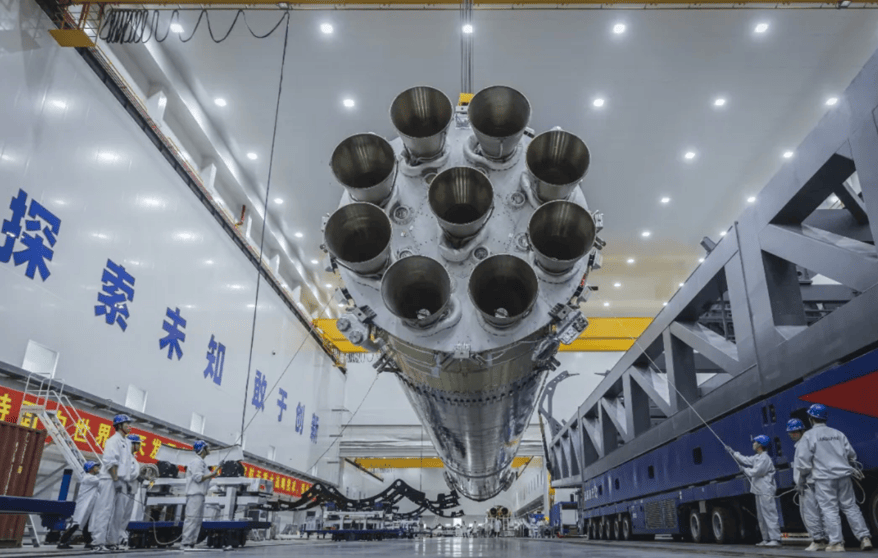
朱雀3号火箭

Search documents
商业航天专家交流系列电话会
2025-12-04 15:36
Summary of the Conference Call on China's Commercial Space Industry Industry Overview - The conference call focused on the challenges and developments in China's commercial space industry, highlighting the high costs and technological hurdles faced by companies in this sector [1][5][17]. Key Points and Arguments Cost and Technology Challenges - The cost of launching satellites exceeds 100,000 RMB per kilogram, with a 700-kilogram satellite priced around 40 million RMB [1][5]. - Rapid technological iterations hinder mass production capabilities, which is essential for the industry's growth [1][5]. Major Projects and Their Status - **Xingwang Project**: Aims to deploy between 1,800 to 3,600 basic satellites by 2035, with over 30,000 satellites planned overall [1][4]. Currently in the experimental phase, it is expected to launch around 200 satellites annually until 2027, when production may increase significantly [2][3]. - **Yuanshin Project**: Plans to deploy 1,296 basic satellites by 2027, with a total of approximately 15,000 satellites. However, progress is slow due to reliance on a single supplier and insufficient launch capacity, resulting in only 108 satellites launched in 2025 [1][4][2]. - **Gesi Company**: Has new tender plans but has faced execution issues, with only partial completion of contracts for 108 satellites. Future tenders may include an additional 108 or 256 satellites [1][7]. Rocket Developments - The successful launch of the Zhuque 3 rocket is seen as a positive development for commercial space, although its technical stability needs further validation. It is anticipated that orders may come in 2026, but mass production will take an additional two to three years [8][9]. Future Launch Plans - The overall launch volume for 2026 is expected to remain low, primarily focused on experimental and verification tasks. A significant increase in launch capacity is projected for 2027 and beyond, contingent on the performance of large-capacity rockets [2][10]. Competition and Market Dynamics - Yuanshin and Xingwang are competitors but serve different strategic needs: Xingwang focuses on national strategic tasks, while Yuanshin targets commercial operations [11]. Both are currently in the foundational stage, making it difficult to assess their economic benefits [11]. Additional Important Insights - The average lifespan of commercial satellites is typically 3-5 years, with national projects like Xingwang designed for 7 years but often replaced within 5-7 years to keep up with technological advancements [13][14]. - The cost structure of satellite manufacturing reveals that payloads account for over 50% of costs, with significant portions allocated to components like antennas and processors [12][20]. - Challenges in China's space industry include a lack of standardized industrial practices, reliance on outdated supply chains, and a shortage of skilled personnel for satellite design and manufacturing [17][19]. Conclusion - The commercial space industry in China is at a critical juncture, facing significant challenges in cost, technology, and operational execution. Future growth will depend on overcoming these hurdles and successfully implementing large-scale satellite deployment plans.
一大堆鳖版星链堆在仓库,马斯克倒吸一口冷气:中方要动真格的了
Sou Hu Cai Jing· 2025-10-25 07:32
Core Viewpoint - The successful testing of the reusable Zhuque-3 rocket's first stage by Chinese private aerospace company Landspace marks a strategic step for China in catching up with SpaceX's Falcon 9 rocket, with the first flight and recovery planned for November [1] Group 1: Industry Context - Elon Musk acknowledged that excluding SpaceX, China's annual rocket launch numbers far exceed those of the United States, highlighting the limited success of American aerospace companies in producing competitive launch service providers [3] - The American aerospace industry has largely been dominated by SpaceX, with other companies like Blue Origin and United Launch Alliance struggling to achieve significant advancements, particularly in reusable technology [3][4] Group 2: Market Opportunities - The global satellite internet market presents significant opportunities, as many countries lack advanced fiber optic networks, making low-orbit satellite internet services valuable [6] - Chinese companies are actively developing two major satellite constellations, Xingwang and Qianfan, to compete in the satellite internet space, with production capacities of over 200 satellites annually for Xingwang and an average of one satellite per day for Qianfan, aiming for 600 satellites by 2026 [7][9] Group 3: Cost and Operational Efficiency - The significance of reusable rockets lies in their ability to drastically reduce launch costs, as demonstrated by SpaceX's Falcon 9, which lowered the cost per launch from $67 million to $28 million [9] - Achieving reusable rocket technology could lead to a dramatic decrease in China's launch service prices, facilitating rapid deployment of satellite constellations and providing competitive pricing for domestic and international clients [9] Group 4: Future Prospects - The potential for achieving flight-like operations in the rocket industry could be accelerated if multiple commercial rocket companies succeed in reusable technology, potentially allowing China to realize its goal of regularized launches by 2030 instead of 2045 [10][12] - This advancement would enable China's satellite constellations to compete effectively with SpaceX's Starlink and position China as a leading provider of aerospace services globally [12]