杠杆型ETF

Search documents
独家洞察 | 2026年展望:重塑盈利、资本市场、技术与全球政策的多重力量正在汇聚
慧甚FactSet· 2026-01-21 08:27
Group 1: S&P 500 Earnings Outlook - Analysts expect a 15% year-over-year earnings growth for the S&P 500 in 2026, marking the third consecutive year of double-digit growth [4] - The top five contributors to this growth include NVIDIA and Meta, with the "Big Seven" tech companies projected to grow earnings by 22.7% [4] - All 11 sectors of the S&P 500 are expected to achieve year-over-year earnings growth, with five sectors likely to see double-digit increases [4] Group 2: Revenue and Profit Margins - The anticipated revenue growth rate for S&P 500 companies in 2026 is 7.2%, surpassing the 10-year average of 5.3% [5] - Ten out of eleven sectors are expected to see revenue growth, with the energy sector projected to decline [5] - The net profit margin for the S&P 500 is expected to reach 13.9%, the highest since 2008 [5] Group 3: U.S. ETF Market Growth - The U.S. ETF market is expanding, with Vanguard expected to surpass BlackRock as the largest ETF issuer [8] - The number and market share of actively managed ETFs are anticipated to grow, aided by new regulatory structures [8] - A significant portion of new money in ETFs is flowing into cryptocurrency-focused funds, reflecting a growing interest in digital assets [9] Group 4: AI in Financial Services - Generative AI and intelligent agent systems are becoming essential infrastructure for financial services, with a focus on improving efficiency and accuracy [11] - The adoption of AI is expected to face challenges in scalability and effectiveness, necessitating ongoing innovation [11] - Maintaining trust and demonstrating quantifiable returns on AI investments will be critical for organizations [12] Group 5: Private Equity Market Trends - Accessibility to private equity investments is increasing, with potential changes in regulations allowing broader participation [15] - Private equity is increasingly focused on technology-driven assets, particularly those related to AI [15] - The need for transparency and valuation discipline in private equity investments is becoming more pronounced [16] Group 6: Energy Sector Dynamics - Data centers are expected to significantly impact the electricity and utility sectors, with new demand anticipated in 2026 [17] - Public utility companies are likely to experiment with different rate structures to manage costs associated with data center services [18] - The oil and gas industry is expected to experience a divergence in performance due to supply and demand changes [19] Group 7: Global Policy Changes - Geopolitical factors, technological advancements, and legislative developments are shaping global policy directions [23] - The focus on digital asset regulation is shifting from "whether to regulate" to "how to implement regulation" [23] - Sustainable development regulations are evolving, emphasizing the integration of sustainability into business practices [25] Group 8: Wealth Management Trends - The wealth management industry is expected to fully embrace AI and digitalization, moving beyond skepticism [27] - Institutions that effectively integrate third-party technology with proprietary data will drive efficiency and client engagement [27] - The competition between traditional wealth management firms and digital platforms is intensifying, focusing on service quality and trust [29] Group 9: Market Influences - The Federal Reserve's policies, consumer sentiment, and international stock valuations are key factors influencing market dynamics in 2026 [30] - Consumer confidence remains a critical indicator for economic activity, with potential government measures to stimulate spending being closely monitored [31] - International markets may continue to outperform U.S. markets, raising questions about ongoing valuation disparities [31]

美股平静市场的“裂痕”:VIX惊现“一日飙升”,杠杆ETF或成市场新隐患
智通财经网· 2025-10-26 23:25
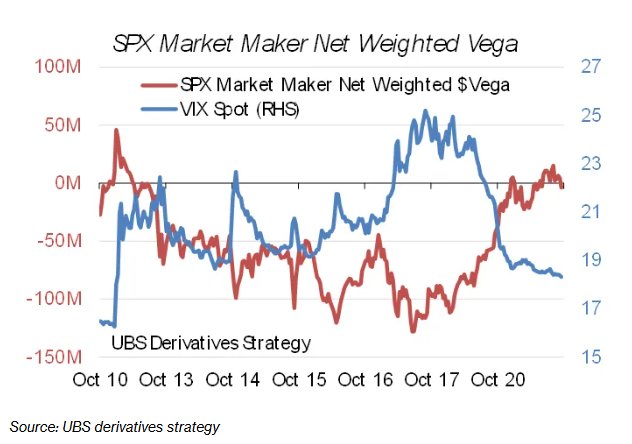
Core Viewpoint - The U.S. stock market appears fragile despite not being particularly volatile, with significant fluctuations in the volatility index (VIX) indicating underlying market vulnerabilities [1][2]. Group 1: Market Dynamics - The S&P 500 index experienced a minor decline of 0.6% on October 16, while the VIX surged to a six-month high, highlighting a disconnect between index performance and market volatility [1]. - The spike in VIX on October 16 was attributed to increased short positions held by market makers in S&P 500 options, which were exacerbated by the need to cover these positions [1][2]. - The rapid decline of VIX back to previous levels on October 17 suggests a quick market correction following the initial spike [1]. Group 2: Technical Drivers - The volatility on October 16 was characterized as being driven more by technical factors rather than fundamental market changes, with VIX-related exchange-traded products (ETPs) not being the primary influence [2]. - Approximately 17% of long volatility investors needed to sell positions to offset the rebalancing actions of traders, indicating a limited impact from ETPs on the overall market [2]. Group 3: Leveraged ETFs and Market Impact - Leveraged ETFs have gained popularity, particularly in stocks like Nvidia and Tesla, raising concerns about their market impact during high volatility periods [4]. - The nominal size of global leveraged ETFs is estimated at $160 billion, with the top ten stocks comprising about 65% of this total, leading to significant trading volume that can affect stock prices [7]. - Banks face substantial risks from leveraged ETFs, including a $300 billion stock risk exposure and potential "gap risk" that could lead to significant losses in extreme market conditions [7][9]. Group 4: Emerging Risks - The current market environment is characterized by "one-day fragility," where prolonged periods of calm are interrupted by sudden market crashes and rebounds, posing risks to market participants [10]. - The concentration of assets in leveraged ETFs, particularly within the technology sector, raises concerns about systemic risks due to their significant weight in the S&P 500 index [10].