极光天基大模型

Search documents
商业航天发展加速,太空算力前景广阔
Ping An Securities· 2025-12-15 09:32
Investment Rating - Industry investment rating: Outperform the market (expected to outperform the market by more than 5% in the next 6 months) [42] Core Insights - The development of commercial aerospace is accelerating, with a promising outlook for space computing capabilities. The continuous improvement in rocket technology and the increasing number of private rocket companies have led to a decrease in launch costs in China, with the cost per kilogram dropping from 115,000 RMB in 2020 to 75,000 RMB in 2024. It is expected to further decrease to 45,000 RMB by 2029 [6][3] - In 2024, China is projected to successfully launch rockets 68 times, with 74 launches already completed from January to November 2025, indicating a significant increase in launch activities [3][11] - The global space computing market is expected to grow significantly, with the market size projected to reach 2.8 billion USD by 2029, driven by advancements in satellite technology and AI applications in space [26][3] Summary by Sections Industry Dynamics - The cost of satellite launches in China has been decreasing annually, with a forecasted drop to 45,000 RMB per kilogram by 2029 [6] - The Chinese satellite market is expected to grow from 82.7 billion RMB in 2024 to 266.1 billion RMB by 2029, with a CAGR of 26.3% [17] - The deployment of computing clusters in space shows a significant cost advantage over ground-based systems, with a ten-year operational cost of 8.2 million USD in space compared to 167 million USD on the ground [22][23] Market Performance - The semiconductor industry index increased by 2.68% this week, outperforming the CSI 300 index by 2.76 percentage points. Since the beginning of 2024, the semiconductor index has risen by 80.19%, surpassing the CSI 300 index by 46.68 percentage points [32][30] - The overall P/E ratio for the semiconductor industry is 96.3 times, with 106 out of 168 A-share stocks in the sector experiencing price increases this week [36]
杭州博士后打起了卫星的主意
Hang Zhou Ri Bao· 2025-12-09 02:31
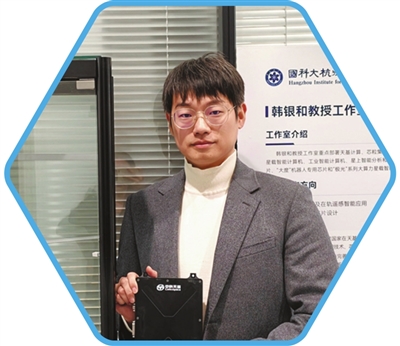
Core Insights - The article highlights advancements in low Earth orbit satellite technology, focusing on two researchers developing innovative communication and image processing techniques to enhance satellite capabilities and security [4][5]. Group 1: Covert Communication Technology - The research on covert communication aims to disguise satellite signals to enhance security, making them indistinguishable from environmental noise [6]. - This technology is crucial for applications like autonomous vehicle dispatch systems, where communication security is vital to prevent system failures [6]. - The team has successfully validated the covert communication technology through various testing phases and is collaborating with multiple organizations for practical applications [6][7]. Group 2: Intelligent Image Processing - The development of an intelligent system allows satellites to autonomously analyze and interpret images, converting them into concise textual descriptions for efficient data transmission [5][8]. - Traditional satellite image processing can take hours, but the new system significantly reduces this time by compressing large image data into brief text descriptions, enhancing real-time communication capabilities [8]. - The application of this technology spans various fields, including disaster management, agricultural monitoring, and traffic planning, showcasing its versatility and importance [8][9]. Group 3: Future Applications and Impact - The "Aurora Space-based Model" is transitioning from laboratory testing to real-world applications in smart cities and emergency management, aiming to improve the connection between satellite data and ground applications [9]. - The ongoing optimization of algorithms is essential for maximizing the capabilities of the in-orbit models, given the limited communication time available during satellite passes [8].