梅雷原油

Search documents
美能源部长放风:中国从我们手里买了委石油
Sou Hu Cai Jing· 2026-02-13 12:27
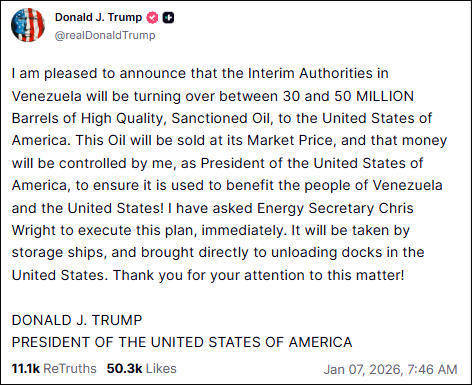
Core Insights - The U.S. Energy Secretary, Dan Brouillette, became the first high-ranking official from the Trump administration to visit Venezuela, indicating a shift in U.S. policy towards the country’s oil sector [1] - Brouillette stated that the U.S. oil blockade on Venezuela has essentially ended, with China being a major buyer of Venezuelan oil sold by the U.S. government [1][4] - The Trump administration aims to reduce the influence of China, Russia, and Iran in Venezuela by promoting U.S. and allied companies in the reconstruction of the Venezuelan oil industry [3] Group 1: U.S. Policy and Actions - The U.S. government has allowed China to purchase Venezuelan oil but prohibits the use of unfair low pricing associated with the Maduro government [4] - Brouillette emphasized that the military action taken by the U.S. was not solely about Venezuela's oil wealth but rather a geopolitical issue affecting the entire Western Hemisphere [4] - The U.S. is looking to improve the business environment for American companies in Venezuela, as indicated by Brouillette's discussions with Venezuelan interim president, Delcy Rodríguez [3] Group 2: Market Dynamics - Following U.S. military actions, several Indian refineries have begun purchasing Venezuelan oil, and the Indian government is encouraging state-owned refiners to increase their purchases of both Venezuelan and U.S. oil [4] - Venezuela's oil production is expected to recover in the medium term, with estimates suggesting it could reach 2 million barrels per day within two to three years [4] - As of December last year, Venezuela's oil production was approximately 896,000 barrels per day, indicating significant room for growth [4]

美国称已和委内瑞拉达成20亿美元石油交易,“或转移运往中国的原油”
Sou Hu Cai Jing· 2026-01-07 08:25
Core Viewpoint - The U.S. government, under President Trump, is moving to secure Venezuelan oil resources following the ousting of President Maduro, with plans for Venezuela to export nearly $2 billion worth of oil to the U.S. [1][3] Group 1: U.S.-Venezuela Oil Agreement - Venezuela is set to transfer between 30 million to 50 million barrels of high-quality oil to the U.S. as part of a deal announced by Trump [1] - The agreement is expected to help avoid further reductions in Venezuela's oil production while strengthening U.S. energy supplies [1][3] - The deal may involve reallocating oil originally intended for China, as Venezuela has been selling its flagship Merey crude at a discount of approximately $22 per barrel compared to Brent crude [3][4] Group 2: Impact on Oil Prices and Market Dynamics - Following the announcement, U.S. crude prices fell by over 1.5%, reflecting market expectations of increased Venezuelan oil exports to the U.S. [3] - The deal is seen as a strong signal from Venezuela's interim government in response to U.S. demands for exclusive access to its oil resources [3][4] Group 3: U.S. Energy Policy and Strategic Interests - Trump emphasized the need for the U.S. to have "complete access" to Venezuela's resources in the post-Maduro era, warning of severe consequences for Venezuelan officials who do not comply [3][4] - The U.S. is reportedly seeking to establish exclusive cooperation in the oil sector with Venezuela, prioritizing American companies in heavy crude sales [6][7] Group 4: Challenges and Future Prospects - The restoration of Venezuela's oil production is expected to require significant investment and time, with obstacles including deteriorating infrastructure and political uncertainty [9] - U.S. refineries along the Gulf Coast are capable of processing Venezuelan heavy crude, which could lead to increased employment and economic benefits for both countries [8][9] - The potential for Venezuelan oil to enter the U.S. strategic petroleum reserve is being discussed, although not mentioned in Trump's announcement [8]