比特币衍生品

Search documents
比特币反弹乏力 衍生品市场依然偏空
Xin Lang Cai Jing· 2026-02-09 16:28
Core Insights - Despite Bitcoin's rebound approaching $70,000, derivatives are signaling caution as traders maintain a defensive stance with little new bullish bets being observed [1][6][10] Group 1: Market Sentiment - The funding rate for Bitcoin perpetual futures, which reflects the fees exchanged between long and short positions, remains below zero, indicating that traders are preparing for downside risks or require compensation to hold long positions [1][6] - The open interest in Bitcoin perpetual futures has not recovered from a downward trend since October, highlighting a lack of confidence supporting the current rebound, with this metric down 51% from its peak in October according to Coinglass [1][6] Group 2: Market Liquidity and Volatility - Following a significant drop on October 10, market liquidity and depth have noticeably decreased, prompting investors to reduce leveraged bets and adopt a more cautious approach [3][8] - The implied volatility of Bitcoin has significantly decreased from approximately 83% to around 60%, indicating a reduced expectation for large price fluctuations in the short term, although positioning remains defensive [5][10]

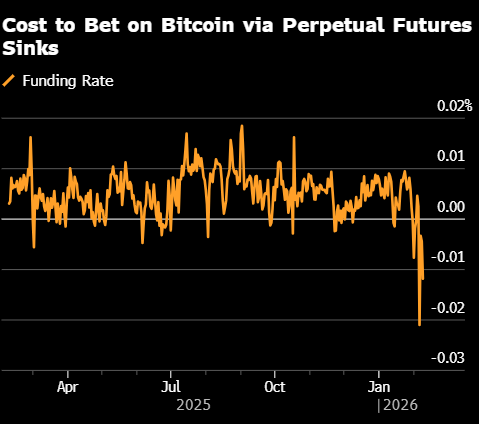
比特币衍生品释放谨慎信号 市场流动性及深度明显下降 多头信心仍显不足
智通财经网· 2026-02-09 15:21
Group 1 - The core viewpoint indicates that despite Bitcoin's price rebound from around $60,000 to nearly $70,000, the derivatives market signals a defensive stance among traders, with no significant bullish bets emerging [1] - Data shows that the funding rate for Bitcoin perpetual contracts remains below zero, suggesting that market participants are preparing for downside risks and require compensation to hold long positions [1] - The open interest in Bitcoin perpetual contracts has not recovered from a decline since October last year, highlighting a lack of confidence behind the recent price rebound, with current open interest down approximately 51% from the peak in October [1] Group 2 - The options market also conveys cautious signals, with Bitcoin's implied volatility dropping from about 83% to around 60%, indicating a decrease in expectations for short-term volatility [2] - The positioning structure remains defensive, with a significant skew towards put options, reflecting strong demand for downside protection among investors [2] - Macro-level uncertainties are reinforcing cautious sentiment in the market, with participants remaining extremely cautious due to potential market-moving events, including political changes in Japan and fluctuations in the precious metals market [2]
比特币衍生品在市场暴跌后发出压力信号
Xin Lang Cai Jing· 2026-02-02 07:45
Core Viewpoint - The recent sharp decline in Bitcoin has resulted in one of the largest gaps in the history of Chicago Mercantile Exchange (CME) futures, with momentum indicators dropping to levels typically seen only during significant downturns [1][2] Market Performance - Bitcoin has fallen over 10% from its weekend high of $84,177 to $75,947 [1] - The CME gap reflects a price discontinuity of over 8%, marking it as the fourth largest gap since the launch of Bitcoin futures in 2017 [1] - The total liquidation amount since Thursday has exceeded $5.42 billion, with a single-day liquidation record of $2.56 billion on Sunday [5] Macro Factors - The overall risk-averse environment is attributed to multiple macroeconomic and geopolitical factors, including a partial U.S. government shutdown, trade war news, rising Japanese long-term bond yields, and ongoing geopolitical tensions, particularly related to Iran [1][2] Technical Analysis - The relative strength index (RSI) has dropped to 32.22, indicating extreme oversold conditions in the market [6] - Bitcoin has breached the 100-week moving average and formed a "death cross," suggesting a potential structural shift towards a more bearish market [6] Future Outlook - Analysts suggest that the CME gap, ranging from $77,000 to $84,000, may attract traders once volatility decreases, although it is unlikely to be filled in the immediate week due to current pressures [2][6] - The option market remains defensive, with significant buying of put options indicating that investors are paying high premiums for downside protection [8] - Analysts have set target price ranges for Bitcoin between $60,000 to $70,000, with key support identified around $68,000 to $70,000 [4][8]
币安发布“1010历史级别清仓”详细报告,赵长鹏否认从崩盘获利,徐明星“就是币安不负责任导致的”
Hua Er Jie Jian Wen· 2026-02-01 03:16
Core Viewpoint - Binance attributes the record $19 billion liquidation event on October 10 to a combination of macroeconomic risks, high leverage, and liquidity exhaustion, denying that core system failures were the main cause, although this explanation has not quelled industry concerns regarding its marketing strategies and market influence [1][4]. Group 1: Market Dynamics - On October 10, global markets were under pressure due to tariff-related news, leading to over $100 billion in unliquidated Bitcoin derivatives and a rapidly shrinking order book, which together triggered a chain liquidation [2][3]. - The sell-off was self-reinforcing, as market makers initiated automatic risk controls and reduced exposure, causing liquidity to vanish from the order book, with Kaiko data indicating that buy depth nearly disappeared during peak volatility [2]. - The turmoil extended beyond the cryptocurrency market, with the U.S. stock market losing approximately $1.5 trillion that day, marking the largest single-day drop for the S&P 500 and Nasdaq indices in six months [2]. Group 2: Platform Issues and Compensation - Binance acknowledged two specific platform incidents during the crash but asserted that these did not cause broader market volatility. The first incident involved a slowdown in internal asset transfer systems, affecting transfers between spot, wealth management, and futures accounts, which was attributed to database performance issues under increased traffic [3]. - The second incident involved temporary index deviations for USDe, WBETH, and BNSOL, occurring after most liquidations had already taken place, which Binance claims was due to thin liquidity and delays in cross-exchange rebalancing [3]. - Binance has compensated users over $328 million and initiated additional support plans to stabilize affected participants, with total compensation reaching approximately $600 million post-crash [3]. Group 3: Leadership Statements - Binance co-founder Zhao Changpeng denied that the platform was a key driver of the liquidation wave, labeling ongoing accusations as "far-fetched" and confirming that users affected by platform issues had been compensated [4][5]. - Zhao Changpeng, who resigned as CEO in November 2023, acknowledged failures in maintaining effective anti-money laundering protocols, with Binance Holdings agreeing to hire an independent compliance overseer [5]. - OKX CEO Xu Mingxing criticized Binance's "irresponsible marketing activities" for triggering the crash, particularly pointing to the promotion of high-yield products linked to the USDe stablecoin, which he claimed led to a "leverage cycle" that exacerbated the market's vulnerability [6].
EasyMarkets易信:比特币静待结构性反转
Xin Lang Cai Jing· 2026-01-15 16:09
Core Viewpoint - The cryptocurrency market is undergoing a painful transition from "false prosperity" to "real value," with a significant reduction in open interest in Bitcoin derivatives over the past three months, indicating a necessary self-purification process to eliminate overheated speculative capital [1][4]. Group 1: Market Dynamics - The decline in open interest has created a more resilient market bottom, making recent rebounds based on a healthier holding structure rather than speculative bubbles [1][4]. - Since October 2025, the total open interest for Bitcoin has decreased by approximately 31%, marking the largest scale washout since the speculative frenzy in the first half of 2025 [4]. - The derivatives market once reached an extreme level of over $15 billion, nearly three times the peak during the 2021 bull market, but has now fallen to around $65 billion, a significant reduction from previous highs above $90 billion [4]. Group 2: Price Movements and Trends - The current rise in Bitcoin prices, accompanied by a decrease in open interest, indicates a typical "short squeeze," where forced liquidations of short positions convert selling pressure into buying pressure, leading to price increases [5]. - Since the beginning of 2026, Bitcoin's spot price has recorded nearly a 10% increase, contrasting with the decline in leverage in the derivatives market, further confirming the shift in market focus [5]. - Despite the accumulation of over $2.2 billion in call options at the $100,000 strike price, indicating market desire to break this psychological barrier, caution is advised as current derivatives indicators do not yet reflect a broad bull market [5]. Group 3: Future Outlook - The focus of the market is shifting from contract speculation to the strength of the spot market as leverage returns to a more reasonable range, which is a positive signal for institutional investors seeking long-term allocations [6]. - The current deleveraging process is seen as a necessary step before the onset of a bull market, although confirmation of a structural bull market may take time [6]. - Investors are advised to monitor the $100,000 psychological resistance level while also considering the interplay between funding rates and spot trading volumes [6].

60亿美元就能“击溃”比特币?
美股IPO· 2025-10-10 03:56
Core Viewpoint - The threat of a "51% attack" on Bitcoin is significantly underestimated by the market, with attackers potentially able to control the network for approximately $6 billion [5][2][4]. Group 1: Attack Cost and Feasibility - Attackers can achieve control over the Bitcoin network by investing $4.6 billion in hardware, $1.34 billion in data center construction, and incurring weekly electricity costs of about $130 million [2][4]. - The total cost of executing a 51% attack is estimated to be only 0.26% of Bitcoin's total network value, which raises serious concerns about Bitcoin's future viability and security [9]. Group 2: Economic Incentives and Market Dynamics - The thriving derivatives market for Bitcoin provides economic incentives for potential attackers, allowing them to establish short positions with less than 10% of the daily trading volume to gain substantial profits that could cover attack costs [8][9]. - The ability to profit from a price drop during an attack enhances the economic feasibility of such actions, making it a credible threat [4][9]. Group 3: Industry Perspectives and Counterarguments - There is a divide in the industry regarding the severity of the attack risk, with some experts arguing that the time required to accumulate and deploy mining equipment makes such an attack impractical [10][11]. - Concerns about market manipulation and the potential for exchanges to suspend trading during suspicious activities are also highlighted as factors that could deter attackers [11][4]. - Historical instances of 51% attacks on smaller blockchains, such as Bitcoin Gold and Ethereum Classic, demonstrate that while attacks can occur, the scale and support for larger networks like Bitcoin may provide more resilience [12][11].

随着鲸鱼转向以太坊(ETH)、英国债券飙升,比特币(BTC)能否守住109000美元?
Sou Hu Cai Jing· 2025-09-02 11:22
Group 1 - Bitcoin (BTC) has been trading within a narrow range of 2.3% since a sharp decline from $112,500, with a lack of momentum attributed to the U.S. Labor Day holiday and regulatory market closures [2] - The confidence in the $108,000 support level for Bitcoin is diminishing, as indicated by the derivatives market, with a potential liquidation risk of $390 million in leveraged long positions if the price drops below $107,000 [4][9] - The annualized premium for Bitcoin's monthly futures is currently at 7%, remaining stable within a neutral range of 5% to 10%, with previous bullish signals noted on August 24 [5] Group 2 - A significant Bitcoin whale has transferred $4 billion worth of Bitcoin to Ethereum (ETH), highlighting a "rotation" phenomenon as altcoins appear to benefit from the accumulation by enterprises [5] - The Deribit skew indicator shows a 7% premium for put options compared to call options, indicating a bearish sentiment among whales and market makers regarding the $108,000 support level [7] - A net outflow of $127 million from U.S. spot Bitcoin exchange-traded funds (ETFs) signals unease among holders, reflecting broader macroeconomic uncertainties or Bitcoin-specific weaknesses [7]