
水雷

Search documents
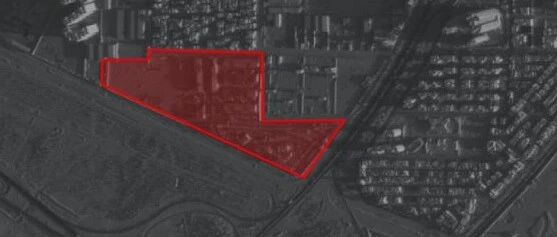
以色列对伊朗海军导弹和水雷生产设施进行打击,称将继续加大对伊朗军事工业的打击力度
中国能源报· 2026-03-27 13:43
Core Viewpoint - The Israeli Defense Forces (IDF) announced a strike on Iran's key naval missile and mine production facilities, significantly impacting Iran's naval capabilities [3]. Group 1: Strike Details - The IDF targeted a facility located in Yazd, central Iran, which is responsible for the production of most of Iran's naval missiles and mines [3]. - This facility is used by Iran for planning, research and development, assembly, and storage of advanced missiles that can be launched from various platforms including cruisers, submarines, and helicopters [3]. - The strike is said to follow the elimination of senior members of the Iranian Revolutionary Guard Corps Navy, indicating a strategic escalation in military actions against Iran [3]. Group 2: Future Actions - The IDF stated its intention to continue intensifying strikes against Iran's military industry to weaken its long-accumulated production capabilities [3].

全球警惕霍尔木兹海峡被布设水雷
日经中文网· 2026-03-12 02:39
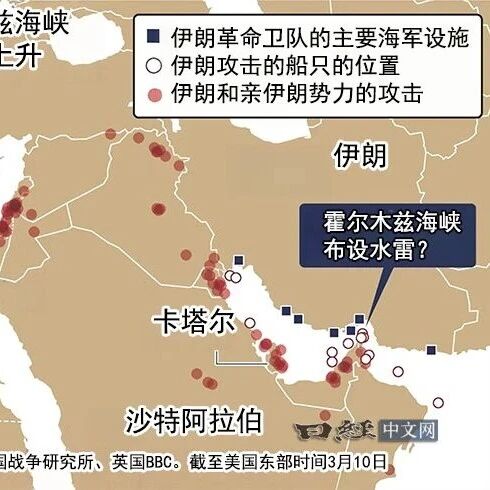
Core Viewpoint - The situation in the Strait of Hormuz is escalating, with Iran's military actions potentially leading to a long-term blockade of oil exports, which could significantly impact global oil prices and the economy [2][6][8]. Group 1: Military Actions and Tensions - Iran is believed to possess between 2,000 to 6,000 naval mines, with recent reports indicating that they have begun laying mines in the Strait of Hormuz [4][6]. - The U.S. military has reportedly cleared multiple Iranian naval vessels, including 16 mine-laying ships, in the region [5]. - The Iranian Revolutionary Guard has maintained a strong stance against the U.S., warning that no oil exports are currently permitted from the region [6]. Group 2: Impact on Shipping and Oil Markets - The Strait of Hormuz is a critical chokepoint for global oil, with approximately 20% of the world's oil passing through it [6]. - Recent attacks on vessels in the Persian Gulf, including a Thai cargo ship and a large container ship operated by Ocean Network Express, have raised concerns about shipping safety [6][7]. - Over 600 vessels from around the world are currently stranded in the Persian Gulf, and if the Strait remains blocked, shipping routes may need to be adjusted [7]. Group 3: Economic Implications - Prolonged military actions and ongoing threats to shipping safety could lead to increased oil prices due to supply concerns, potentially exacerbating inflation and negatively impacting the global economy [8].
决心硬刚美国?伊朗列装1000架无人机加紧备战
Zhong Guo Xin Wen Wang· 2026-02-02 09:18
Core Viewpoint - Iran's military has announced the deployment of 1,000 new drones in response to potential U.S. military strikes, with various armed groups in the region expressing support for Iran [1] Group 1: Military Developments - The new drones include at least six different models, designed for various military purposes such as attack, reconnaissance, and electronic warfare, with capabilities to target land, sea, and air [1] - U.S. Secretary of State Rubio acknowledged that approximately 40,000 U.S. troops stationed in the Middle East are under threat from thousands of drones and ballistic missiles [1] - U.S. Central Command has announced military exercises aimed at enhancing the dispersal capabilities of military assets and personnel [1] Group 2: Regional Responses - An anonymous U.S. Navy officer expressed concerns about Iran potentially launching "swarm attacks" against U.S. surface vessels in the Gulf, which could overwhelm U.S. defense systems [2] - Houthi forces in Yemen hinted at resuming attacks on Red Sea shipping routes, while Iranian-aligned Iraqi militias warned that any attack on Iran could trigger "total war" [3] - Hezbollah has not made a clear statement but is believed to be ready to intervene if Iran is attacked, with reports indicating that their military capabilities have been significantly rebuilt [3] Group 3: Diplomatic Stances - Saudi Crown Prince Salman reiterated that the country would not allow its territory to be used for strikes against Iran [5] - The UAE also declared that it would not permit its territory or waters to be used for military actions against Iran, advocating for dialogue and diplomatic solutions [6] - Both Saudi Arabia and the UAE are cautious about being drawn into regional conflicts due to their economic reliance on oil and gas, as evidenced by past attacks that significantly impacted their energy revenues [6]
释新闻|美军打击“箭在弦上”,伊朗有哪些应对手段?
Xin Lang Cai Jing· 2026-01-30 23:52
Group 1: Military Actions and Strategies - The U.S. has threatened military intervention against Iran, with the deployment of the USS Abraham Lincoln carrier strike group and numerous aircraft to the Middle East, providing a range of military options for the Trump administration [1] - Various military strike plans against Iran have been considered, including a "large-scale" bombing campaign targeting the Iranian regime and its Islamic Revolutionary Guard Corps facilities, as well as smaller-scale strikes on symbolic targets [1][3] - Iran possesses approximately 2,000 medium to long-range ballistic missiles capable of striking Israel and a significant number of short-range missiles aimed at U.S. military assets in the Persian Gulf [3][4] Group 2: Iran's Military Capabilities - Despite suffering significant losses during the "Twelve-Day War," Iran has improved its missile capabilities and can launch attacks using short-range missiles against nearby U.S. targets [3][4] - Iran has integrated 1,000 strategic drones into its military operations, enhancing its offensive capabilities [3] - Analysts note that Iran's missile launch methods have evolved, allowing for direct launches from underground silos, making them harder to target [4] Group 3: Regional Implications and Risks - Any military action against Iran could escalate into a broader regional conflict, which the Trump administration aims to avoid [5] - The U.S. has deployed numerous "Patriot" and "THAAD" missile defense systems in the region, but analysts warn that the vast area needing defense may limit their effectiveness [6] - Iran's ability to potentially close the Strait of Hormuz poses a significant threat to global oil markets, as approximately 20% of the world's LNG and 20-25% of oil passes through this strategic waterway [8] Group 4: Support from Regional Allies - Despite setbacks, Iran's regional allies, such as the Popular Mobilization Forces in Iraq and Hezbollah in Lebanon, have pledged support in the event of military action against Iran [8] - The potential for a coordinated response from these groups could complicate U.S. military operations in the region [8] Group 5: Strategic Considerations - The U.S. has over 20 military bases in the Middle East, with approximately 40,000 troops stationed within range of Iranian missiles [7] - The cost of maintaining a large military presence in the region is significant, raising questions about the sustainability of U.S. operations [7]
红海危机再起!遇袭船只起火进水,船员弃船逃生
Jin Shi Shu Ju· 2025-07-07 01:10
Core Insights - The recent attack on the cargo ship "Magic Seas" in the Red Sea marks the first significant maritime incident in months, raising concerns about the security of this vital trade route [2][3] - The attack is suspected to be linked to the Houthi movement, which has been accused of acting as an agent for Iran's regional strategy, potentially destabilizing both regional and global trade [3][4] Group 1: Incident Details - The "Magic Seas," a Greek-owned bulk carrier, was reportedly attacked with small arms and rocket fire, followed by a collision with an explosive-laden drone boat [2] - The attack occurred while the ship was navigating north and had armed security onboard, indicating a serious escalation in maritime threats in the region [3] - The Houthis have previously targeted over 100 commercial vessels with missile and drone strikes since November 2023, leading to significant disruptions in Red Sea shipping, which typically handles around $1 trillion in global trade annually [4] Group 2: Regional Implications - The attack is seen as a message from the Houthis, demonstrating their capability and willingness to strike strategic maritime targets regardless of ongoing diplomatic efforts [4] - The incident coincides with heightened tensions in the Middle East, particularly following Israel's military actions against Hamas and the U.S. airstrikes on Iranian nuclear facilities [3][4] - The ongoing conflict between the Houthis and the Yemeni government, supported by a Saudi-led coalition, remains at a stalemate, complicating the security landscape in the region [5]