江淮钇为

Search documents
2025年终盘点|“握指成拳、刀口向内”回归聚焦战略 车企整合大幕开启
Xin Lang Cai Jing· 2025-12-31 04:08
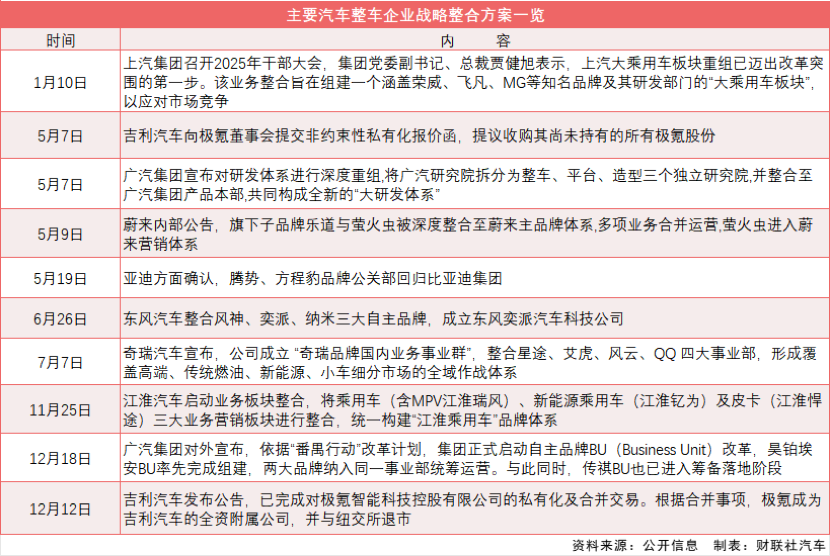
Core Viewpoint - The automotive industry is undergoing significant transformation, prompting major companies to consolidate and streamline operations to enhance efficiency and competitiveness in a challenging market environment [1][3]. Group 1: Industry Trends - Major domestic automakers, including SAIC, Dongfeng, GAC, Chery, and Geely, are adopting internal consolidation strategies to prepare for future market challenges by reducing inefficiencies and focusing resources [1][2]. - The shift from a multi-brand strategy to a more unified approach is seen as essential for survival in the increasingly competitive automotive landscape [5]. Group 2: Company Actions - SAIC Group has initiated a restructuring of its passenger vehicle segment, integrating brands like Roewe, Feifan, and MG into a single unit to better compete in the market [2]. - Geely has completed the privatization and merger of Zeekr Intelligent Technology, consolidating its brands under a unified structure, marking a significant shift in its multi-brand strategy [2][3]. - GAC Group has launched a Business Unit reform, consolidating its brands into a more cohesive operational structure to enhance efficiency and market responsiveness [3][4]. - JAC Motors has also begun integrating its passenger vehicle, new energy vehicle, and pickup truck segments into a unified brand system to strengthen its market position [4]. Group 3: Market Dynamics - The number of manufacturers achieving sales of 100,000 units or more by November 2025 is projected to be eight, collectively holding 57% of the passenger vehicle market share, indicating a trend towards consolidation [5]. - The competitive landscape is shifting from product-centric strategies to a focus on resource integration and organizational agility, emphasizing the need for companies to adapt to new market demands [4][5].



江淮汽车定增35亿元押注高端纯电
Bei Jing Ri Bao Ke Hu Duan· 2025-12-11 16:16
Core Viewpoint - Jianghuai Automobile is determined to make a significant push into the high-end pure electric vehicle market to overcome its development challenges, as it has faced declining sales and increasing losses in recent years [1][5]. Group 1: Financial Performance - Jianghuai Automobile's sales volume has declined by 25.64% in the first three quarters of the year, with overall sales down by 10.66% [4][5]. - The company has reported cumulative losses exceeding 11 billion yuan over the past seven years, with a projected record loss of 1.784 billion yuan in 2024 [5]. - In the first three quarters of 2025, revenue was 30.873 billion yuan, down 4.14% year-on-year, and the net profit attributable to shareholders turned from profit to a loss of 1.434 billion yuan, a decline of 329.43% [5]. Group 2: Strategic Initiatives - Jianghuai Automobile plans to raise up to 3.5 billion yuan through a private placement to fund the development of a high-end intelligent electric platform, aiming to reduce reliance on its traditional OEM model [3][9]. - The company is integrating its passenger vehicle, new energy vehicle, and pickup truck business units into a unified "Jianghuai Passenger Vehicle" brand system to streamline operations [5]. Group 3: Market Position and Competition - Jianghuai's commercial vehicle segment has historically been its strength, accounting for 46.7% to 54.97% of revenue from 2023 to mid-2025, while the passenger vehicle segment has been a follower in the industry [3]. - The company faces significant competition from leading new energy brands that have advantages in technology and scale, as well as pressure from industry price wars [8][9]. Group 4: Technological Development - Jianghuai's reliance on the OEM model has limited its investment in independent R&D, with R&D expenses consistently around 4%-5% of revenue [7]. - The collaboration with Huawei aims to enhance technological capabilities and brand value, but it also introduces dependency risks [8][9]. - The new high-end electric platform is seen as a critical opportunity for Jianghuai to break through technological bottlenecks and improve its profitability structure [9].

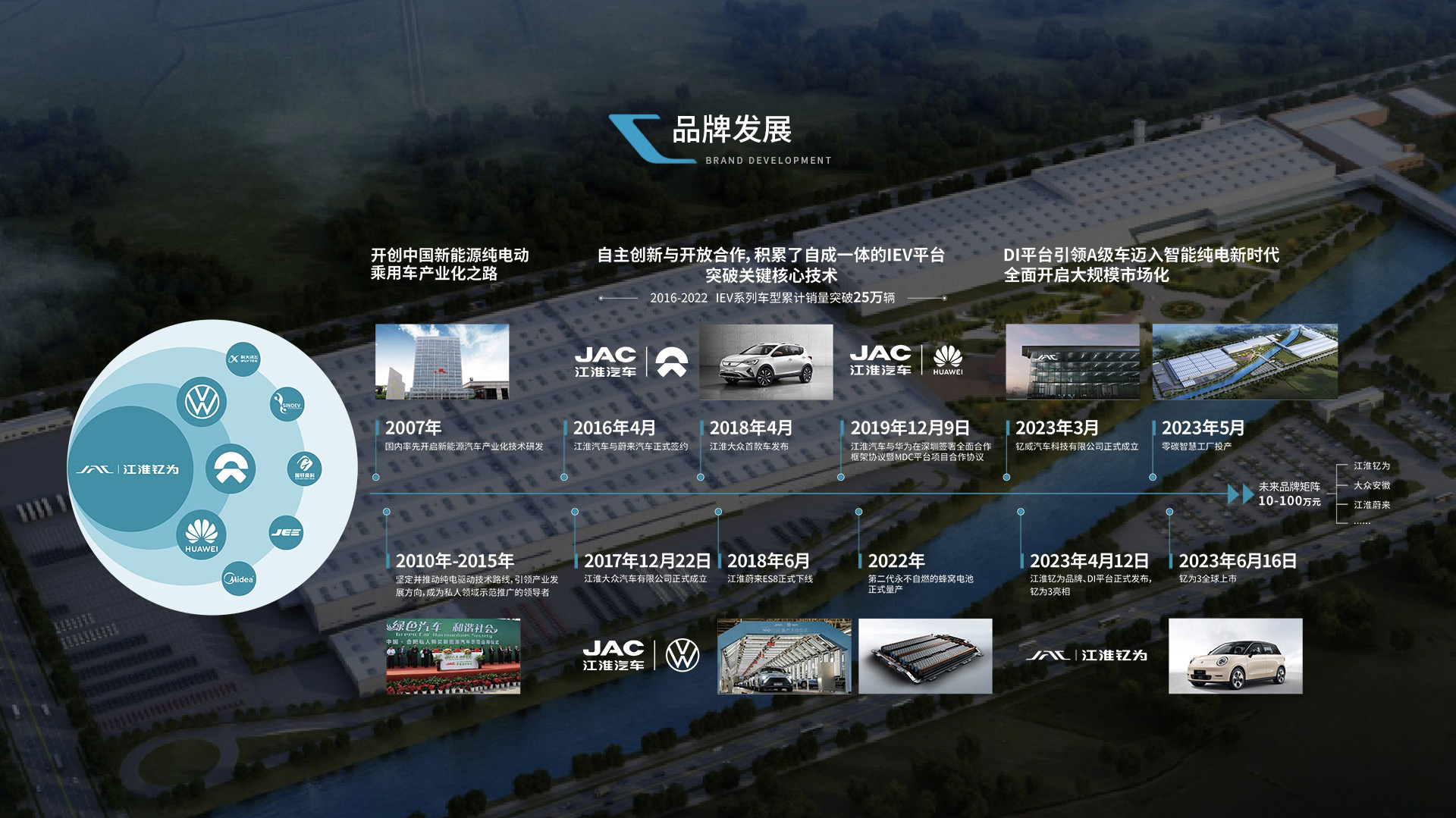
江淮汽车六十一载技术筑基,江淮钇为与用户共创新征途
Qi Lu Wan Bao· 2025-05-20 09:11
Core Viewpoint - Jianghuai Automobile has celebrated its 61st anniversary, marking a significant transformation from a "product-driven" to a "user-driven" approach in the electric vehicle sector since 2007, focusing on quality upgrades and emotional connections with users [1][15]. Group 1: Technological Foundation - Jianghuai Yiwei has established a comprehensive technology system covering three electric systems, intelligent driving, and ecological cooperation through nine generations of technology iterations and four product upgrades since 2007 [3]. - Strategic partnerships with major companies like Volkswagen, NIO, Huawei, and iFlytek have enhanced the international competitiveness of Jianghuai Yiwei's vehicle production since 2016 [3]. - A collaboration with CATL in 2025 aims to jointly develop new vehicle platforms, solidifying the technological foundation for future product quality upgrades [3]. Group 2: Product Innovation Driven by User Needs - The 2025 Yiwei 3 model has undergone significant upgrades, including a full soft-touch interior covering an area of 1.33 square meters, and a new dual-textured steering wheel designed for enhanced visual and tactile experience [4]. - Technical improvements have been made to the chassis and manufacturing processes, significantly enhancing vehicle comfort and noise reduction, reflecting the company's commitment to quality and user feedback [4][7]. Group 3: User Co-Creation and Cultural Integration - Since November 2024, Jianghuai Yiwei has implemented three major initiatives to promote user co-creation, including the launch of the "Black Pineapple Edition" Yiwei 3, which integrates regional cultural elements and user-driven design [8][12]. - The "Inspiration Yiwei" modification salon event in February 2025 aimed to engage users and media, fostering a community around vehicle customization and enhancing brand interaction [11]. - A partnership with the snack brand "Liuliu Mei" during the "Fun Modification Life Festival" in April showcased the integration of consumer culture with automotive design, while plans to establish 100 car owner clubs over two years aim to build a community around vehicle modification [12]. Group 4: Industry Implications - Jianghuai Yiwei's recent developments signify a shift in the automotive industry from traditional engineering-driven models to user-driven ecosystems, indicating a new era of competition based on user relationships [15]. - The integration of technology and user co-creation is expected to lead to a human-centered industrial revolution in China's electric vehicle market [15].